I've been trying to crack the encryption on this for a while. I want to make a free public train status api (I built amtrak.io). If anyone would like to help improve public open data around Amtrak, please contact me.
Been also digging into making a PDF parser for their very complicated schedule files, not that they follow it anyway :)
A comment in the source code seems to describe what you need to do:
   MasterSegment is the length of the string at the end of the encrypted data that contains the secret key
   To decrypt - we do the following
   1. Take masterSegment (88) length - from the right of the data - this has the private key
   2. Everything from 0 to the end - master segment is the raw data - that needs to be decrypted
   3. Decrypt the 88 characters using the public key - that will give you a pipe separated string of the private key (random guid from MDS) and a time stamp (to scramble it)
   4. Now use the private key and decrypt the data stored from step 2.
   5. Parse the decrypted data - and rejoice
   6. KSUE -means key issue
   7. __$$_jmd - the public key that we obtain

   __$_s1 : variable name for the Security object in the Helper.js file - that file has the calls to actually decrypt the data.
                // cw: FORCE the bloody stations to show at the initial zoom level. If this is not done, there is

                // a possibility that stations will not show in the initial map load.

            // I crib this shamelessly from SO...because it is so useful!!
            // http://stackoverflow.com/questions/3125065/how-do-i-limit-panning-in-google-maps-api-v3
/*
__$$_jmd - public key
masterSegment - length of data to be extracted from the encrypted response - 55 is just a fake
//FAKE VARIABLES to throw off people hahahahaha
__$_s - salt value
__$_v - iv vale
*/
I would guess "management", probably under the name of Homeland Security. It seems to be some spaghetti code of loops/callbacks written by a frustrated jQuery developer. Here are some more fun tidbits:
> /MasterZoom is the sum of the zoom levels from the routes_list.json file. That is the index in the routesList.v.json -> arr array where we have the public key stored.
IF THE ROUTES_LIST CHANGES, REMEMBER TO CHANGE THE INDEX TO BE CORRECT /
> /Salt Value - the element is at the 8th position. So we can essentially pick any number from 0-100 (length of the s array in the file), get the length of the element, and then go to that index
the following funky looking code will evaluate to 8. Salt has a length of 8
/
> /Initialization Vector Value - the element is at the 32th position. So we can essentially pick any number from 0-100 (length of the IV array in the file), get the length of the element, and then go to that index
the following funky looking code will evaluate to 32 - IV has a length of 32
/
And my favorite:
> masterSegment - length of data to be extracted from the encrypted response - 55 is just a fake //FAKE VARIABLES to throw off people hahahahaha
I'd imagine it's something like company policy says it has to obfuscated, but the guy actually programming the site realizes it's pointless and fellow hackers could make good use of the data.
IANAL and things may have changed, but it was my understanding that having a copy protection mechanism, even a simple one, gives them better claim to DMCA protection of their content should someone do something they'd like to discourage. "Your honor they read our source code and stole our private key to break the encryption of our protected data" sounds better than "they downloaded the data we gave them"
While everyone here is thinking Amtrak implemented the copy protection, this map was actually built using CartoDB. I honestly just think it's something it includes by default.
The mapping engine is CartoDB, but I (seriously) doubt that this copy protection was implemented by them. They're much more serious & better at writing good code.
I'm not a javascript guy so I'm not going to take this further, but, if you run the following inside the console of the page it loads and decrypts the station data:
I'm sure someone else can take thus further, but, its a mess of javascript. I think its hand-rolled encryption too from a cursory look at the __$_s1._$_dcrt function
I don't have the capacity to do this, but I tried a few years ago:
I no longer am in a situation where I need tracking, but a couple of years ago I had the need for tracking my daily commuter train. I had to resort to scraping the website to find the status. If it was late, I had a push notification sent to my phone (a combination of a free app engine deployment and pushbullet). I tried to get integration via Tasker to set my alarm back if the train was more than [x] minutes, but never got to that point.
I really hope that you make some progress on this, though I wish you didn't have to and Amtrak shared the data.
Yes yes! I love that site. I actually use a simple Python script to parse the data on that site and send me a notification every morning and afternoon of how on time my train is.
Its sad I have to do that. Amtrak should have that system already (they sort of do- but only for trains that are 20 minutes late).
Not really. In terms of density, the only part of the U.S. comparable to Germany (600 people per square mile) is the northeast megalopolis (900 people per square mile). Also, your map includes regional trains, while the Amtrak map is just inter-city. This is a more appropriate point of comparison: https://4194e6d9-a-62cb3a1a-s-sites.googlegroups.com/site/no.... (Note that the middle of Pennsylvania, or upstate New York, or almost all of Virginia are not part of the northeast megalopolis: http://statchatva.org/files/2015/11/Northeast-Corridor2-991x...).
> the only part of the U.S. comparable to Germany (600 people per square mile) is the northeast megalopolis (900 people per square mile)
Which has >50M people, 2/3 of the population of Germany. In that comparison, that region should have then 2/3 of the rail network of Germany. It has 1 medium-speed rail line.
> while the Amtrak map is just inter-city
The Capitol Corridor, for example, is comparable to a Regio train in Germany (but slower, shittier, etc.).
Functionally speaking, the major cities in the NE US are in a very straight line, with the exception of the Hartford/Providence bifurcation. There is little point to building a more complex spider network because the cities you pick up are just so insubstantial.
As for the NEC, it suffers from being a very early build. With the exception of the Penn Station approaches, the line is 4-tracked all the way through the NJ-CT corridor. Despite being 4-tracked, the capacity is still insufficient in places. Furthermore, the line in CT in particular is a fairly curvy line that prevents building up high-speed. So getting higher speed trains really requires building new track, a lot of it in topographically interesting locations and in high-priced real estate locations.
On top of that, there's quite a few tunnels and bridges whose condition is best described not as "past its expected lifespan" but rather as "this should have failed already." So improvements on the order of billions of dollars, basically. It doesn't help that Amtrak appears to have decided that money will never be forthcoming, so all of its plans get scope-creeped to massive pie-in-the-sky boondoggles rather than trying to find smaller chunks that can make immediate improvements for relatively cheap. That's why there's a $150 billion plan to get 3-hr Boston-NYC-DC super-express service involving virgin track the entire length of the corridor and brand new stations (requiring extensive tunneling in downtown cores!) in Philly and Baltimore, or why Amtrak insists on building an entire new station annex in NYC when asking for just two new tubes under the Hudson.
> Which has >50M people, 2/3 of the population of Germany. In that comparison, that region should have then 2/3 of the rail network of Germany. It has 1 medium-speed rail line.
What the U.S. also has is 275 million other people who (1) won't benefit from such a rail network; and (2) won't vote to fund it; (3) will condition any support of Amtrak on useless long-distance routes through low-density regions that sap money away from the only corridor in the U.S. where rail makes sense. And it's a completely rational decision for those people.
Oh, sure, I'm very familiar with the problems. That's why it is depressing.
And it isn't even a rational decision for those people, the economic gains would largely outweigh the costs, being a net-positive for the rest of the country.
Even if that's true (which I'm not sure about), would economic gains from high-speed rail between New York and DC accrue to a taxpayer in Kansas? Or would a taxpayer in Kansas be bankrolling increased prosperity in a far-off part of the country that's already well off?
There is a website somewhere that says how much benefit each state gets from the federal government versus how much their people put in. Half the states lose money. And half gain. And all those gaining states have low density. While all the losing states are in the North East.
>much benefit each state gets from the federal government versus how much their people put in
No, that's not what it shows. It talks about the balance of tax revenue vs subsidies for each state. That distinction is critical and can completely change the balance of which state is receiving more 'benefit'.
If this confuses you, consider the following scenario. State A is filled with farmers subsidized to grow food so everyone in State B has a stable an cheap food supply. From a purely monetary accounting perspective A looks like a leech, but in reality it's a major part of the success of B (and the rest of the states it trades cheap food with) and separating them is a pointless exercise designed to score political points.
This applies to any states receiving subsidies to support the rest of the states (e.g. ones with military bases, government research labs, etc).
All of the states that look like they are self-sustaining mega economies would fall apart without the neighboring states that they suck cheap power, land use, etc off of. Don't perpetuate the myth that some states are just carrying the rest of them, it's just designed to divide people.
You’re saying just getting rid of the farm bill, with all its subsidies for agriculture, would hurt urban areas by destroying production? That seems like a real stretch of economic theory, to me. Subsidizing the low-margin producers in certain states and putting up agricultural tariffs like we do is really not benefitting rich urban areas.
Consumers in NYC don’t sit around saying, “thank goodness I have this expensive cane sugar and cheap high fructose corn syrup because of the exorbitant tariffs on Brazilian sugar and subsidized crop insurance for corn production!”
New Yorkers also don’t get much direct benefit from Conservation Reserve, where farmers are paid to do restoration work on marginal farmland rather than sending the topsoil down the river.
Finally, SNAP, which makes up 75% of the cost of the farm bill, last time I checked, is a conditional transfer directly to consumers, so SNAP tax expenditures to agricultural states are feeding poor people in those states, not subsidizing urban consumers in other states. That seems like a fine way to do the accounting to me.
I support the conservation bits of the farm bill, and SNAP and Medicaid (which dominate interstate transfer payments), but not because they benefit rich urban states directly; I don’t think they do at all. I just think top soil conservation and providing food and health care to the poor are moral mandates, and I’m philosophically in favor of transfer payments from the rich to the poor.
You're thesis seems to be predicated on the notion that everyone in rich states is rich. I suggest you find some retail workers in a rich area and ask if doubling the cost of their food and energy would have an impact on them.
That doesn't seem to have much to do with rail improvements? Will a better service from Boston to NYC make the federal government so much more efficient that people in Kansas will be able to tell?
Besides, the map to which you refer is the best possible result of voter preferences. Those who prefer lower spending are bribed into a compromise by those who prefer higher spending. If we didn't see the results you note, that would indicate a failure of democracy.
> would economic gains from high-speed rail between New York and DC accrue to a taxpayer in Kansas?
Yes, because that economic gain would translate into more taxes, which would be applied across the rest of the country, funding, for example, infrastructure in Kansas.
Of course, that's assuming a reasonable government...
Germany is a small, dense country, which makes it easier and cheaper to invest in mass transit infrastructure. The US doesn't really need it, outside of California and Eastern Corridor. For most of the US it's an apples/oranges comparison. I'm a huge fan of the US building more mass transit and infrastructure in general, but we have different problems and needs compared to smaller European nations.
I remember my German professor saying the same thing. His evidence was pretty simple: "You can drive from Northern Germany to Southern Germany in 8-9 hours. It takes about the same amount of time to drive from Northern Minnesota to Southern Minnesota. Let that sink in a bit."
The other major issue with mass transit is the longer you wait to build the infrastructure, the cost per foot of track continues to go up. Seattle has a long history with light rail cost overruns.
Just got back from Germany, and adored the trains. Everyone, including the passengers worked together to make the schedule on time by getting up, smartly grabbing their bags and getting off at the stop without loitering.
That said, the website for buying tickets was atrociously bad. We had a group of six and the website was full of bugs and broken for tickets with more than five people. You essentially have to do one ticket with 5 and one with 1.
We even went to the gate agent for help and they had similar problems.
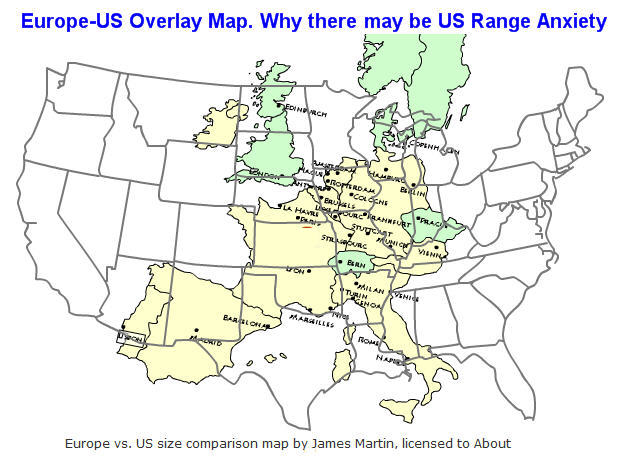
For our American friends who constantly claim that the USA is unique because of its size, or because of lower population density (whether the subject is Internet connectivity or railroads) -- Europe is 33% larger than the USA (contiguous 48); Finland has 16 people/km2, Sweden 23/km2, USA 33/km2, California 97/km2; Sweden is slightly larger than California, Finland is slightly smaller.
Have you ever tried to go from New York to San Francisco? It's the same distance as driving from Porto, Portugal to Abisko, Sweden. You go through 8 countries. Or Porto to Mariupol, Ukraine, in only 7 countries. It's faster in the US, through 10 states as big as European countries.
We have more people stretched out over more land with more varying regions with more varying needs and costs with more conservative social, political and economic values. Nearly all of our trade involves trucking and cargo ships, with freight making up the raw material shipping that isn't time sensitive.
It makes no financial sense whatsoever to fund railroads. We have extensive interstate highways and most of our people have cars. Why pay for a railroad the size of Europe when you don't have to go all over Europe, and all your needs are met via the existing shipping mechanisms? What would be the point?
If you took our cars away, maybe it would make sense, maybe. But before we pay for railroads we might need to pay for our health care or education.
Freight railroads do a lot more than bulk cargo. For example, they're how shipping containers get from west coast ports to the east coast. Rail freight is a fraction of the cost of the cost of trucking and has mostly replaced true long-haul trucking.
I agree that long distance passenger rail mostly doesn't make a lot of financial sense.
Sure it makes sense to fund long-distance railroads!
Even today, most passengers on Amtrak are NOT riding end-to-end. They are riding between Utah and Nebraska; Or between South Carolina and Vermont; Or Boston to Connecticut.
On the California Zephyr - a coach seat is sold 2-3x times for different segments of the same journey.
I’m a huge fan of passenger rail, and I have a soft spot in my heart for the cross country Amtrak trains, having ridden them frequently in my twenties. But I don’t think you offered evidence that it makes sense to fund Amtrak.
Cross country trains in the US are a perennial loss maker, subsidized by under-investing in the profitable dense population corridors, where we could conceivably invest in high speed rail if there was political will to do so (there’s not, but that’s a separate issue).
Replacing cross country Amtrak with comfortable buses would be faster, more reliable, cheaper, and more acccessible to the population that uses trains. Buses are just lower status in the USA, which I think is a pretty silly reason to keep subsidizing Amtrak’s cross country routes.
> Cross country trains in the US are a perennial loss maker, subsidized by under-investing in the profitable dense population corridors, where we could conceivably invest in high speed rail if there was political will to do so (there’s not, but that’s a separate issue).
How much money does the interstate highway system make? Yet we keep funding that for some reason. How much money does you local streets make ?
And before you pull out the "completely different card" remember that both rail and highways serve the exact same societal need: Moving goods and humans from one place to another. We stick humans/goods in a box with wheels and roll them to their destination.
Explain why the box rolling on asphalt should be subsidized but the box rolling on steel should not?
> Replacing cross country Amtrak with comfortable buses would be faster, more reliable, cheaper, and more acccessible to the population that uses trains
I don't believe you have ever taken a bus long distances. I have. Its like being stuck in an airplane. The long distance busses in Thailand are o.k. However you are still glued to your seat in a way that is not true for trains.
I specifically said comfortable buses. I most certainly have taken long distance buses that were not comfortable.
Train focused people need to get over themselves on the highway system. That is what path dependency is. Of course, as a train loving person, I wish the automobile industry hadn’t played so many dirty tricks to get us to an investment posture that makes passenger rail irrelevant, but pretending it’s not so doesn’t help.
Pretending that Americans aren’t happy to pay (whether through gas taxes or the occasional new-construction-over-maintenance boondoggle) for highways and local roads is a fantasy.
Americans, on average, don’t like trains. My wife, specifically, refuses to let us travel by train anymore, she hates them. It’s very sad for me, but my wife’s perspective is shared by the vast majority of Americans. They like cars. They like airplanes. They don’t like trains.
And there are lots of Americans who DO prefer trains over cars.
Please don't be so broad brush in your statements.
WRT your wife - go to Europe and ride the trains there. Recently I went to Spain. In Spain even the ratty commuter train traveled at 90+ mph.
Ride the TGV or AVE train. Those are quick and comfortable.
If at that point she still feels the way she does fine. But "Americans don't like trains" is a statement that is not correct. On the east coast, Americans use the trains a lot
A much better statement is "Americans don't like an uncomfortable experience"
And in San Francisco Area, Caltrain is electrifying precisely because people love the train so much. Caltrain needs extra capacity and the only way to get that capacity is with electrification. Plenty of Americans seem to like Caltrain. Plenty of Californians are ready to use the HSR project when segments open up.
My wife’s interurban train experiences consist exclusively of trains between German and Japanese cities. She doesn’t like them. It’s not a great look to spend your time telling people that they’re insufficiently cosmopolitan because their preferences differ from yours.
The vast majority of Americans, when polled, don’t like the idea of taking a train between two cities. I say this as a card carrying member of NARP (they seem to have rebranded themselves RPA, but whatever)!
I just don’t think rail partisans are practicing effective politics by pretending that current US voters support tax expenditure’s on rail.
The average California voter might, just barely, be in favor of interurban rail. I think the jury’s still out on that one, because the actual money that’s been approved by voter’s in Prop 1A is so vastly insufficient to the task, but I agree that at least in California, there’s enough popular support to at least try to make a go of a decent modern train system.
Indeed, I've travelled from NY to SF in both directions by road, rail, and air. The only experience that was much worse than my travels in Europe and Japan was by rail (namely Amtrak).
There are more people in Europe, there is more land in Europe, etc. Stop with the fake excuses.
Europeans enjoy all of it: cars, trains, and airplanes. The simple fact is that North America is lame and deficient in passenger rail transportation compared to Europe and East Asia, and the comparison keeps getting worse.
We have states as big as European countries with nothing but corn. The only people paying to cross that are people going across the coasts, which still takes three days by train compared to a day and a half or two days by car.
Amtrak long distance trains UNLIKE airplanes are used to connect cities in the middle to other cities in the middle.
Amtraks trains from the west coast to Chicago sell the same seat 2x - 3x over the course of one journey. Most people are NOT going end to end. I have ridden the California Zephyr from California to Denver.
I have see others get on (there are seat tickets) :
Well duh. The key to making trains useful is having people focused in heavily populated areas. If the US were like Europe, some heavily built rail in the Midwest would cover the vast majority of the population.
Russia isn't Europe and that map is pointless because it's just showing some railways without ridership details. The US also has a massive rail network, it's just almost exclusively used for freight.
Your map didn't show ridership either; the purpose of mine was just to show that the European railway is larger than what your map showed. And it certainly is used by passengers all across its length, from Faro to Moscow and beyond.
This is a pretty inflammatory way of saying, “Americans like cars and airplanes. They don’t like trains.”
You’re only making the argument harder for Americans (like me!) who like trains by being dismissive of excellent path-dependent and population-dependent reasons why the US passenger train networks died out.
Nope. I'm saying that Americans are unfortunately missing out on what is elsewhere a great, modern transportation system. If the federal government hadn't used massive war-driven budgets to replace rail with highways, and continued to massively subsidize highways, you'd be there, too.
Yes, if we had not invested heavily in both highways and airports, we may have invested more in trains (there were other problems with the railroads at the time). But that was over 70 years ago. It's not an "excuse" to explain that things are the way they are, and that it makes no sense today to fund renewed railroad investment.
There's a reason we're flush with self-driving car companies and not railroad companies.
It does seem to be going through some mangling and parsing however. Carto's website doesn't look like it's from 1994, so my guess is that Someone™ read a book on "rapid-turnaround web development" upside down a few years ago, and now the current devs have to live with some poor decisions (raw SQL as form input) for the sake of legacy compatibility.
This being said, the error messages are quite fun:
  > SELECT version();
  {"errors":["Postgis Plugin: ERROR:  column \"the_geom_webmercator\" does not exist\nLINE 1: ...ECT ST_AsTWKB(ST_Simplify(ST_RemoveRepeatedPoints(\"the_geom_...\n                                                             ^\nin executeQuery Full sql was: 'SELECT ST_AsTWKB(ST_Simplify(ST_RemoveRepeatedPoints(\"the_geom_webmercator\",1e-05),1e-05,true),5) AS geom FROM (SELECT version()) as cdbq WHERE \"the_geom_webmercator\" && ST_SetSRID('BOX3D(-20037508.3 20037508.25881302,-20037508.25881302 20037508.3)'::box3d, 3857)'\n"],"errors_with_context":[{"type":"layer","message":"Postgis Plugin: ERROR:  column \"the_geom_webmercator\" does not exist\nLINE 1: ...ECT ST_AsTWKB(ST_Simplify(ST_RemoveRepeatedPoints(\"the_geom_...\n                                                             ^\nin executeQuery Full sql was: 'SELECT ST_AsTWKB(ST_Simplify(ST_RemoveRepeatedPoints(\"the_geom_webmercator\",1e-05),1e-05,true),5) AS geom FROM (SELECT version()) as cdbq WHERE \"the_geom_webmercator\" && ST_SetSRID('BOX3D(-20037508.3 20037508.25881302,-20037508.25881302 20037508.3)'::box3d, 3857)'\n","subtype":"query","layer":{"id":"layer0","index":0,"type":"mapnik"}}]}
The ">" prompt above is from this 4-second hacky script to make a shell:
Passenger train service in America needs to be returned to the private sector, without any interference by Congress. [added] Or you can watch the government fuck-up and quickly cast blame on the private sector. Private passenger services would have different, satisfying contracts with the rail owners; this is what companies do in the private sector some people apparently hate so much. There was a time when privately operated railroads were reliable in this country.
Freight currently has deleterious right of way because this is what bureaucrats have agreed to. Imagine these bureaucrats did something similar on the highways you all love so much, making passenger vehicles wait on the side to let trucks move a little faster.
Except that Amtrack is consistently late on the NEC and other regional lines that they have priority on. Really annoying when you are on a train waiting to pull out of a station and can't go because a late Amtrack has priority.
I know Penn is a major bottleneck (we have Christie to thank for that after killing ARC), and there's the added problem of delays conflicting with Metro North/NJT schedules.
We need infrastructure investment in dense corridors if we're to get anywhere remotely near European or Asian standards.
It's not clear to me we even have "dense corridors" like in Europe. I was in Munich, and driving in from the airport what struck me is that the city just ends. The city is 1.5 million people. Then there is another million or so people in the metro area, and 30 minutes outside of downtown its farms. Contrast Philadelphia, which is at the center of the U.S. "northeast megalopolis." It's also 1.5 million people, but there are another 4.5 million people in the surrounding sprawl. You can go an hour outside Philly in almost any direction and still be in suburban sprawl. That totally changes the transit equation. You build high-speed rail to Munich, and you're serving more than half the population of the metro area. You build high-speed rail to Philly, and you serve just a quarter of the population (while the other three quarters is stuck paying for something they have to drive to get to anyway).
This is true at multiple levels of scale. Compare Ulm, Germany to Richmond, VA. Both are about 100-200k people. Aside from a few appendages, you hit farms 2-3 miles outside Ulm in most directions. Richmond, by contrast, is surrounded for 8-10 miles in all directions by suburbs, which have another million people. When it comes to voting for things like transit or train service, the people in the city that might benefit from it are totally outnumbered by all the people in the suburbs who can't.
Acela already exists. It's not very high speed at all, it's consistently higher priced than other competing options like planes or buses, yet it manages to fill seats to the brim. Even at its slower speed, it manages to be preferable to slogging it to an airport, dealing with the security theater, either the mad rush to the plane or the endless waiting, and then doing the whole process in reverse once you land at your destination.
In fact, high speed rail could also be transformative for international travel; airlines could bundle a high speed rail ticket with a much cheaper transatlantic flight from Philly, as opposed to paying out the nose for a flight out of EWR or JFK.
Acela is a great example of why high speed rail in the U.S. is a stupid idea. It's primarily used by business travelers between Boston and DC (and points in-between). Even if Amtrak didn't have to support money-losing long distance routes, Amtrak could not operate Acela without Congress footing the bill for capital expenditures. (Acela runs an operating profit, but that's ignoring the fact that Congress pays for the tracks and trains.) Why the heck should the other 80% of the country pay tax money for a service that's only useful to well-off travelers in the northeast?
Richmond is a great example of the problem. I actually took an Amtrak train to Richmond last weekend, and I was struck by how annoying it is to be there for even a short period of time without a car. I stayed in a hotel downtown that had a couple restaurants within walking distance, but for everything else I ended up taking Ubers. Amenities like gyms, shops, and even pharmacies are spread out enough that almost everyone drives everywhere, even in the neighborhoods within the urban core.
This is probably a major factor that makes Amtrak less preferable than driving even when it’s available - once you get to almost any place in the US, you’d prefer to have your car. Amtrak stations also don’t generally have convenient car rental locations with extended hours like airports do, so that’s not even an option to deal with it.
I think this is a good observation. The USA is just too spread out for rail travel to really work well. Most European countries are no bigger than a medium sized US state, and the cities are denser and smaller than American cities. It's easier to run a rail route between two European cities and realistically serve most of the people in those cities. And the cities aren't so far apart that flying becomes a really time-saving option.
> China launched services Wednesday on the world’s longest high-speed rail route, linking the nation’s capital in Beijing all the way to the country’s southeastern hub of Guangzhou.
> Averaging speeds of up to 186 m.p.h. (300 km/h), the 1,425-mile (2,293 km) route now takes eight hours to complete;
New York to Los Angeles : 2775 miles. Or double the above line. 16 HOURS via High-Speed train. 16 HOURS.
As a point of reference flight time is 6 hours. (Not counting being at the airport 2 hours early, etc.) - so lets just say ~9 hours for a plane. So a plane is twice as fast; but with significantly less capacity.
You are deeply wrong and need to look at proper maps.
Europe is 33% larger than the USA (contiguous 48).
[added]
Note sure why this fact would be down-voted. We don't include Greenland or e.g. French Polynesian dependencies in the European total. Sweden is slightly larger than California, with 1/4 the population. Et caetera. Really, you should look at maps, population facts, as well as the extent and quality of railroads.
And quit pretending that there is no rail connection across Europe. [1] America is failing when it comes to 21st century pubic transportation. Angrily lagging behind European, Japanese [2], or Chinese [3] railroads is not a healthy path.
Define "Europe." "Europe" doesn't have high speed rail. Germany, France, etc., do, and those countries are a lot denser than the U.S. and most U.S. states. Moreover, U.S. cities are shaped very differently from Western European ones. Take the ratio of (city population) / (metro area population) and compare the U.S. state capitals to European capitals. In Europe, it's common for the majority of a metro area to live within city limits, even in small cities. In the U.S., the only major city that gets close to that benchmark is New York.
Capacity. Rail is pretty much unbeatable in terms of pure people per hour. The Tokaido Shinkansen carried 143M people in 2012; the busiest air route in the world, Seoul-Jeju, carried 11 million people in 2015.
From the (admittedly not great) source of CAHSR:
> Providing the equivalent new capacity on the state’s highways and airports would cost more than double
the investment required to develop a high-speed rail system between San Francisco and Los Angeles. If it
was even possible, that would mean building 4,300 new highway lane miles, 115 additional airport gates,
and four new airport runways at an estimated cost of $158 billion. [...] Caltrans estimates operations and maintenance costs on those new highway lanes at
$132.8 billion for over 50 years.
Planes are terribly polluting, and unlike trains, there's no expectation that can be changed anytime soon. If you properly accounted for that externality, trains might be profitable after all.
Amtrak continues to require government support to cover its operating expenses, while Deutsche Bahn,[1] manages to turn an operating profit. So how is Amtrak "defunded?"
[1] Deutsche Bahn is owned by the German government, but unlike Amtrak is operated as a private company.
The issue isn’t who runs it, it’s that the trains don’t have tracks to reasonably run on. Elsewhere, when passenger trains are delayed, every effort is made to get them back on time again - in America, they’re left for hours in a siding while freight trains go by.
Rightly so. Rail freight is important in USA, while rail travel is not. We already have too many semi trucks on the roads; it would be foolish to force more freight onto the highways to pander to some dream about rail travel.
No. Legally, Amtrak always has priority over freight. There are cases where host railroads are badly behaved but more often the problem is that Amtrak is poorly operated.
Hahaha. Have you seen how it works in England? Yet again the East Coast route has returned to public hands because the private operator felt "it wasn't profitable enough"
LNER (the public operator that replaced it) is pretty good, too; my train from King's Cross to Edinburgh was only 6 minutes late to arrive (very little jitter for a 4.5hr service) and the service onboard was great too.
Have you inquired into why they became unprofitable? Have you considered the massive government investments into and subsidies for the two other modes of transportation following WW II?
I don't think they were ever profitable. I think they became unbearably more unprofitable after WWII, but I think they were unprofitable before that.
And, when you talk about government investments into the two other modes of transportation, I presume you mean air and highways. You forgot waterways - also created/improved with government investment.
Are there seriously some US states with no trains? e.g. wyoming, south dakota
Or is Amtrak just one company, and there are other train companies offering different routes? It just seems like such a tiny number of routes (especially compared to Europe train routes)
The USA is much, much, much less dense than Europe.
Anyway, yes, there are no cross country passenger trains in many states, and even for the states that have them they exist as congressional pork, at this point.
It is much faster and cheaper to drive in the US (the train max speeds are slower than the highways), and slightly cheaper and vastly faster to fly.
Only in dense regions, like California and the northeast, are inter-urban trains a meaningful thing in the USA.
Freight trains, on the other hand, are a much bigger deal in the USA than in Europe.



Been also digging into making a PDF parser for their very complicated schedule files, not that they follow it anyway :)