Kind of - the art of fortune telling plays a big part in things
It's not needed now, but we think that it will be needed in the future
It's needed now, but we don't know if we will use it in the future
How MUCH will it be needed in the future
Will there be a future technology that makes this investment unnecessary, or even obselete before the project ever completes
For the latter, a big argument of "No need to invest in commuter trains" argument was "self driving cars are 'just around the corner' and they will make mass transit a quaint thing of the past" was used to deny investment in trains.
> For the latter, a big argument of "No need to invest in commuter trains" argument was "self driving cars are 'just around the corner' and they will make mass transit a quaint thing of the past" was used to deny investment in trains.
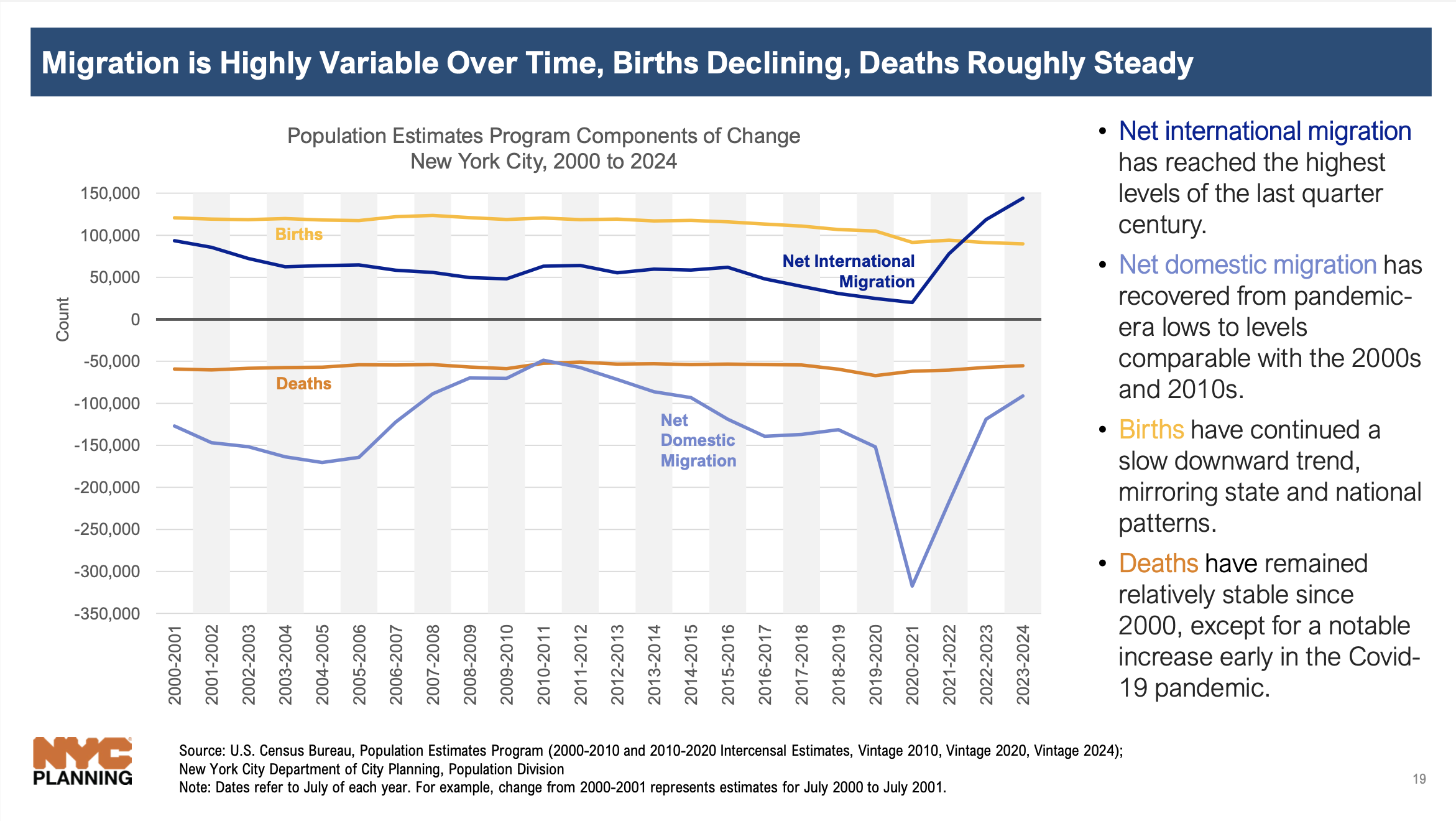
People don’t want to invest in trains because Americans don’t like trains. We have only one real city, and that city’s population consistently has net domestic outmigration. The city’s population is kept stable by a steady supply of international migrants: https://www.cityandstateny.com/media/ckeditor-uploads/2025/0....
Most Americans don’t want to commute sitting next to strangers. It’s not complicated.
They use them heavily when they're available. The NYC subway is very popular and successful, and many see it as a selling point of the city.
> Most Americans don’t want to commute sitting next to strangers.
I never hear city residents talk about 'strangers'. Interacting with others is a pleasure of cities, in fact - it's energizing, it builds social trust. We're social animals. I've never gotten on public transit, or walked down a busy sidewalk, and thought about 'strangers'. Most of those people are pretty sociable.
Some of the people on the subway have eroded social trust by acting antisocially with impunity, a high trust society needs to be beaten into such a diverse and inequal population a la singapore
I'm not sure what you mean, but the NYC subways - and public transportation I've been on in many cities - work well in terms of social trust. The evidence doesn't fit your theory.
Does everything work perfectly all the time? No, not in anything. If you cross the street, maybe someone will drive right into you. But I cross streets without a problem.
No. I generally like Bluetooth speakers - it's nice to share some music and someone's energy, and I mind panhandling less than all the advertising I see in my web browser. At least the panhandler needs the money and doesn't track me, and usually they're pretty friendly and neighborly.
Seriously, what's the big deal? People are looking to confirm all the anti-city hate. Maybe if these people make you uncomfortable, the lack of trust is in the mirror.
In suburbia and places like Tokyo, other people don’t impose their content preferences on me, I choose what I listen to on the train. I dislike ads for the same reason, I get to decide what I want to see or hear. I guess AirPods Pro 3 are closer to giving me that than ever.
Whatever suits you is great. Generally speaking, humans are social animals that live in groups, and sharing space and all that goes with it is natural to us. Many more people choose and want to live in big cities with lots of people around, than in rural places.
> They use them heavily when they're available. The NYC subway is very popular and successful, and many see it as a selling point of the city.
NYC has only 2.5% of the U.S. population and even then it has net domestic outmigration (meaning more people move out every year than move in). The city would be shrinking if it wasn’t for international immigrants, who don’t come to the city for the public transit, but rather the welfare system and ethnic social networks.
> The city would be shrinking if it wasn’t for international immigrants, who don’t come to the city for the public transit, but rather the welfare system and ethnic social networks.
I think your numbers are wrong: the city's foreign born population has been stable for at least 15 years[1]. We're not even at historic highs; those were before WWI.
> the city's foreign born population has been stable for at least 15 years
This statement doesn't contradict the one about international immigrants keeping the city from shrinking. It is easy to imagine how immigrants come to NY, give birth to natural born Americans, who then move out of the city. This process can come to some kind of a dynamic equilibrium with a stable population of foreign born people.
Not only that, when an international immigrant to the city later moves out of the city, like my cousin’s family did, that’s also counted as domestic migration.
Did you hear about the woman in Chicago who was set on fire on a train? Not very sociable.
People use the trains in places like Chicago and NYC not simply because they are available but because owning and driving a car in the city center is very expensive and impractical for most people.
Anywhere less dense, people prefer to drive their own cars.
> Did you hear about the woman in Chicago who was set on fire on a train? Not very sociable.
Did you hear about the other other lawsuit about people burning to death in their cybertruck? Should we compare horrific deaths per passenger? Per mile traveled?
once autonomy becomes ubiquitous, it'll change the safety equation significantly and hopefully eradicate the safety advantage of public transit entirely
If empirical observation is 'technical', then keen eyes can spot the grifters before they can be elected or corrupt the already-elected. Then we just need the will to permanently deter them.


There typically are no technical solutions to rhose.