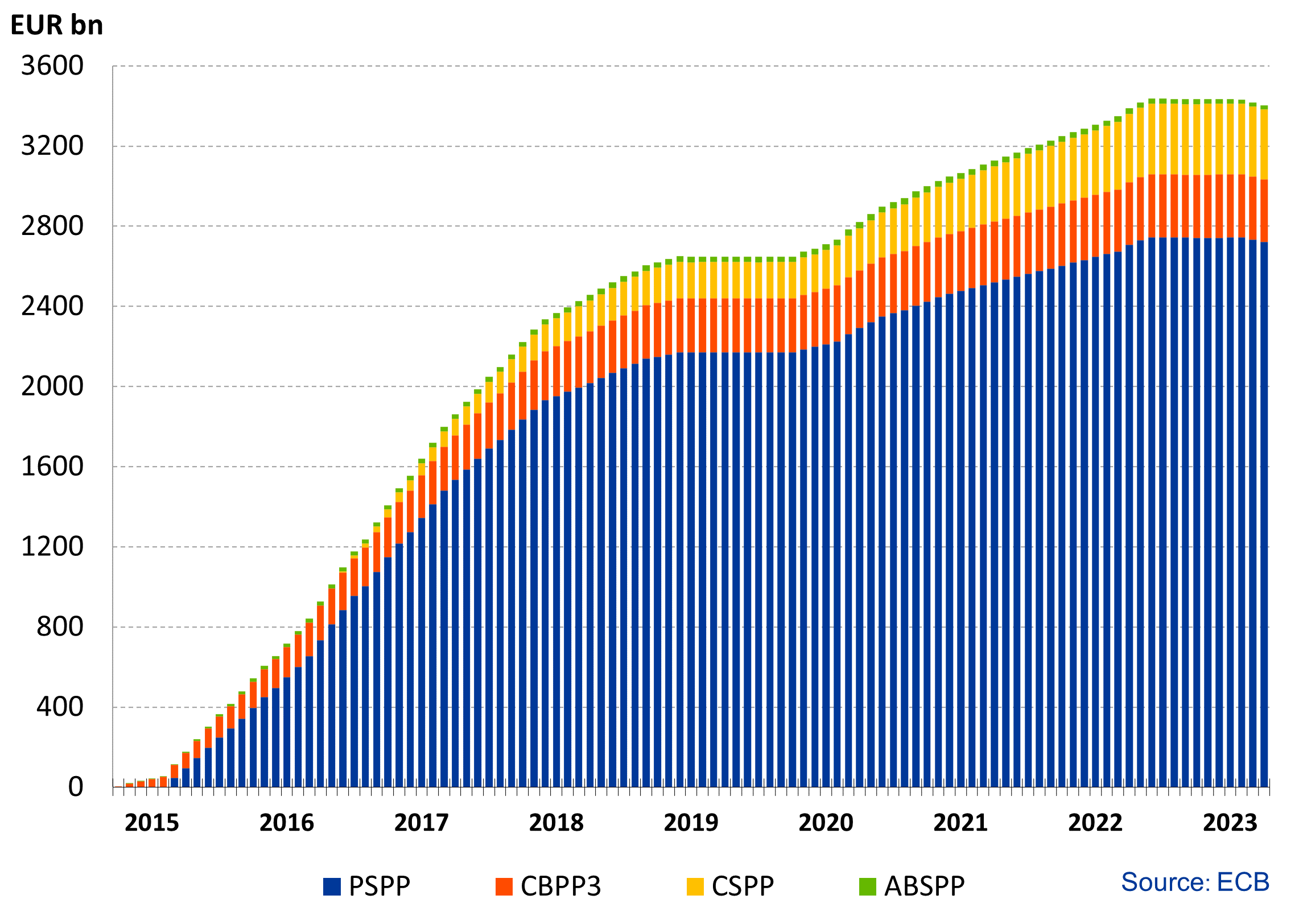
This is not a historic low, but a definitive low. There are several reasons for this.
- in time of a crisis, the world seems to ralley around the dollar, as it is backed by the strongest economy and the strongest military.
- this crisis has hit Europe hard, as it is not only close to the war, but of course, too dependant on Russian oil and especially gas.
- there was a lot of inflation internationally, the US federal bank was the first to raise interest to combat inflation. The EU lags behind and is limited in action due to the fear of destabilizing some of its member countries with too high of a debt.
Consequently, there is a lot of good reason for the Euro to be weak at these times. However, if the energy crisis can be solved and the war contained, a weak Euro also is also pushing exports from the EU. So there is a lot of reason for this trend to be stopped, if not reversed, until the other extreme is reached again.
A lot of people who wonder why the US is so seemingly subservient to SA (vs other Middle East countries) don’t know about this:
* In 1974, Washington and Riyadh struck a deal by which Saudi Arabia could buy US treasury bills before they were auctioned. In return, Saudi Arabia would sell its oil in dollars—not only enlarging the currency's liquidity but also using those dollars to buy US debt and products.*
So in exchange to gaining access to US treasuries (debt) before action, they had to buy US treasuries? How is that a concession made by the KSA if that’s what they wanted in the first place?
SA gets a good deal on treasuries (basically a bribe) in order to sell oil in dollars and then use those dollars to buy treasuries.
US forces nearly all countries to buy USD that eventually get returned as SA-owned debt (huge monetary policy benefits). SA gets more or less bribed by the worlds largest military.
Awkwardness is when SA wants to do stuff that’s is against US morals (like murdering journalists) or when China firmly but politely asks to buy in RMB (like it has recently).
US generally sees petrodollar regime as second only to the military (as evidenced by their eagerness to invade Iraq and gain leverage over SA).
You mean Libya that was bombarded by France and other European militaries with relatively small US involvement? The same Libya that bombed planes[0][1], killed people in front of embassies[2], helped prop up monsters like Idi-Amin[2], waged war against Chad[4] and Egypt[5] and suggested breaking up Switzerland because dictators son brutalized his servants[6]?
The country which was in midst of protests which their government, dictatorial btw, decided to violently suppress?[7]
Yeah, nice guy all around that Gaddaffi. Oils the only reason anybody would want him gone.
>> * In 1974, Washington and Riyadh struck a deal by which Saudi Arabia could buy US treasury bills before they were auctioned. In return, Saudi Arabia would sell its oil in dollars—not only enlarging the currency's liquidity but also using those dollars to buy US debt and products.*
> So in exchange to gaining access to US treasuries (debt) before action, they had to buy US treasuries?
I have no knowledge about this besides what's been written in this thread, but I assume that having the ability to buy before the auction means they get a good deal.
> it had to invade libya and iraq to stop them from selling oil in other currencies
Sounds like a propaganda meme, at least for Iraq that I know a little about.
Iraq was invaded for failure to fulfill WMD disarmament requirements, which was known and very _legal_ reason for invasion, according to the agreement made after Desert Storm. Iraq not just failed to prove that it destroyed all WMDs and precursors, it actively and blatantly prevented UN investigations, which is documented in UN resolutions in 1992, 1995, 1996, 1998 and 2002.
Note it's not just US, those are UN resolutions.
The propaganda meme keeps floating around because UN weren't able to find WMD after invasion, but the point is that the reason was not whether they find or not. It was Iraq's responsibility to provide proofs of WMD destruction, but instead they actively interfered with that. Who knows, maybe there are still WMD stockpiles, hidden somewhere in the vast country.
Europe doesn't just have an energy crisis though, if Russia decides to cut off the gas they straight up have insufficient energy to make it through the winter. The decline in the Euro is pricing in the risk of catastrophic shutdowns of industry across Europe.
All of it a result of moronic politics around nuclear and a failure to build out fossil fuel capacity while the green energy transition was still in progress.
If you started building a nuclear plant ten years ago, it will be finished when the crisis is way over.
Nuclear certainly is crucial in the mix. And used as such: Europe has a lot of nuclear power.
But nuclear is slow. Terribly so. Even an operational plant needs days to react to increasing or decreasing demands. And building such plants from scratch, or extending existing ones, takes decades. Never months.
I've been hearing the same line about nuclear plants taking decades to be built for decades, as if its a valid dismissal. As the saying goes, the best time to plant a tree was a decade ago, the second best time is now. We should be scaling up our nuclear capacity.
Any effort spent building nuclear for the 2040s is effort that could build 5x as much solar and wind for 2025.
Plus transitioning to nuclear just builds another set of kochs and saudis.
Plus it makes your entire economy beholden to one of China, Russia, France, or the US.
Plus it just kicks the can down the road. If you consider direct thermal forcing. We are exactly where we were in the late 19th century with greenhouse gases. There is no option but to transition to a steady state economy, and starting a bunch of projects that only pay off if you use as much energy as possible from them (and even then, solar + storage will be a fraction of the cost by the time they open) isn't the way to get there.
Plus those same five countries won't even let half the world have nuclear power plants.
Plus the world's uranium reserves won't actually last very long if you carry on with exponential growth (doubly so without reprocessing and breeding).
Then there's all the usual risks people mention.
The solution is the same as it has ever been. Degrowth, stopping waste, and renewables.
If Europe can continue to buy cheap Russian gas and oil and use it as they have done in the past then 5x as much solar and wind for 2025 sounds great. That was the Great Plan of the green movement in Germany. In 2010, 2020, 2030, 2040, 2050 or a time after that green hydrogen will become cheaper than Russian gas and oil and then this plan will be completed.
If however Europe can't continue to burn gas and oil when demand exceeds supply because of the weather, then there is a major problem that is going to need fixing in a very expensive and time consuming way. If green hydrogen don't drop in price and no other storage solution can arrive to become cheap than gas and oil, then the climate change goals won't be achieved.
To add to the problem in northern Europe, the locations for hydropower is practically already at maxed utilization. They are also quite old and with large maintenance debts. They are also is causing extinction of several species, and fixing that would cost prohibitively much money, and the solutions will reduce outputs.
The thing is, 5x solar and wind sounds great but if I can specific the time and space for it, I would make a great profit of trading 5 units of energy for 1x at a different space and time. The price difference in northern Europe can be a factor of 10 or even higher between low and high. 5 kwh worth 3 cent each is worth much less than 1 kwh worth 40 cent.
Solar and wind are nice, but they don't solve the base load problem. They aren't consistent enough to operate as base load on a power grid. They are certainly convenient for maintaining peak load, but without solving the energy storage issue in parallel to the added capacity, we need alternatives.
Then comes storage, curtailment, and backup (always necessary: fossil-fuel plants always produce around 9% of electricity in fully-nuclearized France).
Moreover backup is now provided thanks to gas turbines, and we know to run them thanks to hydrogen (clean), which can be green hydrogen (cleanly produced thanks to renewable sources overproduction).
There is no need for each location to deploy each and every type of production unit: each region has its own geography and preferences.
Those benefiting from huge potential for hydro, offshore wind or solar (deserts...) are at an advantage.
Those benefiting from a low production time-profile correlation with most other ones also are blessed.
Those totally unable to deploy anything probably don't need huge amounts of energy or are rich to the point of already importing it (is there a counter-example?).
I have read several of those studies with an automated workflow to find suitable pumped hydro/wind/solar and they consistently miss local awareness. They often use deeply inaccurate land cover classification when the simple usage of open street map could have helped, and for hydro they underestimate the recent local opposition to destroy a village to build a dam.
There's a lot of low hanging fruit in the hydro landscape that people miss.
I have a rivulet that runs near my house. It has weir dams at a few locations on it's path down our mountain, IT wouldn't be that hard to extract energy from the constant flowing water there to feed into the grid. There are turbines that exist to extract energy from a meter high head of water.
Everyone thinks about power like you need one big dam, or one big plant (coal or otherwise). There's a lot of small fast flowing streams that have potential to create extra energy.
I think hydro needs to be reimagined. IT always need to flood valleys to be in the mix.
That really depends on what percentage of water's potential energy is expended in small creeks and the like vs big rivers.
I actually have no idea how to estimate that. Anyone have a good estimate on that? Intuitively, I'm thinking that most of those rivers are fed by many small streams, so it would be approximately equal. I'm entirely unsure of that though so treat it as having huge error bars.
The problem becomes one of how spread out the energy is.
Sure the water in that creek might be falling hundreds of meters, or even kilometers, but without a dam the height differential at your generator is only going to he a few metres at best. Enough to power the lighting, fridge, and washing machine in the houses that the creeks happen to run by, but not much else.
With the advent of long lasting perovskites and (hopefully) some less polluting battery technologies you're not even better off cost-wise.
You might be able to do something with a long pipe parallel to the creek to get more head, but then you're going to spend a lot of your energy on wall friction unless it's very wide.
> Sure the water in that creek might be falling hundreds of meters, or even kilometers, but without a dam the height differential at your generator is only going to he a few metres at best. Enough to power the lighting, fridge, and washing machine in the houses that the creeks happen to run by, but not much else.
Could be, but that's a bunch of stuff you don't have to power with the existing system. Given how many creeks there are, that seems like it could really add up.
> With the advent of long lasting perovskites and (hopefully) some less polluting battery technologies you're not even better off cost-wise.
That's fair. I've learned in my life that I don't have a good intuition for what the costs of large infrastructure projects are.
Who is going to run all the little dams and turbines, though? And how would it ever be cost effective to do so? There is so much maintenance on small lakes that don’t even have a turbine (mainly dealing with silt, which accumulates steadily and is hugely expensive to remove).
Yeah in this example, the water is never stopped. Not even the flow rate, It's just held back for a moment to create a convenient potential energy situation.
This https://www.youtube.com/watch?v=Bhyi1DjGti8 Is something that could be built near a bus stop near my house and not negatively impact anyone outside of the initial construction.
A few example large solar plants in the US seems to have ~500MW capacity, ~30% capacity factor (so ~200MW effective capacity), and taken 2-5 years to build [1][2][3].
A nuclear plant will probably have multiple 1GW reactors, with very high capacity factors. I think your numbers are very optimistic.
Pumped storage is hard because you need a lot of space on a hill for a reservoir. Perhaps we can turn lake mead into a giant pumped storage project with a bunch of solar installed over it to limit evaporation. Then use wind, solar, or even nuclear to fill it (but that’s a lot of water that farmers might want for their fields, again, limiting evaporation is important).
Building a nuclear power plant today is assuming storage for solar and wind will not be figured out within 50 years, allowing you to sell electricity at todays price for at least this time. You can see why no one wants to take that bet. It's over, it was already over 10 years ago, stop trying to fit every crisis around a "nuclear was unfairly maligned" obsession.
The Germans are shutting down perfectly serviceable and world-leading (in terms of safety) nuclear reactors purely out of doctrinaire ideology of the Green Party.
Probably not from Germany, are you? The greens were not part of this decision when it was actually made.
Yes, there was some anti-nuclear sentiment after Fukushima which made for an opportunity. But it was long in the running. Both the SPD and CSU/CDU had interests here. Lots have been written on this in established media, should you wish to delve deeper.
Yes, but the original plan of the Greens seeked to use nuclear power as a transitional technology to first replace coal. While the build up of renewable energy in Germany during the last 2 decades is very impressive, adding more gas to the mix certainly looks idiotic in hindsight. This wasn't the Greens fault, as they haven't been in government since 2005. They are now the ones having to deal with it though.
Yes they were. The decision was made under Schröder/Fischer around 2006.
It was reverted as soon as the CDU took over, and reverted back after Fukushima. But it is originally a "Green" idea and ideology, and it remains to be one today (see: Bavaria trying to get their plants recertified after 2022, because of the gas situation, and Berlin - staunchly Green - fighting it.)
Or just a strong desire that surely somehow this was the green's fault. It's not inconceivable as they have an anti nuclear slant, but this one isn't remotely on them. They do have to deal with the fallout however.
In my book, a party that set up the Atomausstieg, after campaigning on the topic for a decade, after grossly overstating the potential dangers of nuclear, while supporting grassroots anti-nuclear groups and engaging in borderline criminal protests that often endangered nuclear transports doesn't get to play coy once the shit hits the fan in my book.
I think we agree on almost all points, maybe with the exception on the overstated dangers argument. (One should always focus on the good arguments and not the bad, and there are plenty of educated people making coherent arguments without resorting to fear mongering.)
Anyway, don't let this cloud your judgement. There are economic issues here, and economics concerns trumps environmental, in Germany and elsewhere. This would have happened even if no anti nuclear campaigning had ever taken place.
In fact, it might even have happened faster if there wasn't also a big push for renewables, which have taken a lot of resources. The people really responsible should answer for this and not some convenient scapegoats.
The nuclear reactors would have been due for a thorough 10-year check-up in 2019 which was omitted because of the approaching shutdown. So claiming this was "purely out of doctrinaire ideology" seems unreasonable.
True. And it was immediately reversed when Merkel's conservative government took over. And then again reversed by the same conservative led government after Fukushima.
I think money, perk and power go a longer way than ideology. There were probably backroom stuffs we didn't know about. It takes a LOT of cash to feul any movement that huge.
The German parties advocating a Nuclear exit did so because the Germans wanted them to do so. Nuclear power really wasn't (probably still isn't) popular in Germany.
Don't you say. Is there also a wikipedia article on how to replace all industrial, commercial and domestic heating infrastructure with those? Europe wide?
Electric radiators are quite cheap (they retail for less than $100), and homes in the cold parts of europe are typically well insulated, and if you bought a radiator for every person in the eu (0.5B * $100) it would cost .3% of europe's gdp ($18 trillion), or 5% of the eu's budget for 1 year. This helps reduce the reliance on gas for domestic heating.
Those heaters heat one room, not a house or appartment complex. They consume a ton of electricity, are higly inefficient and don't heat your water supply. And while they maybe cheap (are those cheap ones rated for contonous usage or are they some cheap Wish knockoffs?) they are not available in sufficient numbers... Seriously, how comes that people fail to realize how complex things around them are, like infrastructure? These things are not like a consumer grade app or some ride share business...
Not sure where you're getting your facts. I'm sitting in a house with all of these things you claim don't exist, and I'm not an anomaly where I live. My water heater, cooking stove, furnace.. all electric. Most of it installed in the 80's and all original (other than the water heater which has a 10-15 year lifespan).
Electric water heaters and baseboard heaters are common, and extremely efficient. In fact, resistive heaters in the scientific sense (watts in vs. watts out) are the most efficient form of heating.
They're extremely reliable and cheap because of how simple they are.
They may not be _cost effective to run_ in many regions due to high cost of electricity (per watt as compared to gas). But here in BC Canada, resistive elements are extremely common due to relatively cheap power (Hydro in our case). For whole home heating, heat pumps are usually used in new builds because of their advantages, but they're still very tied to the grid and have elements in them for defrosting and the like.
If you scaled up nuclear you'd similarly see prices of electricity drop, and if you have the grid infrastructure (or build it), electric heating (for your home, water, cooking, whatever) becomes pretty attractive.
Sure it exists. My point was that switching from one to the other is the problem. Europe has issues with gett;ng gas and can't switch to electric. If you use electric and run into electricity issues you cannot switch to gas. Even if both solutions are working just fine.
Your comment I replied to claimed electric heaters were inefficient and not available in numbers. I also don't see any mention of existing infrastructure.
Most of the houses I've seen in Canada are heated using baseboard heaters, they're not exactly uncommon. Efficiency seems fine, and most of Europe doesn't get as cold as Canada during winter.
I'm standing on floor heating at this very moment (off, of course). It uses district heating / hot water, which could be heated by any kind of energy source, including nuclear.
The consumer side is actually a lot more trivial than you are making out. It's also about as efficient as gas (0% at the point of consumption as you are producing heat, with about 40% energy loss on the production side).
Electric heating is about the simplest machine you can possibly make (it's just NiCr wire and a thermostat which is already there), and the cost would almost exclusively be the labour of installation. Even heat pumps (including for water) could be built in relatively short order.
The problem is it would entail quadrupling the electricity generating and transmission infrastructure. This is the hard part that takes decades.
> Those heaters heat one room, not a house or appartment complex.
It’s something I’ve always wondered:
At night, it might be more cost effective to heat a bedroom electrically than an entire household with gas. But that’s a forced air heating issue: you can’t block 75% of a furnace’s airflow and expect it to keep working. Europe usually has boilers and radiators so dialing down heating to just a room is possible.
Or better yet, heat the person with a mattress pad instead of the building air at night.
Electricity heating does produce a bunch of heat at other places though, and it all comes from work, whereas the gas could only produce maybe 70% as much work if used some other way.
How is this 0% measured? I would think 1 J coming in from the wall making 1 J of heat means 100% efficient.
Yes there are inefficiencies at generation and transportation. But I don't think those are usually counted when talking about the efficiency of a home device. And it certainly won't be enough to bring it down to 0%.
As an illustrative example, you could get the same heating effect by putting the electricity through a computer or other appliance, or by putting the gas through a heat engine to produce electricity which is used inside the home and warming the house with the waste heat.
Hmm, that type of measurement probably works in some situations, but I don't think it works for heating. For example, I don't think that type of measurement would be as useful for comparing resistive heaters to heat pumps.
I know about heating by computer because for the last several years I've heated my apartment solely by mining Ethereum on my computer. The only dedicated heaters that my apartment has are resistive electric heaters built into the walls, so it's better for me to get a little Ethereum plus heat than just heat.
I don't like the framing of thermalizing potential energy being 100% efficient because efficiency as a general concept is the fraction of what you did vs. what you could do. It's incoherent mathematically, poor communication, and inconsistent with the way the word efficiency is used in other contexts in everyday speech. Direct thermalization is the least efficient possible action. It also leads to absurd statements like 'heat pumps are 400% efficient'. This is further exacerbated by the communication not expressing the upper bound in any coherent way (which is about 800-900% by this framing depending on temperature differential).
You could frame it as fraction of the heating that is possible at carnot efficiency, I guess. Ie. the amount of heat you put into your room / the amount of heat you with a perfect machine could at typical temperature differentials.
Then an element would be about 10-15% efficient (as measured at the wall vs. an ideal heat pump) and gas would be...awkward to calculate (I'd have to open up a textbook if not just multiplying max COP and max thermal efficiency of a heat engine), but somewhere in the 20-30% efficient range. Electric including a thermal generator would be in the 8-10% range somewhere.
Electric heat pumps would be around 50-70% by this metric, or in the 25-40% range somewhere if using a thermal generator.
Thinking about it, I like this metric because it really highlights how much more wasteful burning gas to heat a home with electricity is if you're not using the waste heat for something. If you're not using renewable electricity, even heat pumps don't break even if they're not high quality and well maintained.
Really drives home the importance of insulation and good curtains in cold areas.
Edit: looking at absorption heat pumps, they seem to be a little better than my guesstimate. I think they outperform fossil fuel powered electric heat pumps.
Yes, 100% efficient. But a heat pump is over 100% efficient because it pumps in additional heat from outside instead of just using the electricity's heat.
In fact, electric heating was actively discouraged and built back around 1995. It was often being replaced with gas and wood pellets (which also come from Ukraine/Russia).
This is bullsht and i made an account just to tell you why:
- Large parts of the Uranium are coming from Russia
- Nuclear power is not competitive and nuclear power is very expensive (especially if you conside the costs the government will be left holding the bag on, becuase nuclear power plant companies will spin off their power plants to new companies to go bankrupt once the profiting is done and the cleaning up the nuclear remains starts), no matter how much the pro-nuclear people want to lie about it
- Nuclear power is statistically not dangerous compared to fossil fuels, but not compared to renewables.
- The world's uranium supply is running out. Already since the late 1980s, uranium mines have been unable to meet the world's annual demand. The nuclear industry has so far filled the fuel gap with material from military and civilian stockpiles.
- Nuclear waste is a problem no country except Finnland is anywhere near solving. Germany has been trying to find a permanent nuclear waste storage location since 1999 and have not come closer to finding one since then, because every time the current favorites are revealed the "not in my backyard" screeching starts and local politicials force a restart of the search.
- Many of the world's nuclear power plants are old, because hardly any new ones have been built in ages, because ...
- The construction of nuclear power plants is unbelievably expensive and takes decades, and much of the know-how on how to build nuclear power plants has been lost in europe over the past decades because so few are being built, which drives up the costs even further.
- We still have 7 years of CO2 budget in Germany, so why do some politicians talk about building new ones, although they would only be finished in 20 years at the earliest (and we in DE can't even get the berlin airport built in anything close to the deadline, how long does a nuclear power plant take then ?)
- Budgets for nuclear power plants take budget away from renewables
- We have to change from a centralised to a decentralised grid, nuclear power is a step in the wrong direction
- Nuclear power plants make us dependent on dictators
- Climate change has an impact on reactor operations. With global warming, extreme weather events are on the rise. Unlike renewables, however, nuclear power plants are not adaptable. Rather, their danger increases in our changing climatic conditions.
- Our neighbour france has heavily invested in nuclear power and is is a complete shtshow. There are constant headline to the extend of "Low temperatures caused another french nuclear power plant to go off the grid, worsening the skyrocketing energy prices in france" (The same with "too high temperatures" any many other reasons). Even before the war they had an energy shortage.
The 3 remaining nuclear power plants in germany are:
- Emsland (1335 MW)
- Isar/Ohu 2 (1410 MW)
- Neckarwestheim 2 (1310 MW)
All three are pressurised water reactors and thus not as bad as boiling water reactors, but total rubbish compared to liquid salt reactors.
Moreover, all three have been in operation for over 30 years and all three are due for a "periodic safety review" (every 10 years), which was allowed to be ignored during their last 3 years of operation due to a "grace period under the Atomic Energy Act".
If they were allowed to continue running, the operation time extension of the of all three would start with at least one month downtime, because these inspections would have to be started again. These inspections would most likely also reveal necessary repairs, wich would further delay the timeframe.
By the way, all three power plants have not been employing new staff for some time because they knew the would soon be shut down soon anyway.
In short: these nuclear power plants have been preparing for their shutdown since 2011 and have let everything slide over the last few years because everything will soon be demolished anyway. There are not the necessary fuel rods, not the necessary personnel, not the necessary will of the operating companies and no safety checks that would be necessary for continued operation.
Also: Merkel decided in 2011 (one day after the nuclear power plant disaster in Fukushima) to not allow nuclear power after the 31.12.2022. Merkel, famously in the green party . (for anybody with no clue about german politics: Merkel is in the conservative party)
The conservative opposition needs things to disagree on with the government, the current government had no scandals so far and the conservatives are still salty for being voted out of government, so they just make sh*t up and currently that is the myth of our magical saviour nuclear power.
A nuclear reactor can be built in three years, though admittedly this hasn't happened in Europe. They are mostly (85%) built in under ten years. Figure 3 shows we should expect around 5 years. https://euanmearns.com/how-long-does-it-take-to-build-a-nucl...
>- Large parts of the Uranium are coming from Russia
Not immutable. There are other sources that are much friendlier
>- Nuclear power is not competitive and nuclear power is very expensive (especially if you conside the costs the government will be left holding the bag on, becuase nuclear power plant companies will spin off their power plants to new companies to go bankrupt once the profiting is done and the cleaning up the nuclear remains starts), no matter how much the pro-nuclear people want to lie about it
I doubt this hyperbolic assertion. Prove it.
>- Nuclear power is statistically not dangerous compared to fossil fuels, but not compared to renewables.
Again, prove it. This is unsupported, and in fact from what I've seen, false. So provide some evidence.
>- The world's uranium supply is running out. Already since the late 1980s, uranium mines have been unable to meet the world's annual demand. The nuclear industry has so far filled the fuel gap with material from military and civilian stockpiles.
This is again, an unsourced claim. In fact, a quick google shows: "There is not now, nor has there even been a shortage of uranium. Fear about reliability of the supply of uranium has been used in the past as an excuse to get something else done." Source: https://www.forbes.com/sites/llewellynking/2020/06/08/uraniu...
>- Nuclear waste is a problem no country except Finnland is anywhere near solving. Germany has been trying to find a permanent nuclear waste storage location since 1999 and have not come closer to finding one since then, because every time the current favorites are revealed the "not in my backyard" screeching starts and local politicials force a restart of the search.
I agree this is a problem, but it isn't one that is unsolvable. It's a cultural issue, not a physical one.
>- Many of the world's nuclear power plants are old, because hardly any new ones have been built in ages, because ...
>- The construction of nuclear power plants is unbelievably expensive and takes decades, and much of the know-how on how to build nuclear power plants has been lost in europe over the past decades because so few are being built, which drives up the costs even further.
This isn't inherent, it can change, especially with political need.
>- We still have 7 years of CO2 budget in Germany, so why do some politicians talk about building new ones, although they would only be finished in 20 years at the earliest (and we in DE can't even get the berlin airport built in anything close to the deadline, how long does a nuclear power plant take then ?)
CO2 budgets are now irrelevant currently. China and Russia do not give a shit about CO2 emissions; their energy and GDP are heavily dependent on them. Globalization was the only mechanism that allowed the world to enforce these two countries to behave with emissions, and with the ongoing breakdown of the globalized system, there's no reason they'll reduce emissions. Why cripple Germany's economy to meet a target that the world's largest emitters aren't willing to get anywhere close to?
>- Budgets for nuclear power plants take budget away from renewables
Possible, but renewables have their own downsides, which are well articulated everywhere.
>- We have to change from a centralised to a decentralised grid, nuclear power is a step in the wrong direction
Why?
>- Nuclear power plants make us dependent on dictators
>- Climate change has an impact on reactor operations. With global warming, extreme weather events are on the rise. Unlike renewables, however, nuclear power plants are not adaptable. Rather, their danger increases in our changing climatic conditions.
This makes sense, but I'd suggest that it's probably possible to take this into reactor design.
>- Our neighbour france has heavily invested in nuclear power and is is a complete shtshow.
Source on this, I don't know much about it. I've heard only good things about France's nuclear program.
I agree this is a problem too, and this is why people point out there is also a physical issue which transcends culture.
In terms of radioactive properties remaining over a period of millennia during which a culture can be expected to have lost its identity, or been forgotten completely.
If the problem is not truly unsolvable, a permanent solution may still not be possible without close co-operation with a future sympathetic culture.
In Western Europe (in a political meaning) only Finland has tried for several decades. It's now 12 years behind schedule and the official message is that it will be running in winter (colder in Finland than in many othe places) when the lack of Russian energy will become most visible. Direct import of electricity and gas from Russia have been already stopped. At the moment that's not a problem because it's summer and you can import from other European countries. I'd be very suprised if you can do that in winter. If the nuclear power plant is not ready people will sit in the cold in 6 months from now. Or they will compromise on safety and just run the plant anyway. It is already loaded. No idea what will happen, but I should stop discussing on HN and order firewood.
As others already pointed out, the nuclear exit strategy was decided upon under Merkel's conservative government.
Some added information so: The Green party pushed for an exit of nuclear power as part of a social-docrat government. This exit eas actually pretty well worked out and planned. When Merkel took, one of the forst things was to throw that rather good plan out. Only to revert that decision, hastly at that, after Fukushima. That second nuclear exit, the one Germany is currrently going through, was hastly done, ill planned and rushed.
And lastly, nuclear power does exactly nothing to compensate for reduced gas deliveries. Germany, as in deed a good portion of Europe, is heating with gas. And not nuclear power or electrical.
It's only slow because of ridiculous and unnescessary regulations around it. They can easily speed things up while still keeping it safe, but their (and our/US's) laws are kicking themselves in the butt.
I think more so the precedent it set. Not switching on ~and~ not growing nuclear. It wouldn't be too ridiculous for Germany to be producing 30GW from nuclear by now. That's a 22GW spread from what it is today which isn't negligible.
But yeah, people are definitely being a little over dramatic on the severity.
Can’t heat with nuclear. Not in a way that’s relevant for this, anyway.
Heat is the main challenge and heating alone is problematic all by itself.
Gas dependence was a huge mistake, nuclear is not the short term solution we are looking for and getting away from gas dependence in the past couldn’t have relied on nuclear.
> Can’t heat with nuclear. Not in a way that’s relevant for this, anyway.
That is not a law of Physics. Electric heating is perfectly fine. It’s true that we cannot do it quick enough to matter in this case, but that is not a good reason to just shrug and not learn anything from this. We will need a long-term strategy, because even if we manage to come up with a temporary solution, it’s clear that these things will happen again in the future. It’s just too good as a way of applying pressure on European countries. Long term, it will have to be electric if we want to improve our energy supply and have a remote chance of not staying too far from our climate goals.
We should have seen this coming for quite a while. It was in fact predicted, but mostly ignored by politicians who seemed to thing that oil crises from the 1970s were fun and that energy independence was irrelevant.
This is an important point that quickly gets lost in a simplified debate.
Different types of power have different characteristics. Nuclear power plants runs at constant load and changes in power are slow. They take on the order of days to start and stop, and can not on their own follow load changes on a country wide network.
This isn't good or bad, it just is. They can manage the same base load day every day until they need servicing. But that also means you need other power sources to take the top load. That's usually natural gas turbines, even if it could be other things. Hydro is optimal, but most countries have a limited capacity for that. Which is, somewhat ironically, a similar situation as wind and solar have, but for completely different reasons.
Keep that in mind when people talk about replacing natural gas with nuclear. They do different things.
This mostly isn't physics, but rather a reflection of nuclear power's high capital costs. Nuclear plants have demonstrated that they can ramp up and down pretty quickly compared to e.g. most combined cycle natural gas plants.
"For example, according to
the current version of the European Utilities Requirements (EUR) the NPP must at least be capable of daily
load cycling operation between 50% and 100 % of its rated power Pr
, with a rate of change of electric
output of 3-5% of Pr per minute. " - it goes on to discuss how most modern light water plants significantly outperform this requirement.
"Most of the modern designs implement even higher manoeuvrability capabilities, with the possibility
of planned and unplanned load-following in a wide power range and with ramps of 5% Pr per minute.
Some designs are capable of extremely fast power modulations in the frequency regulation mode with
ramps of several percent of the rated power per second, but in a narrow band around the rated power level. "
> Keep that in mind when people talk about replacing natural gas with nuclear. They do different things.
Having some nuclear base load certainly helps, though, if natural gas is disrupted. Instead of having both the dispatchable power and variable power impacted from reduced natural gas supply, you instead only have a portion impacted.
One strategy is to build a bunch of renewable for during the day. Add some nuclear base load. And then with the surplus power you get sometimes, do power-to-gas with electrolyzer cells. Finally, use natural gas peaker plants and burn natural gas where justified in industry. This is a nice diverse mix with storage.
Solar and wind are also inflexible (they generate when sun and wind are out, not on demand). In addition to hydro, natural gas is on demand, which is why we’ve shifted a lot of generating capacity to it. But that makes Europe dependent on Russia and contributes green house gases even if it doesn’t emit much air pollution.
Hydro is even better, you can modify some dam, then pump water back before the dam, storing energy for later usage which make a very cheap energy storage.
Yes, last winter France imported a lot, because more than 4 reactors were shut down for maintenance due to corrosions problems that has been found.
These problem should had been found earlier, and would allowed to make the maintenance before the winter, but due to covid, inspections have been postponed.
For example, 01/11/20 to 26/12/20 (their website allow only 8 weeks period graph) you can see that overall France exported a lot of electricity to other EU countries in the middle of the winter.
rather because a recent change in the energy code allow to count neighbor firm capacities into the adequacy requirement and the usage of monte carlo methods for adequacy requirement.
Domestic heating is done, mostly, by gas. Hard to replace all of Germany's (or Europes) domestic heating infrastructure with electric heating in couple of years. Not to speak about monts.
So no, nuclear power cannot be used for heating and Europe definitely doesn't have an electricity problem.
This whole comment tree seems to be full of people who deliberately misunderstand physics and economics.
Europe is still going to have access to gas if Russia cuts its whole supply come winter -- in fact, 60% of the European gas supply will still be present. Probably a bit more, since lots of crisis efforts have been made to provide gas from other sources. Only part of the heating needs have to be replaced.
Let's say Germany still had the, what, 8000 gigawatts of nuclear power online that it has shut down during the last decade? Wild-ass guess, but it's a lot. That's base load, of course. Electric power.
Resistive heating is dirt cheap to deploy in terms of capital costs. You can buy a 2000W heater for $20, perfect for domestic use. So the operating costs dominate. Using a heat pump is 3-4 times better in terms of operating costs; that's not as easy to deploy but many places will already have A/C installed and that's usually the same thing.
So then it becomes a question of economics; many industrial processes cannot be replaced with electricity. But as we've seen, heating of living spaces can easily be done with electricity.
So in the kind of crisis we're discussing here, those thousands of gigawatts of nuclear electricity would be pretty damn useful for emergency heating of German homes and businesses, during months where the gas would be more profitably used for the industrial processes that require it.
It sure as hell wouldn't have been cheap, but it would be cheaper than shutting down half the economy, which is what we're preparing for right now.
It's a moot point, of course, because those ~17 nuclear plants are already shut down. But it would very much have made the issue dramatically less painful.
Umm... I'm looking at https://www.ercot.com/ and for all of Texas (if memory serves we're twice the landmass of Germany and probably on par by population) on one of the hottest days of the year, we've got about 84,000 megawatts of capacity. I think you're off by a couple orders of magnitude when talking about thousands of gigawatts.
According to Reuters, I was off by a factor of two, if the number they quoted counts all the plants they decided to shut down. ~4000 GW shut down. That’s a decent wild-ass guess, IMHO.
Yeah, I don't think Reuters is correct here. Everything I'm seeing is that a nuclear plant produces around 1 gigawatt, so we'd be talking about thousands of nuclear plants.
Also probably helpful to think about it on a per person basis. Another comment corrected me that Germany has 80 million people, so let's use that. 8000 gigawatts (8 terawatts) divided by 80 million looks like 8,000,000,000,000 watts / 80,000,000 persons gives you 100,000 watts per person which does not seem realistic. With my air conditioner running at full blast, that's probably just a couple kilowatts, and that covers 3 people. Lights use a few watts. A beefy computer is around 100 watts.
It's possible that Reuters got gigawatts and gigawatt hours confused.
Ah, that's a very fair napkin calculation, the 4000GW number is obviously wrong.
But I don't think it ruins the core of my argument; it wasn't hinging on Germany having reduced their annual power production by 99%. If Germany in fact shut down 15GW of nuclear production (15 plants), that's still on the order of 200 watts for every person in Germany, or one new 1000W resistive heater running 24/7 for every fifth household.
That's the kind of "on the margins" capacity that would indeed make a Russian gas embargo dramatically less painful.
In "emergency situations", there is this crazy modern technology called "blankets" and "jackets" and "coats".
Home heating is primarily a luxury for comfort, not survival. Given sufficient insulation, we generate enough heat from food to muddle through.
Is it fun to shiver under blankets during an energy crisis? No, not at all. But are people going to die? Not likely, assuming access to space alien technology like blankets and coats.
> The most recent data on fuel poverty in England indicates that there were 2.28 million
fuel-poor households in 2012. 5. Cold homes can affect or exacerbate a range of health problems including respiratory problems, circulatory problems and increased risk of poor mental health. Estimates suggest that some 10% of excess winter deaths are directly attributable to fuel poverty and a fifth of excess winter deaths are attributable to the coldest quarter of homes. 6. Cold homes can also affect wider determinants of health, such as educational performance among children and young people, as well as work absences
Maybe if you want to heat a subset of rooms for the cost of heating the whole house.
Electric heaters are extremely expensive to run relative to gas or heat pumps.
Heat pumps are great and extremely efficient, but not they are as hard to install as air conditioners (because they are air conditioners that work in reverse).
Windows here in Europe don't usually slide. And in Europe we like looking out of them :)
But heat pumps are also available in single units now. They're getting quite popular because they can be self installed (no refrigerant engineer necessary).
I believe there are models of window units with heaters available though they may just be doing resistive heating. I've seen plenty of mini-splits running as heaters obviously using heat pumps and they seem to work quite well.
You don't seeem to uave an idea how domestic heating works in most oarts of Europe, do you? And that simple plug in heater will consume so much electricity that your gas heating would still be cheaper. Also, that wall heater doesn't heat your water supply...
Edit: Assuming a plug in wall-heater does all of that, just how many of them would you need by November this year to change something?
2. Hmm, looks like sometimes they explode in a pretty rude, nukey way. Maybe we should stick with coal, oil, and gas.
3. Yikes, climate change. But if we pull all our coal/oil/gas plants down we won't have enough energy and prices will skyrocket. Not enough wind/solar/hydro yet.
4. So... maybe nuclear is a good idea again? Cheap electricity?
We're here. So your argument is we can't use nuclear because electricity is too expensive in Europe, when the whole idea is to increase the supply of electricity and thus bring down the price?
> Also, that wall heater doesn't heat your water supply
There are electric water heaters.
> how many of them would you need by November this year to change something
Maybe someone in this thread is arguing that we can both build a bunch of nuclear plants and distribute electrical heaters to people in ~4 months, but I'm not. This is all a long term thing isn't it? Don't we have to do this anyway for green energy?
No idea why the concept of energy, in the scope of a national ecobomy, is so hard to understand. Of course you can heat with electricity, in the case of heat pumps even sustainable. Thing is, there are millions of house holds, commercial and industrial users that have decades of infrastructure in place heating with gas. No way to replace that in mid, let alone short term.
Also, nobody will freeze to death in his house over this.
> No idea why the concept of energy, in the scope of a national ecobomy, is so hard to understand.
Please don't condescend! I agree this is a big job.
> Of course you can heat with electricity, in the case of heat pumps even sustainable. Thing is, there are millions of house holds, commercial and industrial users that have decades of infrastructure in place heating with gas. No way to replace that in mid, let alone short term.
Again we agree. My point is that we have to electrify for green energy anyway. May as well do it, right? Is your argument that we should only ever heat with gas, and electrification is a waste of time and money? Is there enough gas to do that?
> Also, nobody will freeze to death in his house over this.
The thing you're referring to is someone saying "In an emergency situation (a matter of life and death for the vulnerable)". Isn't it reasonable to consider this scenario? Why is it FUD?
No. The gas is needed for heating homes and industial uses and that was already the case when Germany was using its peak nuclear power. Keeping the nuclear reactors would be almost no help with the current problem because Germany is using almost no gas for electricity.
Anyone a bit better informed would be skeptical and the arguments are on the table for years now. The gas problem is about heating which nuclear energy could only supply indirectly with a low grade of efficiency. Germany, for example, only ever had 6% nuclear energy at its height. You can pretty clearly identify populists that now propose to change course. It would minimally easy the burden, perhaps, but there are more efficient alternatives.
"People will die" from this mistake is hysteria. Nobody informed about the energy problems will take that seriously. Gas is not electrical power to start with.
And if you build more people will die in the next big accident. There is no doubt that there will be a next accident. For Chernobyl you can say criminal neglect was part of the system in the USSR. 3 Mile Island happenend in the world leader in technology. Japan used to have the reputation of having high security standards. Until Fukushima happened and they did not have the situation under control. There will always something fail, regardless how well it's designed. Not necessarily this year or not even in 5. But most of us still intend to live for decades, I'd assume.
If a Jumbo crashes you expect around 400 death. If 2 crash into each other it's twice as many (search for Tenerife if you are too young to remember). If you build 2 skyscrapers for 16,000 employees you risk 16,000 deaths if the worst happens ("Less" than 3000 died, so the cold facts aren't that bad after all.) If you build build a nuclear power station with millions of people around, you risk many more deaths. Not everyone of them immediately, but cancers caused by radiation will continue for decades. Building such things is engineer hubris and some day something worse than what we have seen so far will happen.
Fossil fuel burning pollution kills millions every year even with no accidents.[1]
> "If you build build a nuclear power station with millions of people around, you risk many more deaths."
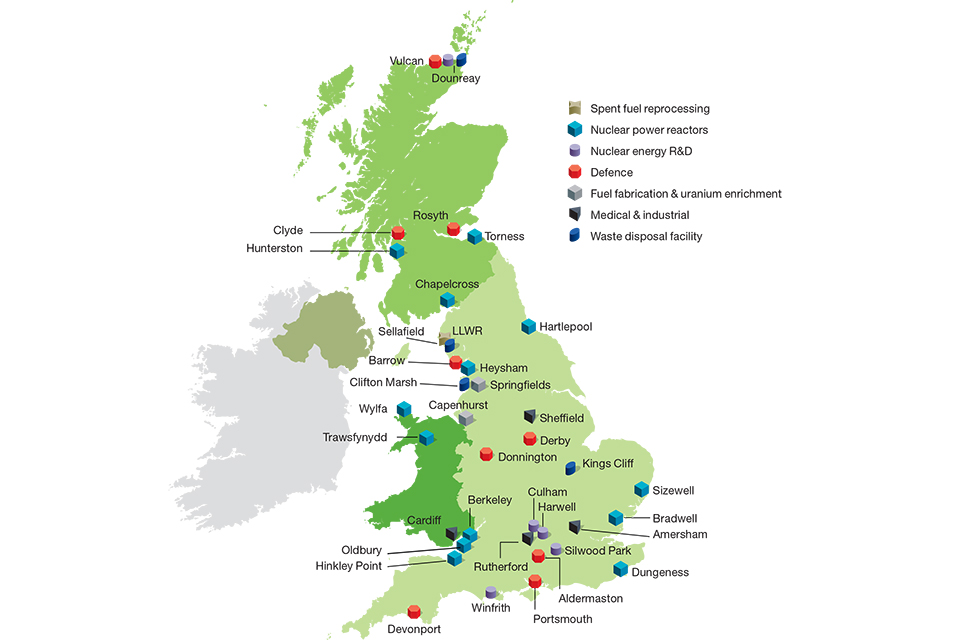
Don't build it near millions of people. See this map of the UK[2]; London, Birmingham, Liverpool, Sheffield are where the most people are, and where the nuclear power plants aren't.
3 Mile Island has not killed anybody AFAIK, but it showed the the world's leading tech nation failed completely in responding to the accident. Some facts could be found only years later when the reactor could be inspected and others will remain in the dark forever because they just could not be collected in time. You want to trust a technology where even accidents without fatalities cannot be investigated?
For Chernobyl the overall death toll is estimated between 50 and 4000. Nobody knows and nobody knows how to even count. How do you count the disabled and sick babies born after it?
For Fukushima 1600 fatalities were reported during evacution. I am not an expert, but I guess it's difficult to attribute because the whole area was devastated already by the tsunami.
There will be lucky outcomes also in the future. But if you have hundreds of thousands or millions of people around, some day we'll be out of luck.
So your nuclear power caused death count over 4 decades is roughly 5000 people? I think we killed more people than that trying to make a non stick pan.
> if Russia decides to cut off the gas they straight up have insufficient energy to make it through the winter.
I agree with your sentiment on massive incompetence regarding Energy policy but this is an exageration.
1. Russia won't cut off gas despite it's threats because gas is quite literally one of the few revenue sources for the Russian economy. Much like Qatar, Russia would implode without Gas money.
2. There are plenty of other gas providers Qatar, Norway, Algeria, even US/Canada LNG, who can sell to the EU.
What they likely won't sell is at the cost of Russian gas which is the pressing point for Central and Eastern European countries.
But the point is, you would shut down heavy industry and go into deficit before you were faced with a doomsday scenario of people freezing during winter.
Shutting down heavy industry is already a doomsday scenario. That would imply millions of people out of work and billions if not trillions of dollars of lost GDP.
> Russia would implode without Gas money
Russia can sell to China and India. US/CAN has insufficient LNG transport capacity to completely replace pipelines from Russia. Germany has insufficient import terminal capacity.
Yes, they wouldn't run out of gas, but the price would likely spike 5-10x and crater the EU economy which is equally as bad.
That is not quite correct. First of all, Russia cannot simply sell to China and India. It takes years to build the necessary infrastructure to do that.
Regarding import terminals: there are LNG terminals all over Europe that are far from their full capacity which all have connections to the German net. That alone would suffice in delivering enough LNG. Apart from that, we're on the fast track of having extra terminals ready by autumn.
Also price spikes as massive as those you mentioned will be prevented by emergency government regulation of the market (already announced).
As someone who works in the industry, I have a lot of confidence stating that we will be fine, thank you.
Last time this happened, during the financial crisis in 2008, Germany recovered remarkably fast. China is doing it due to lockdowns. Shutting some gas hungry indistries down over winter isn't ahlf as bad as it sounds.
>Russia won't cut off gas despite it's threats because gas is quite literally one of the few revenue sources for the Russian economy. Much like Qatar, Russia would implode without Gas money.
Russia literally shut down Nordstream today for at least 10 days.
Getting paid for gas in Euros or dollars they can't spend is worse than not selling it.
Planned maintenance announced with less than 1 week notice and within days of Putin doubling down on Ruble demands.
It is also worth noting that Gazprom has already stopped supplying gas to countries and companies refusing to bow to the rubles demand—Poland, Bulgaria, Finland, as well as some customers in the Netherlands, Denmark, and Germany.
I would entertain the possibility that improving or maintaining the existing standards of living is not a policy objective of most representative governments or their key donors.
Not sure the FX market is pricing that catastrophic risk and not simply low rates and high inflation. Why would only the FX market price it and not equities or German government bonds or vol markets?
Also, when markets generally go down, equity and FX positions are the first to be liquidated to shore up cash.
German companies have manufacturing presence all over the world, including substantial factories in the US. Those factories pay workers in dollars and sell products in dollars. They are somewhat isolated from the impacts of the EU failures.
German govt bonds are still being purchased by the ECB under QE so it makes sense their yields are suppressed.
Let me phrase it differently: I don't see the need to invoke catastrophic risk to explain current FX moves. I would expect a tail event inferred from vol markets to start with.
Increasing renewable energy sources and moving away from locally sourced fossil fuels and nuclear power have always been among the main policy proposals of Green parties.
Green parties did not win that much direct power, but they totally won the energy debate and their policies have become the mainstream consensus among European elites.
Over the past years, European governments (not just the German one) have been busy closing down any energy source that was not renewable or relied on imports from other countries.
Now it turns out that renewable energy sources are still not able to cover the basic needs of the population and the economy, and the dependence on imported fossil fuels has allowed an authoritarian government to launch the largest war on European soil since the World Wars.
I don't know if Green parties will actually face a backslash, but it seems clear that the energy transition in Europe will end up making the continent poorer and far less secure in exchange for little, if any, actual benefit for the environment.
That's just a typo. They tried to stop local non-renewable resources, only to end up having to import them from other countries at a higher price and with a larger environmental impact.
> Over the past years, European governments (not just the German one) have been busy closing down any energy source that was not renewable or relied on imports from other countries.
The German Green (Grüne) party is up in recent polls[0]. They are not just part of the German government coalition, with the posts of Secretary of Economy and Energy (Habeck) and Foreign Secretary (aka Secretary of State, Baerbock) (and some other posts), they are very powerful within the government coalition. Both Habeck and Baerbock are leading Chancellor Scholz of the SPD in polls since months.
It has to be said tho that the Green party is doing "realpolitik" now. While they aim at one hand to drastically accelerate renewables, right now they also invest heavily in getting a more secure energy situation in the near future still using a lot of fossil fuels, including rapidly building up LNG terminals and securing deals with parties they previously frowned upon, e.g. a gas deal with Qatar, the government of which the Green party previously heavily criticized for the human rights situation in the country. And e.g. they accepted - with some bickering - the temporary gas (as in petrol) price subventions the other coalition parties wanted, in exchange for temporary public transport price subventions (a 9-Euro regional ticket, that is valid for a month at a time, 21M sold by July 1, population 83M).
They are still rejecting nuclear power generation, neither wanting to build new plants, nor keeping old plants running (the operators of said old plants already called the idea of keeping those plants running "infeasible" to outright "stupid").
It remains to be seen what the blowback will be if inflation doesn't at least slow down, or if autumn and winter come and people start getting cold. Tho right now, the politicians and leading experts and "experts" say, it doesn't look like there there will be a shortage on a scale that gets life-threatening to some people.
[0] 20-24% share in recent polls, vs the 14.8% they actually got in the last election in Sep 2021. They are actually slightly ahead of the SPD (social democrats) in the polls now. The SPD is the majority partner in the coalition.
Effectively the only option they got. Nuclear is gone thanks to the Green party but also Merkel's CDU - who reversed the nuclear exit at first, thereby fucking up planning and investments into renewables, and then reversed that reversal after Fukushima.
The current government that has the Greens as a major coalition partner isn't really investing in new fossil fuel stuff, but replacements of existing fossil fuel stuff. E.g. the LNG terminals are meant to replace the capacity lost from ceased imports from Russia.
Building nuclear now isn't really an option anyway, at least not to deal with the current situation.
The operators of nuclear plants already signaled that running their plants longer is not an option. That would require a lot of investment, and more importantly a lot of time to renovate, modernize and re-certify these things. An effort I believe they said was in the range of 3 or more years.
Building entirely new plants, even with existing designs, would require at least 4 years even on a very expedited schedule.
So in the short term the only option is to keep using fossils - sourced from some place not-Russia. The Greens, while they certainly do not like that, understood this.
Would we Germans be better off if we had some nuclear plants left? Sure. But we'd also be better off if we instead had that energy mix that the Greens envisioned at the start of the century, that entailed renewables at the core, a bit of carbon (mostly from renewable sources, with tech to make it more or less carbon-neutral in totality) and storage, and investments (driven by government incentives) to use less energy in the first place.
If I had to blame anybody, it would be the 16 years of Merkel governments which managed to fuck up both nuclear and renewables, not the Green party.
Not really. Short term the German nuclear plants cannot be kept operational any longer. While fossils are bad, they are less bad than having none and getting old buclear planta ready when they are not needed anymore. Also, the fossil plants are there, and this cheaper to ramp up. Mid term, the goal seems to be renewables.
All in all, quite reasonable and well thought through under the current circumstances.
How can it not? Unless things can reverse fast (ie imported energy capacity that has left returns overnight) European home heating costs will skyrocket this winter. The average household will look for someone to blame.
They weren’t in charge of energy policy. In Germany for the last 16 years. They had completely different policy ideas to what was actually implemented.
Blaming the greens is internationally some kind of dumb idea that likes to reduce politics to stereotypes. The real effects will be much more subtle and indirect.
Could still end up with the greens losing votes. Currently it doesn’t look that way at all. (German perspective here.)
In Finland, the Greens actively and vocally opposed nuclear power at least up until recent years. They abdicated themselves from a coalition government in the early 2000's over that government's decision to grant a license for constructing an additional reactor at an existing plant. Rejecting nuclear power was definitely a visible part of their ideology. That part of the stereotype was actually true for a long time.
I don't know about Germany, but it is my impression that opposition to nuclear power was a common theme among the green movement in general for decades.
Obviously their agenda also included investing in renewables, as well as reducing consumption, but that wasn't going to happen fast enough, either for political or technological reasons.
I have voted for the local Greens several times over the last couple of decades even though I disagreed with and was frustrated with the views they held on nuclear power until recently.
I'm also unfortunately familiar with many of the common and overblown negative stereotypes towards the greens in general.
Insofar as nuclear power could have played a part in reducing our dependency on fossil fuels over the lasts couple of decades, though, I don't think it's unfair to say the greens in many countries did a lot to hinder that.
Electric energy =|= thermal energy. Nuclear energy solves the electricity part (which doesn't pose any issue at all), while doing nothing to aolve the thermal energy question. No idea why people, on HN of all places on the internet, fail to realize that simple fact...
Nuclear energy does not solve the heating part only because most of the existing nuclear plants have not been designed to provide heating, where gas heating was already in use.
There are many parts in Europe where the homes are not heated by gas, but by the waste heat from the local power plants, regardless whether they are gas-based, coal-based or nuclear.
Any existing nuclear plant could be converted to also provide heating for the nearby houses, if the infrastructure of plumbing for the transport of hot water would be built.
However, the last part of the heating infrastructure, where the hot water pipes would have to be passed through the house walls and through the walls of all rooms, would be extremely costly in comparison with an electric heater, even if the operating cost would be lower.
So it is very unlikely that such a conversion would ever be done to already existing houses, even if it is possible.
Heat pumps would have much lower installation costs, while still being more efficient than resistive heaters.
My argument is that nuclear is a different of energy compared to gas when used for heating. Sonce gas for heating is the tipic at hand, this distinction is quite important. And nowhere did I mention price. I talked about how converting electricity to heat is highly inefficient and will cost nore to heat the same building than gas. Nuclear only factors into that as much as it factors into a given electrical energy generatuon mix.
No, they have warned about a situation like we have it now for decades and were ignored by the conservatives and social democrats for the last 16 years.
They were right all along and are now the ones fixing the situation, after only recently being voted into government.
The polls show:
The two most popular politicians in germany are both greens.
They are the second biggest party in current polls with 22%, 6% behind the biggest party.
In the polls they are the biggest party in the current government (when the current term started a few months ago they were the second biggest party in the current government)
Things are going great for them and there are no signs of that changing.
While the strategy to let Russia sit on the table of grown ups did not work out in the end, I think it delayed Putins actions for a few years. I think Ukraine has much better chances than 5 years ago. And without the pandemic, it might have worked longer.
Trump was basically a clown saying different things for different audiences.
He said that we should be more friendly with Russia and that Russia has been trated unfairly. And then said we should buy more gas and oil from the U.S. What do you make of that? Why would you buy LNG from the U.S if Russia is such a great friend and its gas pipes are nearby?
Then went at great lengths to say how Europe is the biggest foe for the United States and not Russia.
Not to mention that fiasco at the Helsinky summit. If you talk a lot of nonsese people stop treating you seriously.
If I remember right he fancied NK leader as well. Just a clown or showmen or whatever you want to call him but definitly a reliable adviser.
Germany has been warned about its dependency on Russian gas by its EU neighbours and past U.S administrations long before that clown. It's just that Germany thought Russia is not completely stupid and made a risky and bad bet. Now it has to pay. It may be for the better because now it can invest in more renewables(i.e has a cleaner slate)
>"Consequently, there is a lot of good reason for the Euro to be weak at these times. However, if the energy crisis can be solved and the war contained, a weak Euro also is also pushing exports from the EU. So there is a lot of reason for this trend to be stopped, if not reversed, until the other extreme is reached again."
There is still a lot of inflation outside of energy prices. All of the demand-pull inflation from the pandemic is still there. A weak Euro does not automatically translate to "pushing exports" here. From the article:
>"For years, policy makers have welcomed a weaker currency as a means to stimulate economic growth, since it makes the bloc’s exports more competitive. But now, with inflation in the euro zone at the highest since such records began, its weakness is undesirable as it fans price gains by making imports more expensive. In June, euro-area consumer prices jumped 8.6% from a year earlier. Some policy makers have highlighted a weaker euro as a risk to the central bank’s goal to return inflation to 2% over the medium term, ..."
Genuine question - when 80% of all US dollars in existence were printed very recently (from $4 trillion in January 2020 to $20 trillion in October 2021). [1], how do you not get massive devaluation of the US dollar?
When your model of how things work predicts one thing, and then the exact opposite thing happens, it's a good time to question what might be wrong with your model. (Hint: "printing money" doesn't automatically make money worth less.)
> Intuition says that it should. So I think that’s what GP is trying to understand.
Velocity [1].
Ignoring it is like sticking a water wheel in the ocean and asking why it doesn’t turn given the depth. Quantity doesn’t turn it. Flow does. And that depends on more than how much water is present.
Haven't heard the water wheel in the ocean analogy, and I love it! Thank you!
There's a very simple mathematical identity: MV=PQ
M is money supply, V is velocity, P is price level, and Q is all goods and services.
So if the economy produces the same amount of stuff (Q is constant) and if V falls in the inverse ratio as the increase in M, then the price level will not change.
There’s some underpinning techno-libertarian philosophy and assumptions pertaining to believing that claim. I wouldn’t get your central bank news from a website called techstartups. They didn’t print “US dollars” and it’s far more complicated than that. Research how QE works. https://seekingalpha.com/article/4113280-federal-reserve-nev.... Note: I found another seekingalpha “article” referencing techstartups.com too hah!
Correct, but they are not raising rates as aggressively as the US. Powell was not afraid to do 75bps, while the BoE is already giving out dovish signals after a 25bps hike last month.
The Bank of England has since then dropped the ball though, sticking to a slow schedule of raises that seem to have endangered the value of the pound further, falling behind the action taken by other nations and sticking to tiny increases.
Couple that with their slow-ish response speed, because the monetary policy committee only meets 8 times a year, and you get a recipe for a lacklustre response. IMHO.
I do dislike this aspect of modern Britishness. Yes, be modest, be understated, don't exaggerate or boast about the nation. Yes, some poor decisions have been made by the people and the politicians - where isn't this true?
But the flagellatory "everything is terrible and we are merely worms" attitude that prevails among the bien-pensant class right now is so saddening. The UK does have an influence on the world, a pretty outsized one at that, because it is one of the larger and more modern economies. Ahead of it are the US, the world's two most populous nations (China, India), and two comparative economic powerhouses, Germany and Japan. That's it. If you want to count the EU as one economy, great, it takes Germany's place.
Does this mean where Britain goes all must follow? No, of course not. But neither does it mean total insignificance.
The US military itself is a weapon - and that weapon is only as strong and effective as the will of the one wielding it. There was no will to "win" in Afghanistan, to a large extent because nobody had a clear understanding of what that even means. Hence the withdrawal, which is a political defeat. But militarily, you only need to look at the casualty rate to see who had the upper hand in fighting proper.
This reads like a troll farm/propaganda account. Nobody with a brain is buying what you are saying. With such a narrow look at the situation sure you can twist it to look like that. The US had no business in Afghanistan and it took them years to realize it. In that entire conflict the worst enemy was themselves. Compare suicide rates vs casualties in battle.
If the US wanted a total war they could have left that place a toxic wasteland with everything dead for thousands of miles. Instead it appeared to be some lame attempt to capture "hearts and minds" with a completely failed attempt at setting up democracy. Was it a total failure, yup. Was it a stunning military defeat? Nope. Just more M-I-L money burning. Money goes into one side, instruments of death coming out the other.
Wait... so the US army did poorly against guerilla combatants half way across the world, and therefore another country that lost in Afghanastan and a country that hasn't successfully invaded anyone that doesn't border them are a good match?
This is bad for Europe because our salaries (before tax) have already been lower than US salaries. Additionally we pay much more taxes than you guys on salaries (up to 50%) and on VAT (~20%).
Means at the moment until salaries get inflation adjusted that we pay a premium price for everything.
Many Europeans don’t know how much taxes Americans actually pay. It’s not that little, but often paid differently with high property taxes and sales taxes instead of VAT. And most of us (Europeans) don’t have to pay €1000 or so in health insurance for ourself and our family. We might make a bit less money, but most of us have at least 5 weeks of paid vacation (I’ve got almost 7).
- Working professionals making low 6 figures (espicially in states with income taxes) pay much closer to EU taxes than most people think.
- Non professional jobs (service industry and blue-collar) are taxed very lightly, but have worse benefits, less job protection, and an extremely limited social safety net.
- Government jobs have better benefits than other non-professional jobs, but often the pay is not great (I suspect no better than EU, but honestly have no clue what e.g. a postal worker in the EU makes).
- The very wealthy are taxed very lightly compared to the EU.
Agree with most of this. Although to be fair the social safety net is not as weak in the US as most people think, either. The majority of the Federal government's budget goes to Medicare and Social Security, the main gap is just that for working-aged people there is no universal healthcare in the US.
Not sure what you mean by the last point, though, it kind of conflicts with your first point. And in e.g. France the capital gains rate is 19% I believe vs 20% in the US. Various countries in Europe have experimented with a wealth tax, but they've now all gotten rid of it. In what ways are the very wealthy taxed heavier in the EU?
> Agree with most of this. Although to be fair the social safety net is not as weak in the US as most people think, either.
No way. It's almost impossible to become homeless in Sweden while you have the entire homeless villages everywhere. People with disability get paid a living income and are allowed to save money, which they aren't in the US. Then we have tons of other services like child care, health care and universally just way better everything regarding infrastructure and social service. I've lived half my life in each place and honestly the difference is Grand Canyon sized. Even Portugal, one of the poorest still has great free healthcare and all kinds of social safety net sand services.
America is the only country that doesn't offer any type of parental leave.
You might get two or three days or something like that, and then everyone pats themselves on the back saying how progressive we are.
It's absolutely horrific when you consider people may have medical issues which cause them to need to take a bit more time off.
But guess what, you now have insane medical bills, and pressure to get back to work. It's not unheard of for a woman to just get fired if she takes off too much time for a pregnancy.
Sure, that's illegal, but workers are treated so horribly in America. You're lucky to get your paycheck half the time.
No idea. My company employees tens of thousands of people who all of this access. What I don't know is how many more also have similar benefits. I would guess most large companies give this sort of benefit.
>Today, only 21% of US workers have access to paid family leave through their employers, even though, according to the Pew Research Center in 2015, both parents work full-time in almost half all two-parent families.
These lists are almost always useless for comparisons since the definitions between countries vary so widely.
edit: Digging into the sources, the US has 6.4 unsheltered homeless per 10k, but Sweden doesn't even track unsheltered homeless, the most acute category (at 4.5/10k) also contains people in immediate access shelter/hospice.
This is a fair point. To Wikipedia's credit, I think it's adequately addressed in the article I linked.
I think a more general statement could be made. It's nearly useless to make comparisons between countries. The United States cannot adopt Swedish policies and expect to achieve Swedish outcomes. I'd much prefer we discuss policies for our countries in our own contexts rather than introducing comparisons between them.
The parent comment introduced a comparison, though. So, I think it's only fair to introduce some form of statistics.
Thanks for providing a more founded empirical interpretation of the facts! It seems Sweden has some edge on the USA, but the original claim (that it's almost impossible to be homeless in Sweden) still seems as unfounded as I expected.
As another commentator noted, I think climate is something to consider. I expect that you'll find higher concentrations of shelter-less people in more temperate (or at least warm) places. Cultures will evolve to prevent people from needlessly dying, but we aren't inclined to give more than the bare minimum.
> The United States cannot adopt Swedish policies and expect to achieve Swedish outcomes. I'd much prefer we discuss policies for our countries in our own contexts rather than introducing comparisons between them.
And this isn't what anyone seriously proposing for the US to take control of its social issues to do. The mention of other countries usually is just to show it can be done, to be inspired by it and forge your own way to solve social issues.
I don't know why it's usually taken in this absolutist view, where solutions should be implemented as-is because it worked somewhere else. It worked, get inspired by it and figure a way out of the hole in your own local environment...
Yeah, Sweden and the US are different, people are still people and have some overlapping needs, learn how others have done instead of this hubris of "we're different". Everyone is.
I'm not from Sweden but I'd expect homelessness there to be almost never caused purely by financial difficulties or unemployment. The vast majority of homelessness in the Nordic countries is either due to mental health or substance abuse problems, or a combination of financial difficulties and other compounding factors such as those.
GP probably meant it's almost impossible to become homeless in Sweden because of a lack of a social safety net alone.
And one bit of Swedish society that is a bit invisible to the outside: it has an extremely draconian approach to drug abuse. Even though it's a Nordic country and touted for being socially progressive, drug policy here is extremely regressive when compared to Portugal or the Netherlands.
So usually the homeless I see in Stockholm are addicts (alcohol, heroin, amphetamines) that fall through the cracks of the system as they won't stop abusing substances which Swedish policies have no way around to help them, it's extremely punitive for drug use, as even use is a criminal offence. In the case you are taken in custody by the police they may force a drug test and if detected you'll be punished.
This all compounds to leave a marginalised population that has inadequate support to fight their addictions (usually caused by mental health issues) and kept in limbo between the streets and courts to be ordered to get clean.
Yeah that list is meaningless. You won't see homeless camps of homelesd, almost never see a homeless person and if a homeless person doesn't want to be homeless anymore then they suddenly aren't (I know of precisely one exception to this.)
Yeah, don't believe everything you read on the Internet. That list has little to do with actual reality here. You won't see homeless camps of homelesd, almost never see a homeless person and if a homeless person doesn't want to be homeless anymore then they suddenly aren't (I know of precisely one exception to this.)
All that list means is the US vastly under-counts actual homeless people. This is the same well known effect we see in suicide statistics: Sweden just keeps far more accurate statistics.
and most european software engineers (uk/germany etc) their take home pay is similar to what a dev in the midwest would make i.e the rest of the usa. not SV salaries that people like to post about as if they're the norm
Do you have some links that show the tax burden for Europe vs US is similar for low 6-figure earners? I can find plenty of calculators that estimate total tax burden for the US states, but not most European countries.
For example, I used someone in New Jersey (a US state known to be high-tax) vs France at a salary of 100K (which is the same in Euros now!): In NJ, including Federal, state and sales taxes, total tax is $27K. That seems to be a far cry from the $41K (sorry, Euro) I get in France from a very basic calculator that only includes country-level taxes AFAICT.
In Germany, the total taxes on 100K is 34%. The marginal rate is 44%. That's before deductions, which in Germany will be plentiful.
At that level you will pay 800€ per month for public health insurance (it's a percentage up to about 65K income, then capped). Public health insurance allows you to cover children and non-working spouses for free.
So the premiums are not too different between US and Germany. The two advantages I see with Germany is the premiums are proportional to income and likely costs of procedures and medications are better negotiated by the government. Do you have to deal with copay (a small amount you pay per procedure)?
If you are curious about US insurance plans, here is California website for estimating insurance costs. Basically the costs scale with income, number of individuals and their age and their desired level of coverage.
Note that France has one of the highest levels of government spending as a share of GDP (and hence represented by taxes, though this includes sales taxes/VATs/etc/etc) in Europe, at 62% or so.
For comparison, Germany is at 51%, UK at 50%, Netherlands at 47%.
Belgium is close to France at about 61%...
The US (not in Europe, obviously) is at 46%.
And Switzerland at 36%; this is the European outlier in the opposite direction from France.
But a priori, just from this data I would expect French taxes to be about 1.4x US taxes and Dutch taxes to be similar to US ones...
Honestly, it really is true that upper middle class and wealthy Americans pay less tax than their European counterparts.
VAT is broadly much higher than sales tax, property taxes are not exactly unknown in Europe, and if you are an employed professional, your health insurance burden is typically pretty close to zero.
If you live in a no-income-tax state like Washington or Texas, and you are single making $200,000 a year, your effective (not marginal) tax rate, including FICA, is around 26%. I doubt that anywhere in Europe comes close.
The flip side is that poor people in America absolutely get shafted.
Except that our social safety nets are practically non-existent. I bet if you made a middle-class comparison where you took a bunch of the typical EU social benefits, and equated the private costs middle class Americans pay to take care of them privately (healthcare, especially for a family, care of elder relatives, how much they'll need to save up to put their kids in college and retire even meagerly on their private income, etc)... I bet the Americans come out on the losing end of it on average.
I haven't calculated in financial terms which side would be the losing one but when I think about the stress and insecurity it brings, to always be on the edge to not lose your job and avoid struggle in your family. To always be only dependent on yourself while living in a society. It's maddening, I see lots of parallels to Brazilian society and it isn't healthy, even less to such a rich nation.
By my math, I'm come out with around 62.5% of my base income per year. But that includes a payment to pension. I pay for health myself (around €100 per month) but if something happens to me, I'm covered on some things. [edit: based in Ireland]
>" If you work for a richer EU country or the US, you can do very well financially."
Will richer EU country and US companies pay you better than your local wage bracket in the EU? How do you find that? This sounds like the best of both worlds. I'm guessing its tricky?
> Will richer EU country and US companies pay you better than your local wage bracket in the EU?
Of course. Competition to find better remote talent.
> How do you find that? This sounds like the best of both worlds. I'm guessing its tricky?
You have less bargaining power because you are competing in a bigger pool of remote workers. There is a little problem with timezones. But you can get $100K+. If you're good and got connections you can get SF/NY wage wherever you are.
Been thinking about moving to Europe while continuing to work for US companies. But it may difficult to maintain full time status while in the EU. On the other hands, there are plenty of contract jobs I can take on then move to the EU. My biggest problems are:
1) how does one manage works hours in different timezones? Perhaps one can make arrangements?
2) tax: should I take my earning into a personal account in the US/EU? Or alternatively start a corp and do corp to corp without and only pay myself minimum amount?
3) tax: do I pay taxes in the US and in the EU? Do they go after my US corporate?
I know those are difficult questions to answer but I want to put themnout there
> 1) how does one manage works hours in different timezones?
I simply only apply to jobs where I work on my timezone. We have some meetings that end at 6PM locally.
> 2) tax: should I take my earning into a personal account in the US/EU?
Depends on your residency. And depends on the law of the country you end up residing in.
> Or alternatively start a corp and do corp to corp without and only pay myself minimum amount? 3) tax: do I pay taxes in the US and in the EU? Do they go after my US corporate?
You'll maybe need a VISA on the new country were you reside. Easiest would be a working visa. The country may have an agreement with USA where they run a sql-query to find tax-evaders and join it with a table of residents.
You might be found out. The USA may come after you for taxes on revenue of I believe +$150K/year. The USA has some fancy global taxation.
>"Been thinking about moving to Europe while continuing to work for US companies. But it may difficult to maintain full time status while in the EU."
I'm curious are you an EU citizen already? If not I believe you would need a US company that has an EU entity which could supply you with Blue Card in order to work in the EU.
It’s way more than “a bit less”. As someone that has had global teams in multiple countries, the country in Europe that approaches USA salaries is Switzerland. The rest in my experience are paid significantly less that their counterparts in the USA. Especially their counterparts in high cost of living areas.
For example, people I was paying $190k in the USA were making around $110 in Europe and this was well before parity - $1.25 per euro, etc.
It’s probably around 50% of an Americans salary today or there about.
The tech salaries you see discussed in the US are in jobs that also cover healthcare, so we don't pay out of pocket each month for health insurance. And these jobs include "unlimited vacation", however most people don't take more than about 4 weeks a year.
central Europe here: You have to take the vacation! You can take a few weeks in the new year, but not everything and you have to consume them.
Why "have to"? Because it's by law forbidden to bully employees into taking money instead of going on vacation. To never have to deal with this, most employers are very strict wrt vacation days :)
When I worked for US companies that paid employee health insurance premiums, my family's premiums appeared on my W2 as taxable income. Only my own premium was "covered" in a way that did not increase my tax burden.
Health insurance (for dumb, path dependent, historical reasons) for individuals and their families are not taxable, haven't been since WW2.
What you may have seen is the AMA line item that just tells you how much your employer spent on your healthcare. This is a weird attempt to get people to realize how much their employers are paying (much more than the premiums people generally think of as covering their health insurance).
If your employer happened to pay you more than the maximum allowable cost per employee, then your employer had to pay a 40% excise tax on the amount above the limit, but even then, it wouldn't be taxable to you. The roll out of this tax was delayed several times, it may have been repealed, I wasn't paying attention during the pandemic.
While you wish to make it sound "not so bad" the fact is that you do pay more in taxes, and drastically much less money then for USA. 7 weeks of Vacation sounds nice, but depending on your org/work in USA, it can rival that, most FAANG, tech companies and such offer minimum 4 weeks of vacation, 20 days, which is 28 days including weekends "total."
Then many states do not have income taxes, Washington, Nevada, Florida and Texas for example.
Sales tax is also not that high, topping around 10% for the most expensive of cities, but as low as 5%.
Then on income tax, we have very favorable tax brackets that allow us to reduce our tax liabilities. Someone making 250K w/ an LLC can easily drop their bracket to as low as 13%.
As an American, we have pros. You being an European, you have pros - but if you're experienced in the game and have time - there is a reason why USA can have very favorable tax, income
Now if you talk about your public transit, rails and trains - yes I'll concede and say that is much much ahead of USA. :)
You pay health insurance in Europe, it's just that it's baked-in in the salary and you have no choice than to pay for the public system (as there is very little competition).
For example, in Estonia the minimum you have to pay per month just to health insurance is 201.20 EUR and this barely covers anything except extreme injuries, so on top you add a private insurance :|
In finland you are also required to pay for public health care. But employers are also required to provide private healthcare for workers. Vey nice to pay for both public and private healthcare on top of insane income taxes.
Can you elaborate? If you're talking about government health insurance fund (Haigekassa), AFAIK it covers everything fully, and limited dental and eye, doesn't it? Or am I missing something?
You can't in Austria - you can additionally get a private insurance, but it's by no means mandatory.
Although I pay most of my urgent stuff in cash, and get it back later (not everything), because otherwise I have to wait 3 months + for a simple scan :/
Oh yeah, definitely. The security net is great. And I get that for it to work, it needs to be paid for.
I think that the downwards movement is more based in the population aging though.
And the reason I hate it, is literally because there is no opt out at all. Hell, I'd use the public option if there were an opt out because it works well enough for me.
German healthcare system is really interesting, and I wonder if it should be a model for US more so than Canada. Not even because there are some inherent advantages, but because it would be an easier sell politically. Even the "public" part isn't really state-run, but rather a bunch of heavily regulated but still independent non-profits - some territorial, some industrial, some specific to (particularly large) employees.
The opt out is after a fairly high income. Most people will be in the public option (yes,yes, private insurance but required by law). Most people will average 300-500 euro per month plus the employer contribution.
I am curious about the 300-500. If this is per house hold or per employed adult.
Even the vacation thing depends. As an American, I just finished a six week paid sabbatical. I also get 10 paid holidays. And I get another paid day that I can use as a floating holiday. And I get 8 hours of vacation each paycheck, up to 400 hours of which can rollover from year to year. And we get a paid week off in the summer. And we get every Friday as a paid vacation day in the summer (between labor day and Memorial Day). And every five years a six week sabbatical, as I already mentioned.
Well, it's typical for the tens of thousands of employees at the company I work for. I have zero idea how other large companies structure their vacation time.
Yep, health care costs for a family can run $10k/year for Americans (out of pocket maximum) and so basically any kind of major illness or baby delivery will cost that much.
That varies widely by your insurance. And given that tech companies use insurance as a way to attract more employees, software employees often pay way less than that. I'm about to have a child and I will pay $0 for it. My wife's company pays everything. Even if we were using my companies insurance instead of hers, we wouldn't pay anywhere near $10k.
It is not the norm for birthing to be 100% covered even at a place like Microsoft or Salesforce, it is the norm for it to apply towards your deductible and then coinsurance ultimately going up to your out-of-pocket maximum. If yours is covered 100% that’s great but definitely not the norm
News to me, I spent less than 50% of my income last year on everything. Not just taxes, everything. And I'm in roughly the highest tax bracket in the US and have roughly the highest state and local taxes.
I would guess my effective tax rate including sales and local and healthcare and everything else is ~40%
You single and don't have a personal vehicle? I'm Married, and have kids, in a lower COL area. I paid ~9% federal income tax, ~7% state income tax, ~1% of that in property tax, without attributing for healthcare insurance every paycheck, and uncounted more in sales tax, gas tax, etc etc. I have spent ~90% of my take home income trying to barely survive in the last year.
Being able to save 50% of your income is a level of privilege many don't have regardless of effective tax rates.
Took the time to add it all up. Between federal,state,city income tax, sales tax, property tax, excise taxes, healthcare (which European taxes pay for already) premiums; I pay 53% of my income in some form of taxes. I'm not sure if that's less taxes than in Europe, but I'm pretty sure they don't pay 50%+ of their pay towards tax.
Incredible. I wonder what you're doing differently. My rate is around 30% and I live in San Francisco and pay ~9% to the state. Like most of my 150,000 coworkers, I pay ~0% out of pocket for healthcare. Maybe that's the main difference?
A lot goes to fund a military that gets almost as much as the worlds other militaries combined. And the 2023 budget is being held up because some thinkthe annual increase is too small.
I haven't looked at it in awhile but I think the military is around 20% of the federal budget. The big items are Medicare/Medicaid/Social Security. Maybe interest on the debt.
20% (assuming that's what it is) is still no small amount but I'm personally doubtful there would be some sort of sea change in what's possible if it were cut in half or even eliminated.
Careful what you wish for. We (in the UK) fund the NHS significantly to the point that it's now a political football - freezing funding to it and wanting it to be better run is political suicide, but wanting to cancel a piece of national infrastructure (HS2, our second high speed railway) that would demonstrable add to the country's GDP, and cost a tiny amount in comparison, is fine.
A lot of people working in tech in California pay above 40% effective income tax rate with a top marginal tax rate of like 48%. So Europe income tax rates are not as much higher as you might think.
The tax brackets in the US tend to be much progressive though, so for people earning lower salaries their taxes in the US are much lower.
To put this into perspective a little, Belgian income tax is 40% after 23000 euros (which is now 23k dollar) and 50% after 43000 euros. So the issue here is the middle and even lower class being hit with incredibly high taxes.
A California family of two (no kids) making $400k, with no deductions, not even contributions to their retirement, will pay an effective 32% tax rate on all income.
At $600k, it's 37% effective tax rate (again, with zero deductions).
You have to make $817k, with zero deductions, before you'll pay 40% effective tax rate in California.
None of this includes sales tax, which is 10-11% depending on municipality in California. Europe's lowest VAT is 17% in Luxembourg.
It is not my impression that "a lot of people" in tech are making that much, even by the extreme standards of the Bay Area these days.
If you count social security and medicaid taxes the $400k couple is paying 36% and the 600k couple is paying 40%.
So yeah it's not the majority of people in the Bay Area paying 40% but if both spouses are working at big tech companies and they're more than a few years into their career then they will likely be somewhere in this range and paying close to 40%
Most Americans think that taxes are high elsewhere and low in America, and I guess Europeans think that? Maybe it’s true but I think American taxes are higher than people seem to believe though.
A tech worker in Silicon Valley will easily hit >40% income tax (30+ federal, 10 Cali). Sales tax is up to 10%. Many places have affordable property tax due to American laws on home ownership. California may be a state with laws closer to Europe than many other American states (eg texas). Massachusetts/New England generally have “better” laws too (eg MA has stronger healthcare protections than most states).
Not sure what ordinary Europeans actual pay, but an internet search says German taxes go up to 40s, which seems pretty inline with Cali.
Obviously a tech worker in SV will be top few % for American salaries, but you need to be a well paid urban worker in America to be able to get healthcare and an income that affords college for children and good public transit and other things Europeans get from their governments.
German net includes unemployment, social security and health care, among other things (did the stat include church tax or not?), not sure about the California thing. That being said, one million in mortgage buys you one hell of an house in Berlin! And mortgage payments can be tax deductible to an extent as well.
The FICA rate above for California is the social security/medicare tax. An equal portion is paid by the employee and employer. Unemployment is paid by the employer in California. Mortgage tax deductions are a lot more limited since the 2018 tax reforms. Health care is the big wild card since better employers might subsidize 80-100% of the premium while worse one hardly anything. The Obamacare ACA plans can provide subsidized health insurance for lower income workers but the subsidies taper off at a fairly low income given how much you need to survive in California.
So overall pretty much on par then. Higher net salaries in California are offset by better / more predictable healthcare costs in Germany.
Which leaves base pay, I assume the 200k in Berlin were choosen to make the comparison easier. On the surface, lower base pay in Berlin is offset by lower living costs, especially housing (I am aware Berlin is getting more expensive, it is still far from SV so).
In California (and pretty sure this is standard across the USA), unemployment insurance is paid by the employer so doesn't come out of your compensation.
The calculator I used also included payments for social security and medicare contributions, which you would use if you eventually fell below security security income bracket (knock on wood) or if you need medical as a senior (I believe age 65+)
For other health coverage, that is paid for by the employer so also wouldn't come out of your compensation.
Of course it comes out of your compensation in the end. It just doesn't come out of the "headline" compensation number you see.
Which is fine if you're comparing equivalent "headline" numbers. But for other purposes the ratio of take-home pay to what the employer has to pay out (so including all the employer-side taxes) might be more relevant in terms of determining your likelihood of receiving a certain level of take-home pay.
We're comparing headline numbers, not economic cost. There are so many other economic costs to hiring someone that it would be almost impossible to compare. The most blaring one of course is healthcare cost. In the US, the employer bears this cost which is enormous (as healthcare is astronomically expensive in the US) and by your argument this would reduce "your likelihood of receiving a certain level of take-home pay"
And yet incomes are much higher in the US than in Germany.
I think headline numbers are the only useful thing to compare here.
The German calculator (quite transparently) prices in {pension,health,unemployment} insurance. Still a ~10k difference favoring Cali but it shouldn't be left unsaid.
The calculator I used also includes a little bit of pension (called Social Security) beginning at age 62+, but it's not very much compared to what you put in. It is quite a bit different from a typical pension plan. The maximum you can get from social security today is $3345/mth.
As for health and unemployment insurance, both of those are paid for by the employer in the US.
This really isn't how it works. You might pay a premium price for specialty goods and foods imported from the US, but, based on a quick Google search, there doesn't appear to be many consumer items - our top 5 exports are aircraft, machinery, pharma, mineral oils, and medical instruments.
In developed countries, the majority of the costs for goods and services (and taxes) come from labor, which means they're not affected by currency fluctuations too much.
Not a good time to vacation to the US, nor is it a good deal for Americans working in the EU and paid in Euros who need to pay past bills back in the US
Once the salaries get inflation adjusted (20%+ of inflation in my country), then the production costs are going to increase, which is going to increase the risk for the prices to spiral up again.
If you want to talk about premiums, the US housing market is out of control right now; just having a roof over your head in any metropolitan area means paying through the nose. It’s rough all over :(
This isn't true. A certain well-known politician made this claim, but it turns out she counted everyone who had medical debt when they declared personal bankruptcy as a "bankruptcy caused by medical debt." If someone gambled away their home and incidentally had an unpaid doctor's bill, it's a stretch to call that a medical bankruptcy.
To expand on your comment, only 4% of US bankruptcies are because of medical bills <https://www.washingtonpost.com/blogs/post-partisan/wp/2018/0...>. A tipoff that [insert large percentage here] of bankruptcies aren't actually because of medical costs is that only 6% of bankruptcies by those without health insurance are because of that cause. The biggest cause of bankruptcies is lack of income, which health insurance doesn't affect.
Weak but not that weak as it’s roughly tracking the US dollar at 0.78 +/-. Benefits of its raw material/petrodollar nature. And others have pointed out a more aggressive move against inflation than say europe.
Maybe more interesting is that the Euro is also down vs. the British pound and even the Japanese yen. It's true the US dollar is appreciating against almost every other currency, but the euro is down even against the Swiss Franc, presumably also impacted by the war in eastern Europe and its threat to grain and energy imports.
Yeah it's not just the USD being strong but also the Euro being weak.
Main reasons:
- the EU currently has a trade deficit. This is the first time ever. Reason is the energy crisis due to sanctions against Russia: energy prices have skyrocketed and EU is importing loads of energy
- the ECB has been printing money like crazy in the last 14 years. So far this money had been absorbed mostly by banks but slowly but surely it is starting to trickle into the real economy. Recently the ECB has finally increased interest rates and stopped buying Southern European bonds, however they had to start up their bond buying program again because Southern European government bond interest rates went up dangerously fast. This has undermined the belief that the ECB will be able to effectively battle inflation
> Recently the ECB has finally increased interest rates
Did they? I thought they agreed (or iterated) that a rate increase is almost certain. But the increase itself is yet to happen (and it's not clear they are going to increase it by how much)
> the ECB has been printing money like crazy in the last 14 years. So far this money had been absorbed mostly by banks but slowly but surely it is starting to trickle into the real economy.
This is wrong, none of the money the ECB "prints" goes out into the real economy (see [1] e.g.).
It definitely does go into the real economy. They mostly use the new money to buy government bonds, and governments end up spending it (mostly) on people, who then spend it on things. The article you cited is just an explanation of the (long, complicated) technical process by which this happens. The claim money printing doesn't cause inflation is mainly backed by the claim that most Americans used the money "printed" and given to them by the USG to pay off debts, thus destroying money again. But it doesn't really destroy money if you're printing money and then using it to pay off debts. It just devalues the debt itself, because the total money supply has still increased, so the repayments are worth less than the lender expected.
Yes, central banks buy government bonds from commercial banks but that is irrelevant. The commercial banks effectively act as pass-throughs. They buy government bonds knowing that they'll immediately offload them to the central bank. The way money printing works in the modern economy is much more complicated than it used to be, but it boils down to the same thing with the same problems.
You can't own central bank reserves at all, but all banks accept them for money transfers from other banks. That's how money transfers between banks work and being able to do that is why you have a bank account at all. Paying for things this way is as money as it gets.
Until recently the Swiss National Bank was mostly concerned with pushing the franc down, they had the lowest rates in Europe (and after the recent raise they're still negative at -0.25%), after many years of this they've accumulated over a trillion USD in foreign reserves. Trading in the other direction and keeping CHF up should be fairly easy for them.
The main issue is that the ECB will be unable to raise rates sufficiently to combat inflation because some EU member states will be in a lot of trouble.
Hopefully this is going to be a wake up call but probably not. The US economy is much more robust, USD is the reserve currency and it also doesn't help that capital is fleeing to the US.
It's not like that's a particular problem for Europe though. The US imports more from China than from any other country, and about the same as it imports from the entire Euro zone.
Every country is dependent on everyone else at this point. We're all in it together. We do need to be smart about it though. We've been particularly dumb about Russia ever since 2014, that's crystal clear now.
I think relying on (taking advantage of?) cheap Russian gas is only a mistake if you also think that giving Russia a pass over annexing Crimea was acceptable. In reality choosing to do both was a catastrophic error. You can make deals with your enemies (and both Russia and China as oppressive expansionist autocracies are choosing to be our enemies), as long as you make it clear where your boundaries are. We didn't do that clearly enough with Russia, and cannot afford to make the same mistake with China.
Yep, all on it together. But governments in China and Russia don’t have to care about their populations’ wellbeing. They can do bad things and then violently repress dissent.
Western democracies can do that only to a very limited degree. That’s why economic interdependence doesn’t work with autocracies.
The Euro is down a few percent on the pound, but GBP:EUR has been overall stable +- 5% since about 2016. In 2016, it was roughly 2:1 for GBP to Dollar, and 1.4:1 for the euro, but the pound lost a lot of value after that.
Edit — sorry, misread the graph scale there. At any rate, the euro has been more stable against the pound in the last few years than either of them have been against the dollar.
The pound hasn't been 2:1 with the dollar since circa 2008. That was the high pre financial crisis. It mostly traded between 1.50-1.60 from then till 2016.
I've never understood why EUR/USD "parity" is a concept. It seems analogous to two stocks having the same share price - a totally arbitrary number that happens to be equal. Am I wrong?
No, that’s an accurate way to look at it. The important thing is the relative movement, not the precise value (the US economy would not be meaningfully different if we cut a zero of the end of every price).
Psychological effects can come into play, of course.
Notably, the supply of Bitcoin was supposedly calibrated such that dollar-parity would be relatively quickly achieved, and there were indeed headlines made, despite it being a totally arbitrary milestone.
The euro price was originally set deliberately to fall between the pound and the dollar. They could have set any price, but they picked that one with the intention that it would usually be a bit more than a dollar.
There's nothing special about it being worth less than a dollar; it's an arbitrary mark not unlike a year ending in zero. But it only happens when the euro is significantly weaker than it was intended to be.
> But it only happens when the euro is significantly weaker than it was intended to be.
This isn't how central banks value their fiat currency.
If for some reason the Fed puts 20% interest on the USD, the value of the USD would increase dramatically. The Euro is under no obligation to set its value with respect to the USD or the Pound.
There is no "intended" value of the Euro with respect to other currencies.
There's an "intended" value of the Euro with respect to keeping European governments solvent and keeping prices steadily increasing.
If the Euro has to drop to $0.01 to achieve those goals, it will. If it has to climb to $100 to achieve those goals, it will.
It was "intended" when the price was originally set. The goal was that the European economy would keep its ratio to the US roughly the same.
Central banks do have some thumb on that scale, but as you say, it's entirely about keeping the economies healthy, not maintaining any specific ratio to other currencies. If it has fallen so far that the ratio is 1.0, that's not a problem for the currency itself, but it does happen because the economy is struggling more than the American economy is.
> It was "intended" when the price was originally set. The goal was that the European economy would keep its ratio to the US roughly the same.
This is just a baseless assertion you’ve made repeatedly. You should provide some source and be a tad less aggressive about it if you want to be convincing.
I'm no expert here, but was interested in why EUR has always been somewhat close in value to USD instead of being worth a lot more or a lot less, so I tried to look it up. EUR was set 1:1 to a previous unit of account (not a circulating currency) called the European Currency Unit (ECU), which was set 1:1 to an even earlier iteration, the European Unit of Account (EUA). According to Wikipedia, EUA "was defined as 0.888671 grams of gold, or one US dollar."[1] This was in 1962 when the US was on the gold standard. USD and ECU/EUA began drifting apart starting in 1971 when we abandoned the gold standard. So I guess you could say that the original intent was for dollar parity, but that decision was pretty far removed from the creation of the euro over 30 years later.
The difference is that "EUR/USD exchange rate" is a well-defined, known & real thing, tracked & used by millions of people and companies for doing business; whereas no one tracks "GOOG/MSFT exchange rate".
What matters is the movement of prices over time. So if one stock was 20% higher in price than another yesterday, and today they're the same, then that's a big signal. We aren't interested in parity for the sake of parity itself.
Mostly correct. It differs from your analogy because you can't (usually) directly trade two stocks against each other, but it's purely arbitrary. Unfortunately, we humans are very psychologically affects by what appears to be arbitrary reasons. :)
Is it the Euro sinking or the US dollar rising? The U.S. dollar has been gaining a lot of value over the past couple of quarters - enough so to call into question whether inflation is being caused by currency policy, as the Federal Reserve believes, or being caused by actual supply constraints - as I and several other economists believe (but I'm not an economist). The fact the dollar is rising in value and yet prices have still continued to rise tells me the problem is supply.
Supply shortages are something Western policy makers haven't had to contend with for quite some tine, certainly not in the lifetime of the policy makers!
But that basket of currencies is composed of 57.6% EUR. I'm barely an amateur observer of these markets, but it seems to answer the question "dollar sinking or euro strengthening?", it'd be better to look at a basket of currencies that excludes the euro in order to tease out the principal components of the move. And really, should probably also go the other way that looks at a basket of EUR/XYZ currencies and exclude EUR/USD.
But again, this is not at all my area of expertise; I'm a rank amateur with barely any skin in the game. I'm very happy to learn other opinions and ways these things are determined.
There's also the Euro Index (EXY) which is hitting all-time lows (at least as far as this chart goes back). Of course EXY includes the EUR:USD pair so it's kind of the reverse problem.
It’s a fair point. In the last year USD.EUR is up ~20%, dollar index is up ~20%, so to your point the other half the index is has also weakened against the dollar. WSJ Dollar index which is even broader is also up.
Can someone ELI5 how the USD can go up vs EUR if US has higher inflation (about 1% or so) than the eurozone (or at least Germany). Wouldn't that mean that stuff gets cheaper in EU compared to US? Shouldn't there be arbitrage at some point?
There is no arbitrage because the USD is expected to weaken against the euro due to higher interest rates. The December 2022 EUR/USD futures are trading at 1.016
> whether inflation is being caused by currency policy ... or being caused by actual supply constraints
No reason it can't be both. Plus USD is still viewed as the safe haven fiat currency (deserved or not), so USD always displays relative strength vs. other fiat currencies when there is stress in the markets.
Interest rates and interest rate expectations are pretty much the most powerful driving force in the currency markets. The US is at 1.5%, the Euro area is still -0.5% a 2% differential and it seems likely the FED will keep raising rates more aggressively than the EU will.
What does it mean to be supply constrained? The simple definition means you don't have enough supply to meet demand, but that's too simplistic a definition. Supply constraints can happen for two reasons. The supply curve can shift (i.e. a decrease in supply), or the demand curve can shift (i.e. an increase in demand). The Fed's 0% interest rate, coupled with unprecedented government stimulus, lead to a huge increase in demand. So yes, technically, we are supply constrained, but we are supply constrained because of an increase in demand caused by government policy.
Just an example, as part of the CARES act, congress allocated 800 billion for PPP loans that were supposed to go towards payroll. Now the Federal Reserve finds only 25% went to employees. So that was basically an unnecessary infusion of 600 billion into the economy over a really short time window. And that money went to people who already had plenty of money. Is it a surprise why the housing stock is so low?
I think supply shortage is the reason for the high prices. I can't get supplies for my business.
My new treadmill at the business was supposed to be delivered last April. They have not provided a new date.
It took LG 6-7 months to replace (ship) the broken TV under warranty.
My franchise changed towel/linen manufacturing 3 times as old suppliers are not able to deliver. New prices have more than doubled.
Lotion order I put in Nov was delivered in June.
Some might say this is anecdotal but this is the case at every single hotel in America. A lot of small hotel owners are buying supplies from local Walmart stores too.
There are 28 large scale LNG import terminals in Europe. One or two more in Germany wouldn't change the scale of the problem much.
The actual original point though, was that ECB cannot raise rates without causing Italy and others to default, or requiring 'austerity' that would probably cause civil unrest. That isn't the fault of the Germans. It is the fault of other European countries that have never got a grip on their government spending levels.
There's literally no way to get gas from those terminals to Germany on a large enough scale. They really went all-in on dependence on Russian natural gas and their politicians seem to have been richly rewarded for it.
This isn't about the Euro. Yen is at a 20 year low as well, and pretty much all other currencies are soft too. Its dollar strength, interest rates in USD are much higher and going up (for now).
Meanwhile, the Ruble is up from where it was just before the invasion. There is a sudden drop off during the month following the invasion in late Feb when sanctions were applied, but risen since then. It's currently sitting at a 5 year high.
It's not sustainable in the long term, but that term is actually quite long. This isn't going to be a short or medium term crisis. It's going to take years, and a lot of consistent political will. I hope we're up to it.
> It's not sustainable in the long term, but that term is actually quite long.
I'm not so sure about that. There were a bunch of news outlets warning that Gazprom is on the brink of a massive default. Gazprom, of all companies.
If the company that subsidizes Russia's ruling regime can't make their payments in spite of sitting on a huge pile of oil and gas, that does not bode well for Russia's economy.
In some ways yes, but in practical terms it means they’re locked out of the credit markets and are going to have huge difficulty paying international suppliers. Even the ones willing to deal with them despite sanctions.
Why isn't that already reflected in the price? Surely FX traders (who are mostly very large institutional investors) have already factored this into their models since it seems a very important factor?
RUB is a tiny market in FX and probably not many touching it due to current risk surface.
Very large institutional investors are usually not big FX speculators anyway outside of exposure from their assets. FX tends to be a bit more fast money.
Correct, though there is a huge demand for gold currently. Russia was buying 150 tonnes a year from 2008-2020; annual global demand is 4,000 metric tons. Even without selling it or shipping it, they could likely use it to secure debts to China example.
JGBs being owned mostly domestically, that particular country's currency is probably not at risk unless big japanese institutions decide to close shop and retire abroad.
As for the Euro, it's currently at a 20-year low, if that's an answer to you. Since the balance of payment is positive, there's probably no reason to be pessimistic in the long term.
Don't think of the US as having foreign exchange reserves. Other countries have foreign exchange reserves, basically all in US dollar-denominated instruments.
This is misleading if not outright wrong [1][2]. The United States absolutely has foreign reserves, and nearly all countries hold foreign reserves that aren’t solely “basically all in US denominated instruments”. Nor can one just wish away the fact that the USD isn’t the only strong currency in the world, nor the only asset foreign countries hold; diversification doesn’t only apply to individuals.
I say this only because I have a sizable amount of rubles from an earlier trade, and *I have no way to exchange them for USD despite the exchange rate.*
The price you see is a reflection of the price accepted by those able and willing to trade rubles which is currently *a limited subset of the world*. Sure, they have a massive trade surplus due to the commodity shortage, but a lot of the move is engineered through capital controls.
Hardly. As mentioned in the podcast, the emergency measures are more or less gone, and the Ruble is still staying strong. And raising interest rates to increase the strength of your currency is exactly what central banks can and should do.
There is so much propaganda and "Russia-bad" going around in the media, whether you think it's deserved or not is irrelevant to the quality of journalism taking an extreme nosedive.
Elvira Nabiullina (Russia central bank chair) is IMHO one of the smartest central bankers in the world right now. Much better than "transitory" Powell.
Imports into Russia have dropped by over half. meaning they can't use their currency to buy anything. And they import pretty much everything except food and natural resources. Any currency which could not longer be traded internationally would rise as well but it's of little good if you can't trade it for anything.
so before you dismiss all that "propaganda" make sure you don't spread it yourself.
Outside of North America and the EU other regions such as Asia, SouthAm, Africa and ME still trade with Russia.
Yes, it means no luxury goods from the EU and no tech from NorthAm. But the embargo isn’t as broad as one might imagine.
There are some important tool and equipment from the EU and NA that if sanctions remain for years could result in a mega Cuba situation where lots of things are under maintained.
Russia has capital controls. Exporters are forced to buy roubles with 80% of their foreign currency, among other restraints to the free trading of roubles.
If you traded roubles on the black market, you'd get the actual price, and it's much lower there.
>If you traded roubles on the black market, you'd get the actual price, and it's much lower there.
This is simply not true. "Black market", in the form of p2p crypto, had the rate close to the official one since the beginning of the war. Check your sources, they might be biased and feed you bullshit
This is not true though. You pay premium for cash USD in Russia, but that premium is within 8-10%. Not that far from official rate compared to what one could expect.
Personally I'd take a weak currency any day. It helped exports.
Going back to Russia's economy, the future investment is dying. Its airplanes are not getting new parts. Siemens isn't repairing any equipment. The full effects of the sanctions won't hit for another few years.
> Personally I'd take a weak currency any day. It helped exports.
This only works if you have a developed enough domestic economy to supply everything you need. Assuming you’re exporting more than food, you’ll need resources to produce anything, and if that’s expensive then your theoretically cheap export pricing can’t be so low.
Russia’s domestic suppliers aren’t well rounded, but they do have energy independence which is a major factor going for them.
> Elvira Nabiullina (Russia central bank chair) is IMHO one of the smartest central bankers in the world right now. Much better than "transitory" Powell.
She tried to quit at the end of February but was not permitted to.
as siblings noted about Soviet joke - in today's Russia you don't quit your job, your job quits you.
Actually it isn't that much of a joke today - according to the new wartime law Russian government can compel any business to produce the amount of product/service the government wants with the business having no right to refuse, and the government can force people to work overtime, weekends, holidays with the government defining what payment, if any, to happen to the business and the people.
I don't think any monetary expert would agree with you that Russia or its CB is handling their economy well. It's in much worse shape than the EU or US. Russia is raising rates because they have to, not because it's the good policy choice.
This is artificial. Import is very low due to sanctions, export is quite high due to energy price hike, so there's a lot of foreign currency sitting idle inside the country, and exporters should pay their expenses and taxes, so they have to sell at whatever price market is ready to buy.
I actually banked on that a bit, enough to offset losses on other parts of my portfolio.
>Ruble is up from where it was just before the invasion.
The prices in Russia reflect about 1.5-2x ruble fall against dollar since the invasion. The official ruble/dollar ratio is maintained by draconian measures/restrictions against exporters and population (plus significant depression of economy which was consuming a lot of imports, like the car market falling 6 times because most of the foreign car makers/traders are gone, similar situation in IT for example, ie. Russian economy collapsed to becoming only natural gas and oil pump). Very similar to the situation back in USSR when dollar was only 0.63 of ruble, yet it wasn't possible to buy any dollars at that price.
Wrt. original post - it was obvious even back in February that the faster Ukraine wins the less hit Europe will take. Europe has been dragging its feet on military help for Ukraine and as a result dragging itself deeper an deeper into an economical crisis. Leaders of France, Germany, Italy still seem to hope that Russia will take a piece of Ukraine, and after that the things will be back to the good old times. This naïve thinking has already obviously failed, yet they are still clinging to it.
There's usually a black market rate in that case. And.. it appears there is here too [0], but at least in May it wasn't as wildly far off as typical when the government starts fixing the exchange rate. Only 15-20% difference.
> Meanwhile, the Ruble is up from where it was just before the invasion.
A massive economic sanctions package, which eliminates their ability to import goods and services while having their sole export stockpile foreign currencies, does help level the balance of trade.
But that does not mean the economy is not tanking though.
Russia is in tough spot with this situation inflation is high if they drop the rubble it will get crazy high if they don't drop it they can't make the budget work.
Whom can you sell rubble for euro at that price? No ordinary person that I know of could do it in Russia or outside last time I checked.
Outside of Russia, nobody will take your ruble. In Russia, somebody may, but that's not going to be a bank and the actual cost will be much steeper than advertised rate.
(US dollar skyrocketed to almost 100 ruble in March until Russian government decreed its officially worth 60 except now you basically can't legally buy western currency. HODL mode I guess?)
Well, it rounds to the same number. But if you really care about an arbitrary line being crossed, then just know that as of 21:31 UTC, the Euro is still slightly higher than the dollar at 1.0039618 and it has not dipped at or below 1.00 yet.
It is a race down, and the EU is "winning." The EU was/is too heavily dependent on Russian oil and natural gas whereas the US has better isolation due to its domestic fuel production.
Both regions need to improve renewables for national security reasons, and work on winterizing and migration to residential/commercial heat-pump technology to both reduce usage but also move to electrical-based heating/cooling which can be sourced from multiple vectors (renewables, gas, nuclear, et al.).
People frame renewables around global climate change, which while true, isn't the elephant in the room. The elephant is national security and stability, and renewables are a key element.
When the EU restricts russian oil, India and China buy more, and then EU buys more oil from elsewhere -- it's a global market that readjusts relatively quickly.
There is some short term friction around switching costs and infrastructure, moreso for volatile-to-transport gas than for oil, but this shouldn't be a meaningful factor to currency. There are tons of other impacts of war, such as general destruction of capital and people's productivity, as well as plenty of other explanatory factors that would have a bigger effect here.
Oil heating in Germany isn't supper common, it depends a bit on the region as it was trendy during some time in the past but most oil heating which had been build in the past has been replaced by gas at some point in the last 20 years.
US denominated debt in Europe is the real elephant to the lay person. Much debt was created in Europe and elsewhere outside the US that was priced and must be settled in USD - at far lower interest rates than are emerging from the FED at present.
The West/NATO are reluctant to force Ukraine to make a settlement. They've been very clear that it's up to the Ukrainians. That could change closer to winter and it seems Zelensky is aware of that.
A settlement will only be a license for Russia to do the same thing again in a couple of years’ time. It’s not even the third time they do this in the last 20 years. This has no easy solution, but pressuring Ukraine to give up its land would be particularly bad.
I don't get this, so they take over another country near their border. What is the objective downside for the rest of the world and the people affected? We already don't care enough to "help" the Russian people, so why care about adding more of them into the fold? If we really cared and if we thought their suffering was worth the price to pay, we would be invading Russia and Ukraine right now to "liberate" the people. Instead we're weighing up the cost of people's lives and playing word games, perpetually.
They made a it crystal clear what it would have taken to prevent that and what they demanded wasnt even all that unreasonable - respect minsk 2 - something they already agreed to, dont join the NATO gang and cede crimea. All 3 were rejected.
The west refused to even accept the result of a landslide referendum whose veracity was confirmed by our own polls.
It's a good thing respect for democracy isnt a cornerstone of what we stand for coz one of those three demands was just "respect a democratic vote". Imagine the optics of pensioners dying of cold in the German winter because the Americans rejected democracy.
Russia doesn't get to conquer territory and demand the ceding of other countries territories to them.
Russia needs to be dismantled military and ideally should be denuclearised they have proven they cannot play at the table with adults.
This is a rough war for everyone, but its a war that unfortunately needs to happen, Russia must have a decisive defeat or they will continue behaving how they have been for years now which is bad for the entire world.
What you refer to as the adults is a vicious empire that imprisons its journalists, supports brutal dictatorships and topples democratically elected governments and invades on a whim committing war crimes. This is our gang - the "good guys", who just so happen to mimic Russia's worst excesses when push comes to shove.
Now our gang is fighting a proxy war with another nuclear gang because we cant deal with the result of a democratic vote to join Russia in a place that speaks exclusively Russian.
And we're being asked to freeze to death out of sympathy.
Im not sure theres any evidence that the 'good guys' you seem very keen to compare to the Russians, raped and killed children, mass looted everywhere they went and deported or executed everyone over a certain age in regions.
The Russians aren't soldiers like the west expects.
Im sure your opinion would be different if it was your friends and family be executed and raped.
This is all pretty routine in most wars. E.g. for every action taken by Russia in Ukraine we have condemned with fervor (e.g. "bombing a hospital") western media have tried to justify the same behavior in Israel ("but there were militants there!").
In Yemen we dont even really try to justify the war crimes we just ignore them and keep sending weapons in Saudi's war of aggression.
The war crimes committed by Azov since 2014 we are equally indifferent to because hey, it's Russia and those Nazis are good fighters.
This war is purely a clash of empires. NATO are happy to discard all of the principles we purport to represent AND sacrifice the wellbeing of all Europeans even if all we do is give Russia a black eye.
Mass rapes are not 'routine' for most wars. Its an atrocity that is being committed by Russia against Ukraine. Just like how it was an atrocity when other countries mass rapped people.
This war is purely Russias, it is a war of aggression designed to wipe out a cultural, a people, its genocide.
That Russia is committing genocide in Ukraine is unsurprising they already did this before during the USSR with the holodomor.
Russia is solely responsible for this war.
It's lucky that a lot of Europe is happy to sacrifice both its weapons and some of its economy to stop the authoritarian beast just like they did in WW2.
> Genocide has quite a high bar. Biden's opinion is currently that what Russia is doing doesnt meet it.
Genocide is certainly a high bar and the Russians are certainly doing their very best to meet it, its arguable if they are meeting it but per the definition of the UN they are easily meeting it.
Yeah her accusations are only part of it theirs plenty of independent accusations on their.
Why did you need evidence anyway according to you mass rape is a standard part of war no?. So we can expect the Russian armed forces to mass rape in every war yes?.
Not even going to try engagement with you, your replies either lack any sort of critical analysis of the facts or you’re acting in bad faith.
Putin has lied since day 1. His words betrayed his motives and the facts about his actions are clear to everyone. Russia under Putin is a terrorist state. And the sooner the west fully isolates them fully the better.
> Do the same how? Putin's demands were clear at the start of the war [...]
> The majority of those territories were already occupied for the last 8 years
How do you have an invasion, occupation by one country of large sections of the territory of another, with shelling and other fighting between the parties, without a war?
You don't; you are confused as to what the beginning of the war is.
Oh I don't know, EU leadership and officials were more than happy to settle with with a dictator who annexed foreign land, crushed dissent and assassinated political rivals both domestically and on foreign soil. They were happy to sell him weapons. Hell they invited the bastard to dance on their weddings.
It really is a good question why has the world leaders have settled with a person like that in charge of a nuclear power. I wonder if cheap energy had something to do with that.
The better example is that Russia was robbing a bank and now has hostages (I think I've seen many movies about it). Why negotiate even though they're wrong? Because they can shoot a hostage (nuke something).
Their nukes don't mean that you let them do whatever they want. But it means that you have to take limited actions that keep the warfare conventional. And sometimes that means settling with them.
Heck, finding something that Putin can claim is a victory is probably important if you want the war to end. It doesn't matter if it's real, and it may not matter if he thinks it's something he won. It certainly matters that he can tell the Russian people that the cost they bore to "denazify" Ukraine worked. Otherwise, he failed and that way lies bad consequences for dictators.
Russia is past the point of no return. There can be no negotiations as long as Ukraine is still standing. Putin went all in and will get culled when the odds of failure are deemed too great by the court. His successor must be worse than him, as all the better ones have been eliminated already.
It’s a certified shit show and the only thing preventing conventional war in all of Eastern Europe right now is NATO. Economic war (and cyber and psyops) is what’s left, so that’s what they’re fighting with. Looks like they ran out of stuff to steal from their own citizens, so had to start looking outwards.
1) NATO took it's action in Libya due to UN Security Council resolution 1973. First several NATO members (and non-members like UAE and Qatar) were attacked to implement the UNSC resolution. A couple weeks later, NATO took over as a coordinating body of the military forces. Some members (like Germany) declined to participate at all.
2) NATO never put Ukraine on the path to membership, although as a result of this invasion they're changing their mind.
1) Sure, the Security Council provided the figleaf for the rape of Libya and its descent into a failed state. That doesn't excuse the activity, rather it undermines the legitimacy of the Security Council.
2) Please, don't embarrass yourself. Ukraine was explicitly on the path to NATO membership (as of 2008), and the place was crawling with NATO trainers and advisors.
NATO probably won't exist in a decade. The US is not that committed to European security, and nobody else is worth a spit.
1) 1973 was about a no fly zone to protect civilians. NATO decided to upgrade that to regime change, committing war crimes in the process. The country never recovered and the status of NATO as a primarily offensive alliance dedicated to destroying countries we dont like was sealed.
2) This is what NATO itself said at the 2021 summit. It was crystal clear about its intention to continue the admission process for Ukraine.
They are sovereign. Just as a kid in South Central is a free individual who can join any street gang they want for protection. This too is sometimes a death sentence, as the gang they try to join for protection uses them as cannon fodder.
It's possible Russia would have accepted their membership if NATO hadnt underscored its status as an offensive alliance with the destruction of Libya in 2011. Sadly this confirmed the reality to every Russian that NATO is an imperial threat.
Which is a very strong indicator that current inflation is much more driven by real economy factors than by monetary policy (or at least the situation is more complex than the “money printer go Brrr” crowd wants you to believe).
The euro zone and the US are neck and neck actually overall [0, 1] and if you measure it relative their gdp which you should, the eurozone is actually at 61% of gdp whereas the US is at 35% [2]. Japan is the real money printer though at a whopping 130% of gdp!
That's a very misleading metric since it doesn't reflect the real-life experience of most Russians looking to exchange money. It's just a show metric the government is maintaining.
Simply not true. Ask George W. how much EU support he got for the war on terror. Also, the US, while syarting a lot of wars in last decades, didn't start or instigate the one in Ukraine. That was Outin trying to pull a NATO / George W. war on terror thing that didn't work out as planned.
instigated or not it is clearly being played to us advantage: strangle russia + make eu pay for much more expensive us gas. whats perhaps suspicious is all the pre war efforts the us made to stop nord stream 2
The US is raising interest rates faster than others, all other things being equal - which they aren't but for simplicity, it's close enough).
That is effectively what is driving up the price of the dollar - more people are moving their money over to take advantage of rates that they expect will pay more than other currencies.
Think of it like this - Would you move your money to a bank paying 2% interest versus a bank paying 0% interest? Not everyone would, but many would.
US interest rates are rising so US treasuries are getting cheaper to buy, thus providing a higher payoff if held to expiration. ECB hasn't started raising EUR rates yet. That combined with the economic security of US relative to Europe is probably attracting safe haven-seeking capital.
Inflation is just as high in the EU is it not? It's probably the flight to safety effect.
Monetary policy is shifting, Fed has said they will keep tightening until inflation is back to 2%. For whatever reason a lot of people keep betting on a pivot. I don't see this happening, even if the end result is a recession (may already be in one). Inflation continuing to rise is ultimately worse than another recession if the Fed pivots.
- Germany facing record deficit spending to offset energy shortages due to Ukraine war.
- Massive US-denominated debt in Europe, requiring USD to service and/or payoff at a time when the US has raised interest rates and decreases liquidity. This is a huge reversion of a bubble that has enlarged for over a decade.
- Greatly decreased USD revenue from exports to US due to inflation, adjusting EURO downward in a somewhat autonomous rebalancing (meaning not necessarily central bank led).
- Inflation over imports of food, energy & other goods settled in dollars.
- Fissures in the EU over German and Hungarian reluctance to participate meaningfully in defense of Ukraine as a proxy for defense of countries like Poland and Lithuania.
The US Dollar is up against almost every major currency, uncluding the British Pound. It's up against the Franc (though way off of ath's), the Yen, the Krone, etc. It's a safety trade, the European economy is much more fragile than the US's. China and Russia are testing the waters on how far they can push things, so the dollar gets bought up. If Russia cuts off Nord Stream it will be quite disastrous for most every country in the region sans Norway because it's essentially a petrostate.
People seem to think that if Ukraine collapses and Russia just takes it that the EU/US will just be able to back off, but that's not in the cards.
The EU also had loose monetary policy resulting in inflation. USD is getting stronger because of the American oil industry. Demand for exports is always a major factor (probably the biggest factor actually) in exchange rates.
USD can be used to buy Oil and LNG. That's most of it. Euro buys oil in USD and then the USD goes into treasuries. It's called Petrodollar Recycling[1].
Basically, people are expecting the Fed to have a stronger response to inflation compared to the ECB. The Fed is expected to have a stronger response to inflation than most of the world, which is why the U.S. dollar is so strong against other currencies as well.
How about USD in private sector circulation becoming scarcer due to higher prices paid for same output and lower USD federal deficit spending being a deflationary force.
The Yen has bounced around ¥100 to $1 since the early 90's.
I've had a completely unfounded theory about it for years that the tighter two economies are linked, the more likely this is to happen. People dealing in both being more willing just to round one way or the other bringing it into some sort of homeostasis due to simpler in-head math.
The CAD/USD pair would be a counterexample to your theory. Our economies are pretty strongly linked, and usually CAD is about .75 USD, but it's gone as low as .60 and as high as 1.05 (although interestingly it almost always heads back down if it hits 1.0).
Until recently. it's been over ¥130 for a while now; at least some of my digial purchases are denominated in yen, so I've noticed the dollar strengthening.
But, I decided to link to the bloomberg article since it gives a better context.
To my non-expert intuition, it seems a double-edge. Currency devaluation brings the cost of European manufactured G&S cheaper and brings a boost to the economy, and hurts US exports. On the other hand, Bloomberg cites devaluation of Euro would bring more investments in the US as it is now a parity.
As a non-economist, that's one of the basic things about trade that was surprisingly hard to wrap my head around. Your currency is high, that's good because you now have much greater buying power outside your country! Everyone else's stuff is cheap! Also, it's bad, because it means your stuff is more expensive, so nobody outside wants to buy it, so your exports decline.
Basically it's just: high currency is good if you're importing, bad if you're exporting.
OTOH, intuitively, as EU G&S get's cheaper, the market demand for EU G&S spikes, driving the prices up to a different equilibrium than before. It exasperates shortages in EU with secondary/tertiary supply chain effects slogging down the economy.
One anecdotal example is Czech based JetBrains. They announced a few days ago that they're increasing subscription prices. I presume, they have a huge sales numbers in the US.
I really don't understand macro-econ on this scale, Bloomberg article is good, but would be fascinating to read deep analysis of pros and cons.
That’s true and it does become harder to purchase US goods, but the US isn’t exactly the country you try to import from for cheap goods. Much of the appeal in US goods is either in brand or perceived quality.
Keep in mind forex prices are all gambling anyway.
These prices are the opinion of a relatively small number of people, some of whom - like certain well known banks - have a long record of bad faith price fixing.
> In terms of trading volume, it is by far the largest market in the world, followed by the credit market.
Furthermore:
> Trades between foreign exchange dealers can be very large, involving hundreds of millions of dollars. Because of the sovereignty issue when involving two currencies, Forex has little (if any) supervisory entity regulating its actions.
Total nonsense. Forex markets are extremely liquid; narrow and deep. Right now, I could exchange 3M USD for euros (or vice versa) and not even move the price by $0.0001.
I'm pretty sure it was in January 2000. A few days before the 20th. Because the 20th was my grandfathers birthday and I visited him that day, but bought a Wallstreet Journal (Or Financial Times International Edition) with the headline that the euro plunged below parity for the first time at an airport either in Orlando or at the layover in Washington.
I may still have this issue in my memorandum box. But no, I won't go looking for it. ;)
What you're describing is the “long term” possible outcome, but in the meantime, plummeting Euro is a major reason for high inflation in the EU. This is the most concerning “second edge”.
The article is actually talking about public debt, which is different from “investment” in the FDI sense, but is still “investment” from the investor's PoV.
I have a colleague who likes to say that “every concept expressed with less than three words is adding confusion instead of reducing it”, and I like this saying more and more every day.
A weaker currency is better for exports. So Italy can export cars, or olive oil, and the foreign currency it receives will buy more euros for paying employees, local suppliers, etc.
And it merits stating the obvious: In turn, employees and local suppliers suffer a worse quality of life as their salary loses buying power.
Inflation redistributes wealth from people who earn and save in local currency (lower and middle class most impacted) to benefit those who deal more in foreign currency (upper middle class, rich people).
Any inflation above the stability rate, produced by monetary policy, is government thievery plain and simple. I say this as an exporter who financially benefits from local currency inflation.
Absolutely, that's why it's a silver lining in a very dark cloud. Ordinary folks (myself included) suffer greatly in inflation. The only real beneficiaries are exporters of locally produced goods or services
I think so, given a healthy market. Sometimes fiat decisions or policies can discourage or outright prevent local supply from developing. The key is balance.
If anything, Germany is thought to benefit (some said "unfairly") from the Euro, which is weak for its economy, but strong for other member countries. It allows Germany a competitive advantage when it comes to exports.
I manage most of my investments through my bank: basically funds that represent a certain part of the industry, managed by external firms. I have invested in quite a few different ones, everything from the technology sector, to biotech, to emerging industries funds.
Compared to about 5 years ago, the total value had increased by about 40% from what it was initially. This year? Everything's back to around 0% - some of those are in the red, some have measly value increases, but overall it's just like stashing money in a sock somewhere, instead of actually investing it.
In a sense, it's telling of the greater situation economically - and that's even when you ignore the funds that had some Russian investments as a part of the portfolio (the trading of which was suspended altogether).
When you consider the inflation that we're having here (Latvia) and now also the situation with the overall value of Euro, it doesn't look too good, to be honest. But hey, I'm paid comparatively little anyways and people working at US companies probably make in a month what I make in a quarter, so no point in crying over insignificant amounts of money.
I'll continue to have some financial stability, just will never have things like nice cars or owning my own housing at this rate.
I wanted to start ordering some goods from EU to take advantage of the favorable FX. Turns out a lot of vendors have stopped shipping to the US (especially for goods that are also available in the US). Some of these goods are nearly double the price in the US.
Rising nationalism worldwide is a bane to European prosperity and I don't see that trend reversing. In the latest bout of EUR depreciation, one can interpret Russia's invasion as a nationalist imperative. The prior bout of EUR volatility accompanied Brexit, of course. And over the last decade, the US has been a better investment destination than Europe (probably the case going forward too).
In contrast, many commentators thought London (and Paris to a much lesser extent) would take financial market share away from New York during the aughts, the heyday of globalization. Celebrities like Gisele famously demanded to be paid in EUR, while Jay-Z showed off his Euro notes in the video for "Blue Magic."
It doesn’t really help that the last crisis exposed that Eurozone governance is a headache compared to the relative cohesion of a one-country currency, due to the individual countries butting heads about policy.
To look at the government styles of other major reserve currencies (USD, CNY, JPY), state/provincial/regional governors have little to no impact on monetary or financial policy. Florida doesn't have the ability to veto the FDIC saving a New York bank for political points, the same way Germany was very will-they-won't-they over several major bailouts.
The difference is that even when non-Euro countries have different regional leaders butting heads, you still have both fiscal and monetary policy controlled by those elected/appointed from the same country.
In the grand scheme of global economics, yes, nationalism has a very big impact, and it typically lasts longer than pandemic lockdowns or gas sanctions.
> Rising nationalism worldwide is a bane to European prosperity and I don't see that trend reversing.
Also importantly, the EU's economic raison d'etre ended last quarter.
It was simple: Germany props the EU with transfer payments and EU members commit to buying German goods. Now Germany has a trade deficit. A major exporter-manufacturer has a trade deficit. That's like China having a trade deficit. This is absolutely cataclysmic and an economic fuse of unknown length just got lit on the EU.
And the worst probably isn't even behind us as Brussels continues to self-destruct for the sake of stopping a comic-book villain version of Putin who is apparently an existential threat to the West, but also not powerful enough to even take over Ukraine.
I'm not one for predictions, but unless Brussels comes back to reality and stops dealing with platitudes and the ideas of insulated Davos elites, it's quite likely the EU ceases to exist as we know it within the decade.
> the ideas of _Klaus Schwab_, it's quite likely the EU ceases to exist as we know it within the decade.
EU people gave control to Schwab. Your timeline looks to be correct for EU crack-up caused in part by unpayable pension obligations.
In the meantime, my tourist dollars spend further in Europe this summer.
> a comic-book villain version of Putin who is apparently an existential threat to the West, but also not powerful enough to even take over Ukraine.
Russia is more than powerful enough to take over Ukraine on its own. But Western aid to Ukraine — because of the perceived Russian threat — has been enormous. US direct military aid since the major invasion this year being more than Ukraine’s most recent annual defense spending.
> [...] Brussels continues to self-destruct for the sake of stopping a comic-book villain version of Putin who is apparently an existential threat to the West, but also not powerful enough to even take over Ukraine.
You might be underestimating how close Vladimir Putin is to a comic book villain. I'd recommend you to take a look at https://meduza.io/en/feature/2022/06/16/the-criminals-in-the... . (Meduza is a reputable Russian journalistic medium, operating in exile from Rīga, Latvia. )
> I'm not one for predictions, but unless Brussels comes back to reality and stops dealing with platitudes and the ideas of insulated Davos elites,
I've noticed from up close how much of the EU structure, especially the EU parliament, is actually very approachable by the ordinary member state citizens it is supposed to serve.
> it's quite likely the EU ceases to exist as we know it within the decade.
The risk certainly seems a lot higher that for the US or Russia. "Quite likely" is a bit of an exaggeration at this point though. I do hope a decent EU will last quite a bit longer. I feel like all recent crises have actually strengthened the EU.
Depends if you have Euros or Dollars. The Euro used to be worth much more than a dollar. Of course, the value of a dollar is also falling, so it just means the Euro is falling faster.
- the dollar is falling compared to US living expenses (US inflation)
- the euro is falling compared to the dollar (exchange rate)
- therefore, the euro is falling faster compared to US living expenses
- but the euro is not necessarily falling faster compared to EU living expenses (EU inflation)
Indeed, EU inflation and US inflation seem to be about the same, which means that the exchange rate change is not because one or the other is experiencing more inflation.
Considering oil is priced in USD it will cost more euros to buy it. The USD is also the global reserve currency and it’s more expensive for a European to participate than ever before in the Euro era.
On the other hand it’s a great time for Americans to travel to Europe. Americans have for decades been relatively wealthy compared to Europeans but today are considerably so.
If you’re a Euro planning a trip to Disney, it’s very expensive right now.
The exchange rate doesn't matter. What matter is the change in the exchange rate.
Commodities like food and gas go to the highest bidder usually. If country A is paying $10/pound for bacon and country B is also paying $10/pound for bacon the bacon suppliers will sell bacon to both countries, but if all of a sudden country A is only paying $2/pound for bacon because their currency went down 80%, the bacon suppliers will only sell their bacon to country B at $10/pound.
This article mentions the interest rates issue but glosses over it.
Imagine two currencies ABC and DEF. They are at parity (ie 1 ABC = 1 DEF). ABC's central bank has 10% interest rates. DEF's central bank has 1% interest rates. What happens? ABC strengthens against DEF just based on the interst rate differential.
Why? Imagine if it didn't. You could borrow DEF 1B, convert to ABC, earn 10% interest and then pay it back later. If the exchange rate remains fixed, that would be a risk-free return of 9%. Because of that it doesn't happen. Think about it. This creates demand for ABC.
Because of skyrocketing inflation, the Fed has raised interest rates. Europe has not [1] and really can't.
Secondly, in uncertain times, there is nearly always a flight to the safety in financial markets, which usually means US Treasury bonds. This too creates demand for US dollars.
So there are issues with th eEuro but really what you're seeing is a strong US dollar. This is a temporary situation.
I'm not saying the energy issues in Europe aren't significant. They are. We can hope this creates pressure for a peaceful resolution to the war in Ukraine. This idea seems to make a lot of people angry like it means capitulating to Russia. Every conflict ends diplomatically (including WW2). Russia too is facing pressure to find a win and end the war as it's not sustainable long term so we're really in a game of chicken. Putin may be hoping a European winter (where the effects of an energy shortage will be more pronounced) will sway the odds in his favor.
You're trying to draw a distinction that doesn't exist.
The Allies said to Germany they wanted unconditional surrender. The Germans agreed. Various terms were agreed to including the cessation of military operations (on both sides). This is, by definition, a negotiated agreement ie diplomacy.
Putting the highly questionable ethics of the two atomic bombings of Japan aside for a second, these bombings like any military operation are ultimately a negotiation tactic.
Can you explain a little bit about what you mean by the "...and really can't" line? Is this just because they lack some of the mechanisms of a true central bank as a shared entity across the eurozone, or something less obvious?
So, a certain level of inflation is actually good. The general benchmark modern developed nations go for is 2-3%. High inflation can cause all sorts of problems even without getting into hyperinflation. Negative inflation ("defaltion") or even zero inflation causes problems too. Just look at Japan over the last 35 years to see this in action. Deflation promotes saving rather than spending such that there is less economic activity and this has a knock-on effect on creating unemployment.
Side note: lack of consumer spending is a ticking time bomb for China thanks to having to fund your own retirement and the demographics caused by the One Child Policy.
So 2-3% is really the sweet spot.
It's also worth noting that countries that run deficits like inflation too as it decreases the real value of their debt.
Central banks can contrl interest rates by setting the benchmark rate. For example, if the Federal Reserve offers 5% for US Treasury bonds (which are considered essentially "risk free") then why would a bank lend a business or you money at less than 5%? It's more risk for a lower return. This is monetary policy.
So as you can imagine if someone can only borrow money at 20% vs 2% it will have an impact on economic activity. That's the point. In the US, high inflation is seen as being driven by demand outstripping supply so interest rates are a crude tool for reducing demand. That's why the Fed has been raising rates.
The eurozone largely has the same inflation problem thanks to energy demand and housing but doesn't have the economic activity driving it. So if the ECB were to aggressively raise rates, the fear is this could cause a deep recession in the eurozone.
So that's what I mean by "they really can't> The eurozone has the inflation but not the economic activity.
I think it's because some of the member states are already heavily indebted with weak economies, like Greece and Italy. A recession caused by monetary tightening may be annoying for Germany or the Netherlands, but very bad for most of the southern European countries.
Italy already pays 1.9 percentage points higher rates than Germany, and has 140% debt to GDP. If the ECB sharply raises rates, then Italy's debt might become unsustainable. The Economist notes: "The country probably cannot tolerate yields on its bonds much above 4%. Around that point, the goals [of the ECB] of price stability and defending indebted countries would become irreconcilable.
Should interest rates surge, the euro area would look dangerously frail. "
Italy and Greece have a lot of debt so raised interest rates means their payments go up a lot more. Since they are part of the euro and can't print their own money they have no easy options.
Well, uncovered interest rate parity would have DEF strengthen not ABC.
There are indeed other mechanisms, e.g., currencies with higher interest rates experiencing higher demand, but that also has limits/doesn't hold strictly etc.
> ABC's central bank has 10% interest rates. DEF's central bank has 1% interest rates. […] You could borrow DEF 1B, convert to ABC, earn 10% interest and then pay it back later. If the exchange rate remains fixed, that would be a risk-free return of 9%.
If you have now 100 ABC = 100 DEF you have the choice of getting in 1 year 110 ABC or 101 DEF. If ABC depreciates against DEF and in one year 1 ABC = 0.918 DEF both choices become equivalent.
Would you really go into "broken currencies" with high interest rates, for example?
The carry trade in FX, i.e., borrow in low yielding currency invest in high yielding currency is a classic trade, but it is not risk free. FX can move against you.
Basically, uncovered interest rate parity says that the interest rate differential creates an offsetting effect in the FX rate. Empirically, that is a bit shaky/doesn't always manifest, there are debates on time horizon, etc., though. In short, FX not easy to predict.
You're quite optimistic. I fear this is a 1930 moment. By the end of the decade we might have a Nazi Russia, WW3, North Korea attacking the South, China taking advantage of the situation and invading Taiwan. Japan remilitarising and maybe becoming a nuclear power.
I'm not sure if you're talking about Putin or after Putin. Putin is an autocrat in all but name already. It's unclear whta'll happen to Russia when Putin inevitably dies. It could plunge into chaos, which is a big risk of any cult of personality.
But Ukraine has revealed that Russia's military is a paper tiger. Russia too is in decline (demographically).
> WW3
So if we actually have nuclear war between major powers, it's over. There's really no point worrying about this happening because it's unlikely you can impact this outcome so you'll be better off just assuming it won't happen.
> North Korea attacking the South
I don't fancy their chances. Sure NK has a large standing army but they can barely feed themselves. Kim Jong-Un isn't an ideologue. If anything, he's Saddam Hussein, which is to say he's motivated by his material reality rather than, say, any kind of fundamentalism. Kim likes his luxuries. Attacking the South would invite his own personal ruin. The only way I see this as realistic is if NK will otherwise collapse. Is a collapsing NK really that much of a threat? I mean they could cause a lot of people to die but could they succeed? I somehow doubt it.
Remember too that NK only really exists because China wants it to exist. China, like any major power, likes having buffer states between it and other major powers. The US is no exception here either. The US almost started wW3 over Cuba after provoking the USSR (ie Jupiter MRBMs in Turkey).
China doesn't war on th eKorean peninsula. China likes things the way they are. Just how long would NK survive without Chinese support?
Side note: it has been a huge failure of US foreign policy not to consider that Putin too would want a buffer to NATO.
> China taking advantage of the situation and invading Taiwan
What'll eventually happen with Taiwan is a big open question. China knows what a shitstorm it would be to invade. Success isn't guaranteed either. A small body of water can be a huge barrier to even large militaries. Only 17 miles separates England and france at the closest point and Nazi Germany could never cross it and invade. Had there been a land bridge, the UK would've absolutely fallen in 1940-41. No one has successfully invaded England by sea since 1066.
> Japan remilitarising and maybe becoming a nuclear power.
Japan is a declining power due in large part to demographics. Japan is a bit like the UK in that it is highly dependent on imports. It also has a major power in the form of China as a direct neighbour. I really doubt Japan is the will or even the means to become a major military power.
I'm honestly way more concerned about the rise of fascism in the United States than anything you mentioned.
> But Ukraine has revealed that Russia's military is a paper tiger
Russia has lost the blitzkrieg but gained ground in Donbass through regular warfare. They are throwing USSR era resources into the battle and haven't even issued a general mobilisation order. When China is going to sell them computer chips, they will have the resources to build guided missiles and ICBMs. I'm afraid they are not quite the paper tiger that the Western press is painting them to be, nor the 'glorious' USSR. I hope this war would end up like Afghanistan for Russia, further weakening it and leading to yet another break up. But it might end up like Chechnya.
China is showing a unwillingness to really help Russia in any meaningful way, because they likely fear the ire of sanctions as well.
I don’t think much can help Russia at this point in time it’s really just a matter of time till they run out of steam, it is Afghanistan all over again.
>Japan is a declining power due in large part to demographics.
I mean, if you're calling Japan a declining power due to below-replacement birth rates, then every industrialized nation, including Russia and the US, is a declining power.
But can the EU even scrape together the raw material inputs to produce enough to make up for the trade deficit? Will they be competitive with Chinese exports? Can they implement this strategy given their labor market constraints?
In this situation the US is importing deflation (Euro) and the EU is importing inflation (USD), assuming you pay in the currency of the country you're buying from.
And given the deficit there is more of former happening than the later.
I may be wrong but international trade is often labelled in US Dollars [0], so for US entities buying at EU, it would change little, while for EU entities buying in US, it would be costlier as they would have (or their bank) to buy more Dollars to pay for the imported stuff.
For US entities selling to EU, nothing changes, but for EU entities selling to US, they would receive less Euros for a given amount in Dollar. As their cost structure is in Euro, they will have a lower net income.
Same. They seem to be one of the few airlines that are well run. Maybe cause the founder is still CEO, I don't know.
I also respect their honesty. They tell you "we get you from A to B the cheapest way", no more. Traditional airlines' ads are all about traveling in luxury, which is extremely dishonest considering 99% of their travelers experience a not-far-from-Ryanair level of comfort.
Ryanair have a long history of very savvy, far sighted planning. Back in 2001 when many airlines cancelled orders for Boeing planes after 9/11, Ryanair signed a long term contract for 155 brand new 737-800s at a huge discount. They've taken out some smart long term options on jet fuel before a well.
I think their big thing was understanding the difference between stated preferences vs revealed ones. They took away beloved perks of flying, and managed to show that people weren't willing to pay what it cost to provide them.
I still remember their proposal for ultra-cheap standing-only tickets (couldn't get that one past regulators). Kinda wonder if it was seriously meant or not.
Any non-flat rate pricing for baggage is godsent. I've long been annoyed that US airlines will charge the same amount to check a small bag, with a few pieces of lightweight passenger cabin contraband, as to check a giant 50 pound duffel bag.
So long as the airlines rigidly enforce carryon size restrictions. It was bad enough when baggage was free, now you’ve got people slamming steamer trunks in the overhead cabinets just to avoid the fees.
Unless the flight is sufficiently empty, Ryanair staff often walk around the gate and get anyone with a large or heavy-looking bag to put it on a scale.
(They have the scales available before check-in, so it's reasonably fair.)
That’s the game with discount airlines. Not only baggage, but $ to print your boarding slip, $ to pay luggage fees at airport, etc.
If you read the costs closely and can avoid them, they work great. I flew from SFO to Stockholm with Norwegian Airlines for $400 return on a 787. About the same as SFO to JFK.
But it was no frills. No even free water served (you could ask for it) or any meals. If you prepare it’s great. If you don’t it’s pricey.
There was a similar deal for Paris/SFO return for $300, but United Airlines was determined to undercut them, so I got a United Airlines return flight instead for $275. The billing summary was hilarious:
Fare USD $ 1.49 Taxes & Fees USD $ 273.96 Total USD $ 275.45
cake was not like we have today, it was dough used to line the oven to keep the actual baked good from burning, like how some recopies say to have a pan of water in the oven.
In terms of the sentiment, The EU dug the hole on this one, and de-nuking their grid was just plain stupid.
If no one will be there you can drain the pipes and leave it unheated over the winter. People typically do this with summer homes.
(I think this thread is silly though: there's no way enough people will move to warm climates for the winter to make a dent in cold-country fuel consumption.)
At least in the UK, the part of the bill that is really increasing is the Standing Charge (a charge just for being connected to the gas network). So even if you turn off your heating your bills are still going to increase.
The problem with CNY are several fold: defacto peg, difference in price between onshore and offshore cny, strict currency controls make treasury operations challenging for real users of the currency, governmental policy of treating foreign holders different than domestic, etc.
At the end of the day most currency holders want a liberalized currency and CNY is far from that.
I remember some Reddit post asking about CNY and the replies were all “Wait, all the rich Chinese are desperate to get their money out and you want to bring your money in?”
Likely so that the euro zone can rush exports for cash buildups and then increase the value of the euro so it can buy oil and gas. Meaning it will bounce back up soonish. Else a lot of people will freeze.
The flows of money through FX are astronomical amounts of capital, and even central banks struggle to maintain a hold on a subset of their own currency market, let alone artificially dumping and pumping a currency. The SNB (Swiss National Bank) is probably the most powerful in that regard (able to adjust the currency to their liking), but that is due to having an abnormally strong currency they've used to buy foreign reserves they can utilize to maintain the price targets they want.
I actually have long term questions about the viability of the EU as a major global player.
It doesn't have the natural resources that the US/Russia/China have. It is interesting that the time was the nations that would be the EU were most dominant, they used colonization to get the resources from all over the world (see for example British Empire).
In addition, there is still lack of political unity, with a much less powerful centralized government compared to say China or even the US.
Natural resources are overrated, human capital is vastly more valuable. The EU has a large, highly educated population with stable civic institutions. Sans another major war, Europe will be fine.
All poor countries in the EU are brain drained... more and more educating the population is benefiting rich western states, more than the ones that produced the human.
I've had many arguments with people where I can't get it across that it costs a lot to get a human being all grown up, socialized, educated and ready to work in high value industries. Then we get them swept away to the west (and for good reasons, more money, higher quality of life etc.) and end up with nothing for all our societal investment. If we're lucky, some of them come back with some know-how and create a viable business, but most don't bother.
3 / 4 of the people I went to school with (primary, secondary, high school and college) are now gone for good. Almost as many upcoming graduates (soon to be 18+) are planning to either study here and go, or just go.
This pains me as someone that decided to stay behind and try to change something. But I do understand their motivations.
>Natural resources are overrated, human capital is vastly more valuable.
They are overrated until you don't have any. It's hard to manufacture anything without natural resources. It's hard to heat your home or fuel your car. As far as the "stable civic institutions" the farmers in the Netherlands would like to have a word with you.
Well, it does have resources. Wine from France, for example. Natural gas and oil (Norway for example). But the EU, so long as it avoids political fragmentation will be ok because they can manufacture products and they have skilled workers and knowledge. It's not just about resources.
The entire Western-led global economic order is designed to pry open new markets, especially ones that provide important resources. That's why it's sometimes called neo-imperialism. China has become a major power with the aid of that economic system and is now inexorably tied to it. The fact that it has a lot of natural resources is incidental. It followed a very similar development strategy to Japan, Taiwan, South Korea and Singapore - all economically thriving countries that lack natural resources. Russia on the other hand has become severely diminished by it's inability to integrate into that economic system. It's biggest exports are natural resources, much like any given developing country.
I think any sober assessment of which regions will achieve or maintain economic preeminence in the coming decades would have to include Europe and almost certainly exclude Russia.
Low euro should make exports more competitive, no?
I remember after 2008, greece and other countries, couldn't devalue currency enough to help them get out of the recession as they were all tied to the euro; that extended their pain longer than otherwise would have been expected.
And that’s a good thing. Heavily export-dependent economies such as Germany that have outsized influence on EU’s economic performance need a weak Euro in this time of crisis.
What is the impact of this on ordinary citizens? Not the impact of inflation or impact or gas supplies, etc. The impact of this two currencies having parity.
A variant of this is ... if you're in the US, what are you deliberately purchasing from the EU now (and how?). Are there consumer goods you care about where it now makes sense to order from the EU even with a greater shipping cost + time? If you're in the EU, what are US goods you would ordinarily buy but which are now out of reach?
Germany, and by extension Europe, abandoning nuclear power and making itself more dependent on a country historically at odds with the rest of Europe will go down as one of the biggest political/economic blunders of the century. Germany is such a powerful economy in Europe that it being so dependent on Russian gas will effect every country and they will all collectively suffer.
It's also pathetic that both the US and EU both now have to go beg other bad actors for oil/gas.
interesting fact - Ukraine in the middle of war now sells electricity for profit to Europe because they haven’t completely abandoned nuclear. This is even despite the fact of them losing their largest nuclear plant (in Zaporizhja) to russia.
Germany’s decision to abandon nuclear is one of the most stupid ones ever.
I am curious if this is correct: The EU has a population roughly of similar size to that of the US, and the EU had (when it included the UK) an economy roughly the size of the US in terms of GDP (https://www.thebalance.com/world-s-largest-economy-3306044). Is that right? (I just looked this up via Google)
Also, Discussion of Europe's lack of mega companies / weakness is often a theme here, and there are many fair points to be made about its lack of entrepreneur culture and unfriendliness to business. But I'd like to point out that it's worth to think about more than just economies in comparing the EU to the rest of the world. So let me mention a couple of other things worth noting:
Stuff like GDPR or the currently-in-the-works AI act (not to mention all the other rights and wellfare benefits common in much of the EU) don't help the EU's economy but do benefit its citizens in many ways (as far as I am aware).
There are no mega-companies because it is not a single market in practice. Language alone splits your market.
It would be like launching your SV startup only in California and not getting the other 49 states for 'free'. For each new state you launch in, there is regulatory burden and language burden, not to mention culture differences affecting UX. Small markets limit growth and reduce ability to raise capital -> ergo the US competitor will almost always win.
But the US has thousands of different tax jurisdictions. Even US lawyers have difficult time giving fast, proper answers on inter-state tax matters. Law and legal readings change every year. How is the US in practice a single market where you get other states "for free", other than language?
Sanofi, Nestle, Airbus, Stellantis are not. And those are just the ones I come up woth from top of my head. Germany's strength are actually mid sozed comoanies ezcellong it what they do. And the big obes, is it really a surprise that the biggest EU economy actually has a fair share mega corps?
> EU's economy but do benefit its citizens in many ways (as far as I am aware).
I guess you can easily argue that a stronger economy also is pro-citizen and benefits the people. I have had discussions with close friends in EU and I get the opposite response. They're all in tech aiming to move to CH for better salaries and stronger capitalistic/enterpreneurship environment.
Doesn't Switzerland has a law similar to gdpr? plus as many companies are operating in eea too, they must obey gdpr too
Salaries of course are better (in some Cantons, not all of them)
Most people wanting to move to Switzerland due lower taxes and such tend to ignore the way hogher living costs there, in end what you save in taxes is spent on rent and groceries. Best thing is to work in Switzerland but life across the border in France. Even better, replace Switzerland with Luxembourg and benefit from evil-EU enforced retirement benefits. Added bonus, FANG is offering jobs on Luxbourg, if you want to stay in "tech".
there are other advantages there, like some cantons have really low taxes and not so high renting price, plus there are some ways to use your pension ahead of time, as initial deposit for buying a house. Some do not like living across the border in France due to different reasons (qol, safety) but that totally depends on individual
I;m getting more and more convinced that the EU/US are far more tied together at this point then anyone thinks. I wonder if we are going to see the EU/US parity act like a peg to the dollar (or conversely, the dollar pegged to the euro) for a while.
The contracts are in euro/dollars, what "paying in rubles" actually means is that Russian exporting company must sell euros for rubles immediately upon receipt, so that the euros can't be frozen via sanctions.
But they pay in euro to gasprombank and Russia is doing conversion on their behalf. It's a flex to say that EU is paying in rubles for propaganda, when they are not...
But isn't the end effect the same? End result is euros are being dumped for rubles by EU nations themselves.
Once the euros are converted to rubles, it's unlikely they get converted back into euros somewhere else in the supply chain. As opposed to USD, which facilitates 87% of world trade.
There is a difference. Russia is free to convert money as they wish, just as they could do in the past, nobody is forced to do conversion by themselves
What definition of strong are you using? Ruble (only one l) has historically been around 85:1 and now its ~60:1. (Rubles:Euros, i.e. 85 Rubles for 1 Euro)
Can you actually trade ruble? For some reason, for example, Sep-2022 futures chart for ruble has a gap between Jun 15 and today. And forex.com claims USD/RUB and EUR/RUB are unavailable for trading.
Yes, you can still trade it. Foreign currency exchange is decentralized. Us and EU exchanges have stopped trading and ruble, but you better believe in the n in Chinese exchanges still trade it
I think you are theorising too much based on a bit of Russian propaganda. I looked at a few exchanges and the spread on rubble is so high you could not buy more than a few dollars at the rated prices.
Look at the spread at the Bank of China ( China's largest bank and foreign exchange).
They are buying rubles 10.75 RMB and selling at 12.5 RMB. They are selling USD add 674.
This gives 63 rubles to the dollar.
The fact is that major economic powers in the world have not signed onto sanctions and have access to both Russian and Western currency.
It is true that many parts of the West have lower need for rubles because of sanction, but if you I think that the entire Globe has frozen trade with Russia and trade in Russian currency, you are the one that has fallen for propaganda. They just no longer can use western exchanges to convert currency. See the link below.
That's a huge spread, which is exactly what I was talking about. You buy 1$ for 63 rubles on that bank chances are the 2nd dollar will cost you 64 rubles. Need to see the order book and market depths at different prices. High spread also means there haven't been many trades recently.
Did you read the link? $703 million worth of rubles is being traded a week, and that is just yuan and just one exchange.
So far you have changed your position from you can't trade it at all to the spread might become incrementally worse if trade exceeds 700 million US dollars worth a week
The ruble is strong because imports have been cut in half due to sanctions, while exports continue unabated. Actually, Europe sends more money to Russia now than before the war.
They did that indeed, especially in the early days to avoid a complete collapse, but since then it's not the primary mechanism at stake.
This is a great reminder that keeping your money afloat is not that hard as long as you can export. (For the record, what destroyed Venezuela comes from the fact that they needed to import light oil in order to process their heavy one. Once the sanctions cut the input flow, the output flow dried up pretty quickly and it was game over)
I don't think it will matter long, given the catastrophic failure of the Russian military (which is currently demilitarizing Russia pretty quickly, how ironic), but from the economics PoV it's still interesting to witness.
>The contracts likely have clauses related to failures to deliver, and Russia will have little influence over how those clauses will be implemented.
Im sure there are plenty of clauses, but once you are at economic war with a country, the contracts don't matter. They aren't worth the paper they are printed on. Thats my point.
Russia says old contracts are void and has the gas. EU Can agree to new contracts or go without. They cant use the old contracts to make Russia give them gas on the original terms. What will they do if Russia refuses? sue them for breach of contract, sanction them, and seize their foreign reserves?
The answer is easy. They are going to claim the money from the reserves that were put on hold until the war ends.
E.g. if Russia would continue with gas supplies, the money for gas would got into the locked accounts. After war would end, Russia would get locked accounts minus reparations. Now if Russia stops supplies, after war ends Russia will get locked accounts minus reparations minus penalties for the failure to deliver gas.
I dont think Russia cares about the reserves because they don't think they will ever see them again. Reparations could easily exceed the total reserve.
Plus, they aren't planning to leave Ukraine, so they aren't planning to get it back
Therefore the money is a sunk cost and not leverage. Therefore finical penalties don't matter.
There's a circular logic in your claim. You claim they aren't planning to leave, and therefore it is not leverage. But the point of that is to exactly affect the plan to leave, which is not set in stone, obviously. The fact that they aren't leaving right now doesn't guarantee they won't leave in the future.
I think you are confusing consistent logic for circular logic. Putin never plans to hand back eastern Ukraine, why would he care about something that affects russia only if it does? They are not planning for failure.
The u.s. and Canada have a demilitarized border. This would be bad for the u.s. if we went to war with Canada. However, we don't plan to go to war with Canada, so we aren't basing our decisions on that outcome.
There are certainly things that may make Putin and more specifically Russia (which can also let go of Putin) let go of eastern Ukraine. In fact, there's a spectrum of such things from nicely asking, through sanctions and military resistance, all the way up to a second front opening on the border with China or nukes flying. The plan (whatever it is) has a line drawn somewhere on that spectrum, which signifies it is time to let go. And every new bit of military equipment, fines, sanctions is pushing it slowly toward that line.
Your claim is essentially there's no line, or that there is not a spectrum or that that line is beyond any economic measures. But there's no proof of that, so the logic in your "proof" is circular because your proof predicates on you knowing exactly where the line is (or isn't), when the location of the line is the thing to be proven.
I'm not saying there is no line to get Russia out of Ukraine. Anything is possible.
I am saying that it unlikely to be reached and my personal opinion is we are moving further from it not closer.
I'm also saying that Russia is not making decisions as if it will be crossed. They are doing the exact opposite, making decisions assuming that they will not be forced out and will not get the reserves back.
I don't think they would realistically get the foreign reserves back even if they left, so that isn't much of an incentive.
The US and EU have to much politically at stake to hand them back, even if they leave. It would be seen as letting Russia get away without consequences for the invasion.
Time will prove one of us wrong. In 5 years Russia will either be occupying Eastern Ukraine or not. They will either have control of the foreign reserves back or not.
I think that's not completely obvious how it works at the moment. Russia has unilaterally required payments in Rubles despite long-term contracts saying something else. Some smaller countries have refused and got cut of any deliveries. EU has generally declared not to pay in Rubles, but I don't know what e.g. Germany does at the moment. There is no realistic exchange rate for the Ruble because Western companies don't want to touch it and Russian companies have been forced to buy Rubles for most of the foreign currency they get.
Sanctions would be stop selling gas. Just saying look we have this contract, we want to continue with it, but we change the terms without asking sounds something else.
To make priorities clear: Attack war is a crime and Putin, his government, and army leaders belong to Den Haag and then into prison.
But every westerner continuing to drive their car, fly to holidays and other wasteful lifestyle activites makes energy prizes go up and pays for Russia's war. Europeans a bit more directly than Americans, but in the end we have a global market so nobody goes free of reponsibility. Nothing they will end up in court for (would be a miracle if even Putin did, Bush and Blair didn't for doing not too differently), but certainly morally wrong.
Haven't checked recently but a month ago or so it was said Russia earns more money for oil and gas than in February, despite the volume having decreased quite a bit.
>The EU’s executive body told the EU governments in a closed meeting that the authorities were not preventing companies from opening accounts with Gazprombank and would allow them to buy gas in line with EU sanctions.
>The EU will get a taste of what this means as Russia is turning off the still-operating Nordstream 1 pipeline for ‘routine scheduled maintenance’ from next Monday, July 11th to July 21st.
Ok, I don't follow the details so closely, I assume you are correct.
Which Russian companies still have significant income in foreign currency? I thought trade has mostly stopped. Except for energy, but that is dealt with in a different way anyway as discussed above, because still excluded from sanctions from the West and the Ruble requirement from Russia.
Then there is of course China and India which seem to intensify trade. No idea what currency they pay in and whether the increase has already been significant during 4 months.
You’re right. Europe sold out a chunk of its high profile technology industry and never bothered to invest afterwards. Philips was the worst. They bought up every single electronic component supplier then sold it all to China. And let’s not look at the whole Nokia and Microsoft shit show.
The electronic design industry shrank so quickly that it actually pushed people out into other sectors.
We’re just pouring fuel on the race to the bottom. Lots of old men got to die rich.
Edit: don’t know why parent post was flagged. It was spot on.
Europe has a lot of braindrain as well. If you are truly talented, why would you stay (many don't)? Either you're not that good, or something else is tethering you here (many valid reasons).
You get decent healthcare that won't bankrupt you even if you're comfortable. And you're a few orders of magnitude less likely to get shot by some rando.
Also longer vacations and a more relaxed working environment.
I know of far more people heading to the EU from the US than the other direction.
> If you have a top tech job in the US you good have insurance.
Relative to health care in the EU, not that good. Top-tier platinum PPO from top silicon valley employers is still going to cost a lot out of pocket (way above the so-called max out of pocket) if you have health expenses and that's on top of the $25K-$30K we're paying for the coverage itself.
Why would it cost more than the “so called max out of pocket”?
A top tier platinum plan will, per the legal definition of platinum, pay for 90% of expected health expenses.
Max out of pocket should be less than $5k for a family of 4 on a platinum plan, and the employer will be paying 70%+ of the premiums, if not more.
Assuming you are seeing in network providers, which for a top tier platinum PPO should be almost all doctors, and a BCBS plan would be nationwide, then your premiums would be say $500 per month for a family of four, and out of pocket max will be $5k per year at most.
Total expenses of $11k per year for the most expensive locale in the US. And that is assuming you max out health spending every year, which probably will not happen. And that is off the family has only one working adult.
And you get an HSA to invest $7.3k per year and withdraw it tax free at any point in the future. You can have a few hundreds of thousands saved up for healthcare expenses by the time you retire, all tax free.
> Assuming you are seeing in network providers, which for a top tier platinum PPO should be almost all doctors, and a BCBS plan would be nationwide, then your premiums would be say $500 per month for a family of four, and out of pocket max will be $5k per year at most.
You're wrong. I'm not speculating here, I'm talking about the real numbers.
My monthly premiums for a Platinum PPO plan through my employer (in Silicon Valley) is slightly over $2K/month (for a family of 3). Same plan at my previous employer, same price (a bit cheaper but that's because it goes up every year). This is also very similar to what an ACA plan would cost. Your guess of $500/mo is way off.
So out of pocket is ~$25K on premiums alone (pre-tax though).
> Why would it cost more than the “so called max out of pocket”?
You can easily go above what the insurance company calls "max out of pocket". Again, I'm not speculating here but telling real experiences.
That's because if you get a bill for, say, $10K, the insurance company can decide they will only pay $8K so you're stuck with $2K. But not all of that $2K is counted against the out-of-pocket max. The insurance company will say only some smaller amount, say $500, will count as credit towards the out of pocket. So I get to write a check for $2K but in the eyes of the insurance company I've only paid $500 this year. Repeat a handful of times and I can easily go over the so-called max out of pocket in real money.
> My monthly premiums for a Platinum PPO plan through my employer (in Silicon Valley) is slightly over $2K/month (for a family of 3). Same plan at my previous employer, same price (a bit cheaper but that's because it goes up every year). This is also very similar to what an ACA plan would cost. Your guess of $500/mo is way off.
My calculations are for the portion the employee pays directly, meaning the ~25% to ~30% the employer does not pay.
Since all employers of this caliber part the 75% portion as a benefit without option to receive it as cash compensation, it is not appropriate to consider the employer subsidized portion in the amount the employees pay.
> That's because if you get a bill for, say, $10K, the insurance company can decide they will only pay $8K so you're stuck with $2K. But not all of that $2K is counted against the out-of-pocket max. The insurance company will say only some smaller amount, say $500, will count as credit towards the out of pocket. So I get to write a check for $2K but in the eyes of the insurance company I've only paid $500 this year. Repeat a handful of times and I can easily go over the so-called max out of pocket in real money.
If you have an ACA compliant plan, which the platinum designation indicates it is, this should not be happening for in network services that have prior authorizations. Either the insurance company thinks you are being given superfluous treatment not supported by evidence, or the insurance company is ripping you off in which case you need to file an appeal.
> it is not appropriate to consider the employer subsidized portion in the amount the employees pay
I'm talking about the employee-paid portion deducted from paychecks.
People who are surprised by this tend to be single. Most companies usually pay close to 100% of the employee premium. But they are far less generous on the family member premiums.
> this should not be happening for in network services that have prior authorizations
There's a lot of insurance company weasel wording in that phrase. Plenty has been written on how when you go to an in-network hospital, turns out that every doctor who shows up while you're unconscious (some of whom you'll never even knew saw you until the bills arrive a few months later) is actually an out-of-network contractor.
Lots of things shouldn't be happening, but happen every day in the US health care industry.
> People who are surprised by this tend to be single. Most companies usually pay close to 100% of the employee premium. But they are far less generous on the family member premiums.
I can see this happening. However, in my ~3 different employer experiences, the employee and children are very well subsidized, and the spouse is the only one the employer usually does not cover to incentivize the spouse to use their own employer’s subsidies.
> There's a lot of insurance company weasel wording in that phrase. Plenty has been written on how when you go to an in-network hospital, turns out that every doctor who shows up while you're unconscious (some of whom you'll never even knew saw you until the bills arrive a few months later) is actually an out-of-network contractor.
This is true, and I had not experienced it. Good news is that is illegal now:
The last couple years have had quite a few good rules come into place, including another one that obligated your doctor/hospital to give you a good faith estimate for which you are only responsible for the estimate + $400.
It is still extremely risky and costly in the US, even if you have nice employer subsidies because the second you lose the ability to work, you are on the hook for many, many thousands of dollars of expenses at the same time you no longer have income. And then if you want government help before age 65, you basically have to liquidate all your assets and become poor forever. Dual income families are almost a requirement just for that reason.
Age 50 to 65 is extremely risky in the US. A few wrong steps and you are deciding between sacrificing your kids’ future to save yours.
I have seen gold metal level plans high deductible health plans that qualify for HSA. I do not know about platinum, but the difference in gold and platinum is gold covers 80% of expected expenses and platinum covers 90%.
My gold level high deductible health plan has a ~$3k deductible I think (for family coverage).
I imagine even a platinum plan can be high deductible if the deductible is set to equal the out of pocket maximum.
Either way, the numbers will not be too different for gold and platinum plans.
What are you talking about? I’ve worked in two top tier companies and the most I’ve ever paid for the coverage is $120/month (1 firm I paid nothing). How are you paying $2,000/month at a “top SV employer”. I’ve never had to pay more than the maximums (how does that even happen), and my out of pocket costs have always been under $50/visit for a specialist visit. I really don’t understand how you get these numbers.
To be fair, the OP with that high cost was using a 'Platinum' PPO plan as the comparison, i.e. zero out-of-pocket (besides modest copays). Almost nobody offers these plans anymore, because they're ludicrously overpriced. Most plans are premium PPOs with a deductible of $500-1000 or HDHPs.
Besides bragging rights, I can't see why anyone would want the Platinum PPO. My 'HDHP' PPO costs me ~$200/month for a family and has a family OOP max of $6K. Even not including the HSA tax breaks and the $2K contribution to that HSA from the employer, that extra $1800/month for the 'no cost' PPO would easily be hit by the OOP max in only a few months. That's assuming you actually hit the OOP every year.
just out of curiosity. What happens(to citizen/employee) if due to some health issues they are not able to perform their job as a tech worker for 6-12 months?
People have good care in the US too, just not everyone. If you’re highly desired to be considered part of the brain drain of Europe then you’d likely be able to get good healthcare.
Why would you leave anymore, as remote working has become common? Quality of life has always been a major reason for staying in Europe, while low professional salaries have driven many away. Today the latter is much less important than it used to be.
1. It's not as common as everyone claims.
2. Big money comes with US companies, and then you can be at whim of US timezone, or worse, a big company that is not remote-first or asynchronous.
That relies on the assumption that money is the sole reason to decide where to live. Even from a monetary perspective, top talent can easily earn >100k€/year in Europe too, which enables a very good lifestyle given that you have to spend way less on social services. That‘s not to mention the rise of remote work if you prefer to work a US-based company.
Less? By what metric? The tax burden is lower in the US than in Europe by a good amount. Does paying a lot more in taxes not count toward paying for social services?
You are right - it would be better to compare something like the yearly middle-class lifestyle spendings of a 100k€ and 200k$ family all things considered. I would think the difference is smaller than expected considering housing alone. However, a large drawback in Europe is that the upper-ceiling of earnings in Tech is much lower than in the US, there is not much air above 150k€ unless working in management at a large corp.
You pay more in taxes, but when you become more vulnerable (older, less healthy) you are safer.
The problem with money savings is that they might not keep their value. Last thing I want is to be old, ill, broke and living in a country with no free social services. That said, it all depends on the risks one wants to take... Life is dangerous. :)
It could be as simple as just enjoying your 40 hour workweeks and 2-4 weeks of vacation, which many western European countries have written in stone / law.
The counterpoint to that will often be "But, why not just work extra hard in the US for 10-20 years, and then retire? I'd much rather work hard now, and then live my life at [30/35/40]" which is probably also a valid point, but Americans will soon notice that Europeans are in a much less hurry to "retire".
It all comes down to labor laws, and work/life balance.
There are TONS of talented workers in Europe, that live just fine as it is. And many just truly enjoy a relaxed, easy, and predictable lifestyle.
because Europe has a incredible quality of life? Where would you move? There are some attractive cities outside but they are not many imho. I don't want to drive a car, want to live urban and with a lot of alternative culture around me. I am done with suburbia. It's the other way around, why should I move? There's quite a few reasons to stay in Europe. It's not all about money (assuming inflation stays manageable, but it's a war here, who knows).
I also doubt the amount of braindrain, i see a lot of brain-gain where I live (in the south of germany and I don't include europeans).
I don't think many people I know would abandon family, friends, language, and culture to move to a different country unless the incentive was very high. Moving to the USA is also quite hard and the rhetoric around it isn't great so even a double or triple salary (which I've heard is the norm in some industries eg. software) isn't particularly tempting.
I doubt Germany, France, Austria etc. would see much significant drain. Poorer countries (eg Poland) have been already hit quite hard and might be impacted a lot more by this though.
Canada is a much better option for many, because pay is closer to us but people also get nice healthcare. The best option would be Switzerland.
On the other hand in Eu there are places where qol is much better compared to what you can get in us(be that Netherlands, Denmark, some parts of germany/france/spain) and this qol is improving each ear even in poorer eu countries. Tech workers can get a more than decent pay at faang style companies or by working remotely for us
Citation needed, specifically regarding your use of the term "a lot".
Sure enough, if you take the small percentage of extreme tech talent or very entrepreneurial employees, many in that group might consider taking their business to the US.
But how much is that really? 1%? 5%? Can't be much more. So, 95-99% don't...hardly a brain drain.
The other thing Americans can't seem to comprehend is that not everybody is a dollar-chaser. For the typical European, if they have a decent quality of life and some reasonable disposable income, they are satisfied.
* Top 1% pay 48% of all income taxes
* Top 5% pay 59% of all income taxes
* Top 50% pay 96% of all income taxes
* Bottom 50% pay 3% of all income taxes
The point I made is that I don't expect a "lot of braindrain" from Europe and that this concerns a tiny percentage willing to move to the US. What is the relation with the tax revenue you shared?
Deepmind is a British company (now owned by Google), and are for sure at the forefront of AI from anything I can understand.
Covid vaccines were almost all done by European companies.
Europe is different for sure, and incumbents often use regulations to fight innovation but that happens in the US as well. Internet access for example is a lot better in Europe compared to US.
Agreed. I lived in Germany until last year and it wasn't great. Especially since companies there often do only 2-year contracts, or only have higher speeds for the 2-year contracts.
Hungarian? I assume you mean Czech (xvideos)? And xnxx (not sure if they're related). There's also a Cyprus based site (xhamster) although I suspect they have substantial operations in not-Cyprus.
This is Putin's line. Anyhow, it's not true. The US has been warning Europe (especially Germany) for years that it has become overly reliant on Russian gas and overly dependent on US military aide. Germany even laughed at the US President's face for implying it. Granted it was Trump, but anyone with any semblance of common sense saw this coming, and even someone who is often wrong isn't -always- wrong.
No, just a direct observation! Biden just told Scholz to stop Nord Stream 2 and he immediately complied with the order! And now EU politicians advise the populace to take shorter showers and wear warm clothes inside.
I am not sure we are living on the same continent. Europe has not entered the war; the war has entered Europe, on a Russian tank. “Europe” (whoever this is) cannot withdraw from the war. The war will be thee until either Ukraine or Russia bleeds dry. And if it is Ukraine, then it will be only a start of political and economical instability.
France, Italy and Germany’s economic comfort is absolutely meaningless in the face of what Russia is doing. You haven’t figured out the fact that peace with Russia is a country being invaded, looted, with thousands murdered, war crimes and abuses? But wait there’s more, a few years later the Russians do it again.
What’s Brexit anything to do with this, UK had its own currency. Thinking that Brexit has decoupled U.K. from EU’s market destiny is just wishful thinking.
Before the Brexit referendum 1£ had been reaching peaks at 1.44€
Sterling is really not doing much better than the Euro against the dollar, and you will feel the effects of inflation just as much as city boys… It’s wishful thinking to believe that the UK will stop being affected by what happens in Europe by throwing a tantrum and going sulking to its metaphorical bedroom.