I recently ran into an overload issue and it turned out to be a not-obvious "hard limit" that was mentioned. Everything would be smooth for a bit and then my throughput would be halved after I walked away, backing up the queues indefinitely and paging me again.
I had moved a single-broker RabbitMQ from GCP to AWS and the instance type I chose had bandwidth "up to" 10Gbps. Being less familiar with AWS, I did not realize they will actively throttle based on credits because "up to" means "burstable to" regardless of available capacity. My messages are pretty large and I was running out of credits after about an hour.
Bandwidth was the last thing I considered since I hadn't had the issue on GCP. Switching to a larger instance with guaranteed bandwidth was a band-aid. Clustering to spread the load between multiple instances will be my longer term fix. Lesson learned, hopefully this helps someone someday.
In General Aviation at least, there are varying levels of autopilot (depending on how nice the system is you can maintain heading and altitude or fly a pre-programmed course with navigational waypoints), but all of them will fly you right into the side of a mountain or into restricted airspace if you let them. You can't just set it and stop paying attention. It seems that is what people want when they think of "autopilot" for their cars.
+1, Instead of developing super smarts autopilots we could just instrument the highways so they can tell the car where to go. The instrumented roads could send out warnings and give control back to the driver when there are roadworks ahead.
That would require a massive infrastructure investment. And seeing as we can't seem to even get a good chunk of roads to even be in good repair, I don't have high expectations for the possibility of instrumented roads.
So be it. We already have extreme amounts of signage for traditional drivers, it's time we stop treating autonomous cars like second rate vehicles and start providing detailed surveys of roadway boundaries and all of the signage that drivers rely on to autonomous vehicles in a manner suited to them instead of a human.
You say that it would take a massive investment but realistically existing signage, reflectors, and road markings probably cost more than the equivalent for an autonomous vehicle would.
If we were willing to do that, we could have had self-driving cars decades ago. They were showing off systems with magnetic lane markers on the Discovery Channel when I was a kid.
The exciting thing about self-driving cars this time was that they worked on existing roads, making them financially feasible.
And what happens when the lanes are shifted for road construction? Killing a driver is bad enough, killing an innocent construction worker would be marginally worse.
Key thing that unlike Tesla's self driving system. just about nothing can happen in a plane that will kill you if don't disable the auto pilot in 1-2 seconds.
Perhaps final stages of ILS approach? That'd be the exception, but pilots are trained and certified for this - and definitely not allowed to snooze off then.
(I'm not a pilot, but have spent a fair amount of time and money on various PC flight sims; edit: and used to drive a Mazda 3 with a very good radar cruise control and AEB, before ditching it for a bicycle because getting old and fat).
I'm a pilot and wouldn't consider them autonomous. In the most sophisticated systems, you can plug in a fairly complex route to destination but there's a disconnect in automaticity when transitioning from cruise to approach. There are standard terminal arrivals, but they all assume contact with ATC for specifics, and in the case of lost communication in instrument flight you're expected to use your best judgment for ambiguous sections of the route clearance. Autopilots don't have judgment, and they also can't do two way communications either, so they're not able to accept ATC clearances directly, a pilot has to do that. So yeah not autonomous.
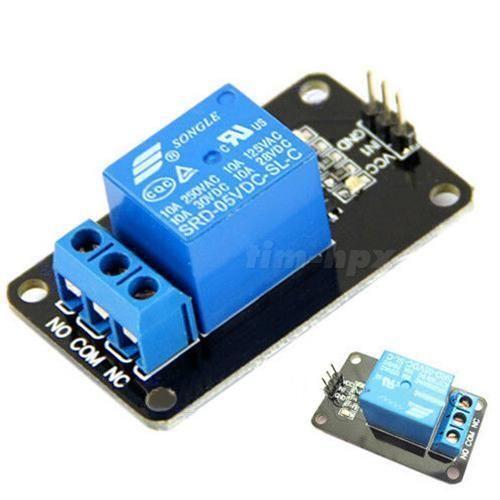
Is the relay for your heater controlling the main voltage input or is it controlling at the thermostat connection?
I've been wanting to do something similar with the units in my apartment (they're similar to what you'd see in a hotel window unit). The thermostat and controls are integrated and I can't disassemble to access them, so I either need to build a rig to push the buttons (hard) and turn the temperature dial or just put a relay at the mains and manually set them for AC\Heat depending on season. Adding a relay to the mains seems straightforward, but it's 220v and I don't want to mess up.
Solid State Relays (SSR) do work great. Internally they use an LED to close the switch rather than the mechanical coil mechanism used in the classic click relays; these are totally silent.
I am using one to turn on/off the mains power of a 12VDC transformer. The nice thing about an SSR with an input range of 3–30V (a common type) is that you can drive it directly (and safely!) from a Raspberry Pi GPIO pin (3.3V).
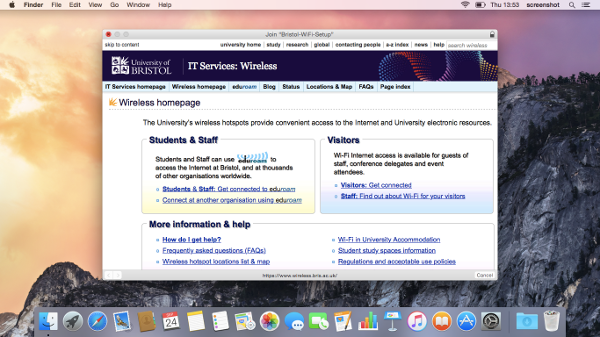
My iPhone constantly misses captive portals and I have to hunt for a non-ssl website. I can't say if it's 5% or 30% of networks, but enough to be frustrating. Does anyone know if it is common for apple.com to be whitelisted for iMessage or something?
The captive portal browser (pop-up on macOS, slide-over on iOS) doesn't support full JavaScript or cookies (or previously didn't, maybe that has changed), so some captive portals specifically allow the captive portal test domains through.
I've never seen a setting for it. It's just a modal dialog with a webview. Like iOS, you have "Cancel" as an option until it connects and changes to "Done."
Except some portals actively try to avoid intercepting any of Apple's methods for determining whether you're on one. You're much better off with an off the beaten path solution.
Any site that doesn't redirect to the SSL version (if applicable) will work. The benefit of using something like captive.apple.com is that it's specifically designed to NOT use SSL in order to trigger redirects and such, whereas something like example.com just so happens to not redirect to their SSL version, so it's (essentially) guaranteed to work vs example.com who could decide in the future to redirect to their SSL version if they want
If I regularly used that as a known-good site that should be up with no SSL, I'd trust that an apple-maintained site (backed by akamai) would be up before "example.com".
I'm sure there are plenty of others, but someone might remember that URL over another so I thought it would be helpful.
It's reserved for the purpose of documentation/illustrations (especially RFCs themselves) without fear of changes/invalid domains/directing mass traffic. It's also useful for establishing an idiom for those RFC examples.
example.com is maintained by IANA. It's an official example address for documentation purposes. So on one hand, it will survive even if Apple disappears, on the other, they're likely not expecting any significant traffic.
Using the site for captive portal access does not actually generate any traffic for the site, because the middlebox intercepts and rewrites the request. Traffic only occurs if there is no captive portal. Hence the easily parsed "Success" body of the Apple site.
Phones confirm whether you passed the captive portal by requesting the usual check url again. That means they'll still get one request after a successful login.
Yes, the project he talks about is OSMOCom, Open Source Mobile Communications. http://osmocom.org/ will give you a little more context. I'm assuming this would allow you to route data over these types of networks given the proper hardware in your own environment.
Thank you for that. This is quite interesting, I thought there were quite strict guidelines about who was allowed to broadcast on 2/3G frequencies? Or is this bandwidth not as controlled as others?
As "extrapickles" pointed out in another comment thread, the spectrum requirement for this is an even bigger hurdle than getting all of the expensive equipment together to pull it off. The tech requires an amount of frequency separation that spreads outside the bounds of the ISM spectrums, so you'd need licensing or would need to be running in a third-world country with no regulations (which is actually a viable use for the tech).
For the unaware, ISM = Industrial, Scientific and Medical. These are the shared unlicensed frequencies that the general public may use. Wifi falls inside of this range.
...or in a place where no one who cares can receive your unauthorised transmissions. If you're not interfering with anyone who has the "right of way" on those frequencies, then you might as well not exist to them.
This isn't anything out of the ordinary or directed at 4chan (like the tweet is trying to say, in my opinion). Google Analytics is free for up to 10 million hits per month and then they ask you to upgrade to premium. Most people just assume that Google Analytics is free forever but there is a limit. I would agree that 150k per year is exorbitantly high for that service, however.



I had moved a single-broker RabbitMQ from GCP to AWS and the instance type I chose had bandwidth "up to" 10Gbps. Being less familiar with AWS, I did not realize they will actively throttle based on credits because "up to" means "burstable to" regardless of available capacity. My messages are pretty large and I was running out of credits after about an hour.
Bandwidth was the last thing I considered since I hadn't had the issue on GCP. Switching to a larger instance with guaranteed bandwidth was a band-aid. Clustering to spread the load between multiple instances will be my longer term fix. Lesson learned, hopefully this helps someone someday.