"Initial unveiling of the newly designed globe came in the form of a leaked 27-page design proposal entitled BREATHTAKING Design Strategy,[6] which used such over-the-top language that some suggested that it was part of a viral marketing scheme."
I really don't get why people would want AI to write their messages for them. If I can write a concise prompt with all the required information, why not save everyone time and just send that instead ? And especially for messages to my close ones, I feel like the actual words I choose are meaningful and the process of writing them is an expression of our living interaction, and I certainly would not like to know the messages from my wife were written by an AI.
On the other end of the spectrum, of course sometimes I need to be more formal, but these are usually cases where the precise wording matters, and typing the message is not the time-consuming part.
> If I can write a concise prompt with all the required information, why not save everyone time and just send that instead ?
This point is made multiple times in the article (which is very good; I recommend reading it!):
> The email I'd have written is actually shorter than the original prompt, which means I spent more time asking Gemini for help than I would have if I'd just written the draft myself. Remarkably, the Gmail team has shipped a product that perfectly captures the experience of managing an underperforming employee.
> As I mentioned above, however, a better System Prompt still won't save me much time on writing emails from scratch. The reason, of course, is that I prefer my emails to be as short as possible, which means any email written in my voice will be roughly the same length as the User Prompt that describes it. I've had a similar experience every time I've tried to use an LLM to write something. Surprisingly, generative AI models are not actually that useful for generating text.
People like my dad, who can't read, write, or spell to save his life, but was a very, very successful CPA, would love to use this. It would have replaced at least one of his office staff I bet. Too bad he's getting up there in age, and this newfangled stuff is difficult for him to grok. But good thing he's retired now and will probably never need it.
What a missed oppurtunity to fire that extra person. Maybe the AI could also figure out how to do taxes and then everyone in the office could be out a job.
Well, you know this employment crisis all started when the wheel was invented and put all the porters out of work. Then tech came for lamplighters, ice cutters, knocker-uppers, switchboard operators, telegraph operators, human computers, video store clerks, bowling alley pinsetters, elevator operators, film developers, lamp lighters, coopers, wheelwrights, candle makers, weavers, plowmen, farriers, street sweepers. It's a wonder anyone still has a job, really.
Let's just put an AI in charge of the IRS and have it send us an actual bill which is apparently something that just too complicated for the current and past IRS to do./s
Edit: added /s because it wasn't apparent this was sarcastic
Shorter emails are better 99% of the time. No one's going to read a long email, so you should keep your email to just the most important points. Expanding out these points to a longer email is just a waste of time for everyone involved.
My email inbox is already filled with a bunch of automated emails that provide me no info and waste my time. The last thing I want is an AI tool that makes it easier to generate even more crap.
Definitely. Also, another thing that wastes time is when requests don't provide the necessary context for people to understand what's being asked for and why, causing them to spend hours on the wrong thing. Or when the nuance is left out of a nuanced good idea causing it to get misinterpreted and pattern-matched to a similar-sounding-but-different bad idea, causes endless back-and-forth misunderstandings and escalation.
Emails sent company-wide need to be especially short, because so many person-hours are spent reading them. Also, they need to provide the most background context to be understood, because most of those readers won't already share the common ground to understand a compressed message, increasing the risk of miscommunication.
This is why messages need to be extremely brief, but also not.
There was an HN topic less than a month ago or so where somebody wrote a blog post speculating that you end up with some people using AI to write lengthy emails from short prompts adhering to perfect polite form, while the other people use AI to summarize those blown-up emails back into the essence of the message. Side effect, since the two transformations are imperfect meaning will be lost or altered.
This is a plot point in a sci-fi story I'd read recently, though I cannot place what it was. Possibly in Cloud Atlas, or something by Liu Cixin.
In other contexts, someone I knew had written a system to generate automated emails in response to various online events. They later ran into someone who'd written automated processing systems to act on those emails. This made the original automater quite happy.
(Context crossed organisational / institutional boundaries, there was no explicit coordination between the two.)
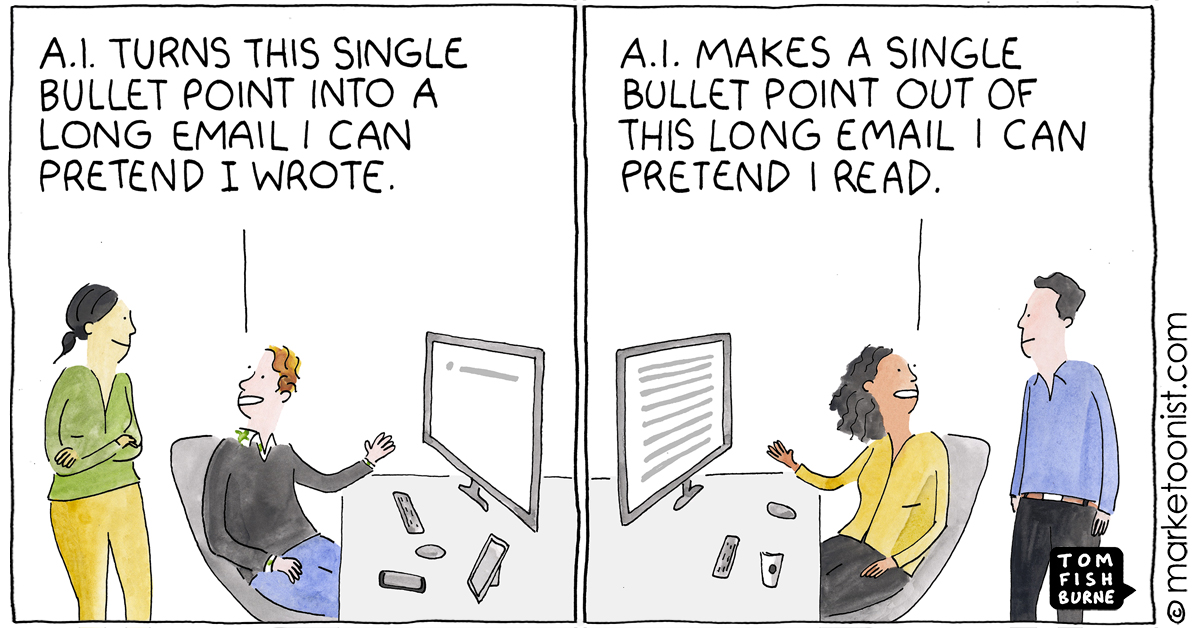
There's a cartoon going around where in the first frame, one character points to their screen and says to another: "AI turns this single bullet point list into a long email I can pretend I wrote".
And in the other frame, there are two different characters, one of them presumably the receiver of the email sent in the first frame, who says to their colleague: "AI makes a single bullet point out of this long email I can pretend I read".
The cartoon itself is the one posted above by PyWoody.
If that's the case, you can easily only write messages to your wife yourself.
But for the 99 other messages, especially things that mundanely convey information like "My daughter has the flu and I won't be in today", "Yes 2pm at Shake Shack sounds good", it will be much faster to read over drafts that are correct and then click send.
The only reason this wouldn't be faster is if the drafts are bad. And that is the point of the article: the models are good enough now that AI drafts don't need to be bad. We are just used to AI drafts being bad due to poor design.
I don't understand. Why do you need an AI for messages like "My daughter has the flu and I won't be in today" or "Yes 2pm at Shake Shack sounds good"? You just literally send that.
Do you really run these things through an AI to burden your reader with pointless additional text?
MY CEO sends the "professional" style email to me regularly - every few months. I'm not on his staff, so the only messages the CEO sends me are sent to tens of thousands of other people, translated into a dozen languages. They get extensive reviews for days to ensure they say exactly what is meant to be said and are unoffensive to everyone.
Most of us don't need to write the CEO email ever in our life. I assume the CEO will write the flu message to his staff in the same style of tone as everyone else.
I think you might be misunderstanding the suggestion - typically when people say "email like a CEO" they're talking about direct 1:1 or small group communications (specifically the direct and brief style of writing popular with busy people in those communications), not the sort of mass-distribution PR piece that all employees at a large enterprise might receive quarterly.
For contrast:
"All: my daughter is home sick, I won't be in the office today" (CEO style)
vs
"Hi everyone, I'm very sorry to make this change last minute but due to an unexpected illness in the family, I'll need to work from home today and won't be in the office at my usual time. My daughter has the flu and could not go to school. Please let me know if there are any questions, I'll be available on Slack if you need me." (not CEO style)
An AI summary of the second message might look something like the first message.
The problem is your claim is false in my experience. Every email I've got from the CEO reads more like the second, while all my coworkers write things like the first. Again though I only get communications from the CEO in formal situations where that tone is demanded. I've never seen a coworker write something like the second.
I know what you are trying to say. I agree that for most emails that first tone is better. However when you need to send something to a large audience the second is better.
Yeah, the examples in the article are terrible. I can be direct when talking to my boss. "My kid is sick, I'm taking the day off" is entirely sufficient.
But it's handy when the recipient is less familiar. When I'm writing to my kid's school's principal about some issue, I can't really say, "Susan's lunch money got stolen. Please address it." There has to be more. And it can be hard knowing what that needs to be, especially for a non-native speaker. LLMs tend to take it too far in the other direction, but you can get it to tone it down, or just take the pieces that you like.
>When I'm writing to my kid's school's principal about some issue, I can't really say, "Susan's lunch money got stolen. Please address it." There has to be more.
Why?
I mean this sincerely. Why is the message you quoted not enough?
I hear you. I get it enough to know it’s needed, but actually doing it can be hard. LLMs can be nice for that.
Being too flowery and indirect is annoying but not impolite. If you overdo it then people may still get annoyed with you, but for different reasons. For most situations you don’t need too much, a salutation and a “I hope you’re doing well” and a brief mention of who you are and what you’re writing about can suffice.
> But for the 99 other messages, especially things that mundanely convey information like "My daughter has the flu and I won't be in today", "Yes 2pm at Shake Shack sounds good", it will be much faster to read over drafts that are correct and then click send.
It takes me all of 5 seconds to type messages like that (I timed myself typing it). Where exactly is the savings from AI? I don't care, at all, if a 5s process can be turned into a 2s process (which I doubt it even can).
How would an AI know if "2pm at Shake Shake" works for me? I still need to read the original email and make a decision. The actual writing out the response takes me basically no time whatsoever.
An AI could read the email and check my calendar and then propose 2pm. Bonus if the AI works with his AI to figure out that 2pm works for both of us. A lot of time is wasted with people going back and forth trying to figure out when they can meet. That is also a hard problem even before you note the privacy concerns.
I sometimes use AI to write messages to colleagues. For example, I had a colleague who was confused about something in Zendesk. When they described the issue I knew it was because they (reasonably) didn't understand that 'views' aren't the same as 'folders'.
I could have written them a message saying "Zendesk has views, not folders [and figure out what I mean by that]", but instead I asked AI something like:
My colleague is confused about why assigning a ticket in Zendesk adds it to a view but doesn't remove it from a different view. I think they think the views are folders. Please write an email explaining this.
The clear, detailed explanation I got was useful for my colleague, and required little effort from me (after the initial diagnosis).
However, I do know people who are not native speakers, or who didn't do an advanced degree that required a lot of writing, and they report loving the ability to have it clean up their writing in professional settings.
This is fairly niche, and already had products targeting it, but it is at least one useful thing.
Cleaning up writing is very different from writing it. Lawyers will not have themselves as a client. I can write a novel or I can edit someone else's novel - but I am not nearly as good at editing my own novels as I would be editing someone else's. (I don't write novels, but I could. As for editing - you should get a better editor than me, but I'd be better than you doing it to your own writing)
When it's a simple data transfer, like "2 pm at shake shack sounds good", it's less useful. it's when we're doing messy human shit with deep feelings evoking strong emotions that it shines. when you get to the point where you're trading shitty emails to someone that you, at one point, loved, but are now just getting all up in there and writing some horrible shit. Writing that horrible shit helps you feel better, and you really want to send it, but you know it's not gonna be good, but you just send it anyway. OR - you tell ChatGPT the situation, and have it edit that email before you send it and have it take out the shittiness, and you can have a productive useful conversation instead.
the important point of communicating is to get the other person to understand you. if my own words fall flat for whatever reason, if there are better words to use, I'd prefer to use those instead.
"fuck you, pay me" isn't professional communication with a client. a differently worded message might be more effective (or not). spending an hour agonizing over what to say is easier spent when you have someone help you write it
I believe the strength of gravitational force would not be constant either, as your center of mass would still have a fixed location, so every point on the disc have different distances to that center of mass (in addition to not being orthogonal to the surface). But maybe it might be approximated with an infinitely long cylinder, so the center of mass is infinitely far away below the surface ?
The thinking in the other post, that the mass increases as you move away from the center, in a manner that the two effects cancel out, intuitively seems like it should be feasible. Remember that the center of mass is just an abstraction, you need to take the full integral over all mass to get the force vector at each point. And if you're closer to more mass further away from the center, which a shape like the one described above should give you, it might work. But one would have to do the math to be sure.
Edit: come to think of it, maybe that effect would let you adjust the direction of the force, too. Thinking about center of mass can be treacherous with more complex shapes...
French high speed trains are fast, for instance the average speed of the train on the Paris-Strasbourg section (~400km in length) is 250km/h. This is the global average speed, so it is even faster on the high-speed section, going at around 320km/h. I often take this train, which is very convenient.
To emphasize just how fast this is in comparison to regular rail:
When I was visiting France some years back and took the TER train on the way from Paris to Strasbourg (300mi / 500km), and that crawled. On the way back, we took the TGV, which flew.
If you look at booking tickets on SNCF's website, the difference is stark: about 5 hours via the TER, versus a little under 2 hours via the TGV. (From that perspective, it's a little funny to describe the TER as crawling, seeing as that's not meaningfully different from driving that distance.)
There are some portions of Amtrak that have comparable max speeds (notably, the Acela) but even then, the average speeds on those routes are nowhere near 200km/h.
I took the TER from Strasbourg to Paris just weeks ago (just 2 3rds of the distance for me because I was not in Strasbourg). It travels well over 100 km/h all the time and it makes only a few stops. That is only half or even less of the TGVs' speed, but still faster than by car. Definitely not crawling.
As I mentioned -- it's not actually slow in absolute terms! The experience is lodged in my mind because it took so much more time than the reverse trip, and it was sweltering to be stuck on a train with inadequate air conditioning on a rather hot summer day.
There are of course many benefits to taking even the TER over driving the equivalent distance: you don't have to be laser-focused on driving (especially in a foreign country where you might not speak / read the language or necessarily know the rules of the road), you don't have variation in travel times due to traffic (which, by driving, you would only contribute to), reduced per-passenger emissions, and so forth.
Some information online indicates that the non high speed train takes about 20 mins more than the high speed train on that route. It does not seem a huge time difference
The connection that takes 20min longer has two additional stops (the fast connection is a direct one) but it is still served by TGV or ICE trains, like the direct connection.
The distance between Paris and Strasbourg is >400km, so even the "slow" connection has an average speed of ~200 km/h. The actual regional train connection (TER) takes nearly 5 hours with plenty of stops in between. Slightly faster non-regional but non-TGV connections only exist on lines that are not served by TGVs.
This reminds me of Voyager buses in Ontario during the 80s/90s. They had two routes between Ottawa and Toronto.
One took maybe 6 hours. The other 12+ or some such. The 12+ hour took almost the same route, but stopped at every. single. town.
Woe to the person wanting to go from Ottawa to Toronto, and buying the wrong ticket. This is pre-Internet so research was less common and easy, and if you have no idea it could matter...
Why are there so many "Update Reamde.md" pull requests ? They all are named exactly the same, and most of the time add a single line to the readme with the name of the commit author. I guess some git tutorial somewhere shows how to open a PR with this repo as an example, and people actually do it.
I really don't know, I didn't measure it. It wasn't as fast as a QWERTY keyboard but it was fast enough. It was definitely way faster than typing using a 10 key numpad on a phone. Based on Steve's recommendation I had also tried a one-hand keyboard that was basically a half sphere with buttons for your four fingers and a number of 'shift' buttons for your thumb (basically all chord all the time) and I never got comfortable enough with it to use it for any length of time.
The etymology of "chauve" (bald) in "chauve-souris" (bat) is debated, but I've often read that it could be a deformation of a word designating an owl or a crow (it would be a cognate with the late Latin "cavannus" (tawny owl), for example).
On a similar note, the "cerf" (deer) in "un cerf-volant" (a kite toy) probably derive from occitan sèrp (snake) as a reference to dragon-shaped kites from Asia.
Religious exemptions bother me quite a bit as a non-religious person. Why can people demand special treatment because of "religion" but my beliefs don't count unless I an hiding behind religion. I don't think the beliefs of religious people are more valid or deserve more respect than mine.
Our whole existence is a religious subject. And everything we do while we exist falls under it. Also no, it does not have to be organized to be a religion.
Every vaccine available in the US was developed or tested using stem cells from aborted babies, and the J&J one is also manufactured with them. A lot of religions forbid intentionally benefiting from others' sins.
If the bit about others' sins was even remotely consistently applied, then adherents to that religion would simply not be able to participate in modern society.
Even the Catholic Church has given the A-OK for its adherents to take these vaccines. At this point, anyone you encounter citing a "religious" objection is more likely to be citing a personal preference.
Isn't religion supposed to be a deeply personal thing, not necessarily tied to some earthly institution or organization? What if I sincerely believe that complete and total bodily autonomy is a God-given right but I'm not a member of a church who shares my views, are my beliefs invalid?
> Isn't religion supposed to be a deeply personal thing, not necessarily tied to some earthly institution or organization?
You are asking the wrong guy, but I'd note that the person I was responding to mentioned sin. That implies some things about which religions he was including, and membership in those religions implies some other things about obedience to religious authority and so on. If you're in the clear with the Catholics and the Baptists when it comes to sinning, that covers a lot of ideological ground.
> What if I sincerely believe that complete and total bodily autonomy is a God-given right but I'm not a member of a church who shares my views, are my beliefs invalid?
As I implied in my other comment, I do think there's a distinction to be drawn between religion and personal preference. I don't have a really deep take on this, but I'd note that it wouldn't be the first time the law had to take these things into account. I do not know that much about this stuff, but I think being a member of a group (even the Scientologists!) helps if you want your beliefs recognized as religious beliefs. A problem prophets and mystics have had to contend with for quite some time, I imagine.