The capital gains / income tax rates have only a minor impact on the weight of growth in valuation models. One way to see this without getting to technical: there are a number of (very large) institutional investors that pay no tax at all (university endowments, charities, etc). If what you're saying is true, untaxed investors would have radically different allocations than similar taxed investors. That's not the case.
Just to take issue with one piece of this, the crash requirements do need to compete with commercial aviation, because in the customer mindset they will.
Probably parents realizing their children were making in-app purchases beyond what they (the parents) were aware of, and charging them back as unauthorized use. The cc processors pass that on to the merchant, and will drop them if there are too many. Likely Roblox just reached some critical mass where they couldn't sustain it any more.
When I read about the age verification system for Roblox, it immediately made me think of a post on the official Patreon blog from just a few days ago, talking about how they're going to have to start asking for identity verification for "adult/18+ creators" due to new standards from Mastercard. And, yes, this clearly isn't exactly the same thing, but the similarity in requirement combined with the timing make it at least fractionally more suspicious to me that this is driven by payment processor requirements -- or at the very least, whatever concerns are driving those requirements.
It's also worth pointing out that unlike Patreon's requirement for adult material creators, Roblox's verification is optional, which most of the discussion here on HN seems to be eliding.
> For now, only one feature requires age verification: Roblox's new voice chat feature. During its initial beta, it will only be available to players who verify they are at least 13 years old. But the implication seems to be that other features -- perhaps specific Roblox games or community tools -- could be age-gated as the company works to protect its relatively young user base.
There are two other reasons bike lanes don't have the kind of demand induction properties that roads do:
-Bike lanes (and ultimately, bike destinations) have way higher humans-per-square-foot of road / parking lot density than cars lanes. The throttling mechanism on behavior for the car example is ultimately drive time, and new lanes quickly become capacity constrained (first at the interchanges; later at the parking; last in the lanes themselves) in a way that slows ultimate travel back to the indifference equilibrium. The equivalent for bikes tolerates a way higher flow of humans.
-Induced demand for cars is in part a function of the fact that you can (up to a point) drive at any speed, meaning that if roads are added that support commuting in from 30, 40, 60 miles away, that can be a doable commute. There is no amount of development that will create a 60 mile bicycle commute. Here, the demand induction mechanism with travel lanes and housing is reversed: you need convenient housing to drive the demand for bike lanes.
The Embankment in London (Westminster to Blackfriars) lost one of its four vehicle lanes for a kerb separated two way cycle lane. It carries more traffic than the four vehicle lanes, but looks far emptier, which invited much complaint at first. I’m glad to see TfL are still building more cycle lanes, various types to suit the roads used.
It is surely true for the density part. However I have now seen bike lanes that are two years old that would be efficiently « unjammed » by doubling.
Another great aspect of bike density is that when you double the lane you allow way more traffic. When you are slow and small, you don’t need much space to overtake a slow electric bike.
The reason bike lanes do not have demand induction effects is because there is inherently low demand. A majority of the population cannot use bicycles for long trips, and even those who can cannot use them for all trips.
Bike lanes are ableist and classist. Only healthy citizens with an excess of time and energy are able to use them for trips. The elderly, children, those with heart conditions, asthma, or many other health conditions, and anyone needing to transport anything heavier than their own body cannot use the lane. In most cities this represents a minority of the population. Creating exclusionary space for bicycles is the opposite of progressive policy and efficient urban design.
If you look at other countries with a lot of bike infrastructure, you can see that your point doesn't really hold up to reality. First, reducing road usage so only those who can't use a bike (for whatever reason) helps everyone, since it allows more efficient transportation and encourages a denser city (see the linked post). (this partially handles time, in dense city centers bikes can be often faster already)
Most people can use an electric bike (this checks the energy part) and with electrical cargo bikes can transport a lot without a lot of physical exertion.
And, last but not least, for those who truly can't use anything bike-like the fan-favorite netherlands allows the use Canta, very small microcars, on bike lanes. These are way cheaper than cars and need less skills to drive, so elderly can drive them as well.
Way better than requiring everyone to drive couple tons worth tens of thousands of dollars after absolving an expensive and time consuming course on how to use them without injuring anybody or worse.
PS.
I don't know many children that can drive a lot on roads without a bicycle. That's a very weird example. I don't think many people advocate removing sidewalks in favor of bike lanes.
It’s unfair to consider electric bikes as most bike lanes are explicitly not designed for them. They operate at a higher speed than regular pedal bikes and are more dangerous to pedestrians and cyclists. We may as well suggest that everyone use electric motorbikes and then car lanes will carry much more traffic.
Also, obviously children are not driving cars. But they still use the road as passengers. It is much less common and mostly not possible to have children too large for a baby seat but too young to travel on their own (4-12 years old or so) using a high traffic bike lane.
> They operate at a higher speed than regular pedal bikes
They can, but don’t have to. Strange would be the market were bicycles only capable of going at 20mph or 0mph were used.
> We may as well suggest that everyone use electric motorbikes and then car lanes will carry much more traffic.
Good idea!
> It is much less common and mostly not possible to have children too large for a baby seat but too young to travel on their own (4-12 years old or so) using a high traffic bike lane.
Most parents are not physically capable of operating such a contraption regularly. I would hate my life if I needed to lug my kids in that contraption when I want to take them to the park, doctor, grocery store, or any life activities. In a bike lane with e-bikes and racing bikes overtaking me constantly
Hmm, maybe it would help if I added an electric motor. But my kids are still at risk of injury if I’m hit by irresponsible cyclist, it will be a horrible tangle of metal and limbs. So maybe we should be in some kind of enclosure…
The idea is that in such a city you don't need to lug around your children unlesd they're quite young. Children as young as 8 are fully capable of going to school, park, etc... on their own.
With some physical aptitude you can easily go 25-30km/h on a bog standard Walmart bike. On my unrestricted ebike I never pass 32 on a bike lane (if I'm going faster I just go into a car lane). So an ebike limited at 32 is no more or less dangerous than a normal bike. No need to build a car.
Anyways cyclist on cyclist injuries are much less severe in general than car on car.
In terms of traffic flow, I notice that there is a big difference in how terrain affects manual vs powered bikes. I am an avid cyclist, so I say this just to point out that humans tend to be power-limited, while machines tend to be speed-limited. I’ve observed, when my friend and I are out together, that we need to keep more space between us if we are on different modes of power, to account for the abrupt changes is our relative speeds when the terrain shifts abruptly.
Is the injury stat a guess or a fact? I wouldn’t have intuitively been willing to hazard a guess either way myself.
And when everyone adds enclosures i.e. ends up in a car, you’re at much more risk than you were before and have all the harms of car-centric urban planning.
The physical ability of people is historically specific and if people were to generally cycle most would be able to ‘operat[e] such a contraption’.
It is possible to regulate cycle lanes so that people don’t just zoom around irresponsibly. Curiously you don’t seem to consider equivalent risks from cars (can’t drivers act irresponsibly? is it preferable that they have several orders of magnitude more mass with which to injure people?)
Look at childhood independence (or childhood mobility) in car-centric cities vs bike+transit cities. The argument that children are more mobile in cars does not hold up to any real-world scrutiny.
It’s unfair to consider electric bikes as most bike lanes are explicitly not designed for them.
Where do you get this information? Sure they can go faster, but most folks here are decent about things and they sure help going uphill. It means more people can use the bike lanes - notably, people without the strength to go uphill.
an 8 year old is not too young to travel on their own to limited places. If your bike lanes are actually safe, it is safe for them. And realistically, most places let actual children ride on the sidewalk.
Kids too large for a baby seat can generally sit in a pull-behind wagon.
In several locations in the US electric bikes are speed-limited to 20-25mph (32-40 km/h). There's no reason you couldn't set the speed governor much lower to match human speeds.
At least where I live (Seattle) if I were to take up biking I'd need a electric assist, since the hills are absolutely massive and steep.
At least in Germany most electric bicycles are limited to about 25 km/h, which is about what normal cyclists manage on straight roads, anyway. It's definitely not unreasonably fast.
There's also the category of electric bicycles limited to 40 km/h, which are handled pretty much identical to motor scooters (require insurance, cannot use normal bike lanes, unless specified, etc.).
In the EU electric-assist bikes (which are the ones allowed in bike lanes) are limited at 25 km/h. Sporty normal bike commuters regularly are faster than people on them.
Electric light motorcycles replacing cars would be an absolute benefit to everyone. The biggest issue for those is range (density) and getting killed by a car.
This is wrong on so many levels. I’ve spent years biking in the Netherlands. People from age 7 up into their 70s ride their bikes regularly and safely - so safely that bike helmets are a total rarity. People ride ebikes and even gas mopeds on the bike lanes, and it all works out just fine. People drive electric mobility scooters in the bike lanes. People in wheelchairs have special adaptors that let them pedal with their hands and use the bike lanes. Your statement that most parents are physically incapable of moving their young children on bikes is proven false by the tens of thousands of Dutch parents who transport their kids in bike seats every day.
Bike travel is about as egalitarian as it gets. You can buy a serviceable bike for a couple hundred dollars, with basically no extra costs - compare that to a car, or even a bus pass, and it’s a screaming deal.
> People from age 7 up into their 70s ride their bikes regularly and safely - so safely that bike helmets are a total rarity.
Bike helmets are designed to provide some degree of protection in simple falls, meaning falls that are caused by lots of control as opposed to a collision with another object like a motor vehicle.
I've heard that older Dutch cyclists are dying due to head injuries that could be mitigated by using a helmet or riding a trike insured of a bike.
There have actually been studies done on this. The estimate I’ve seen is that for every year of life that would be prolonged by mandating helmet use in NL, 25 years of life would be lost from the loss of exercise by people who don’t take bike trips because they are put off by helmet wearing. This is a real thing that has to be taken into account.
The other interesting stat is that an hour of bike riding in NL carries approximately the same risk of head injury as an hour in a car in the USA. So, should we make all car passengers wear helmets? It would make them safer…
Would helmets in cars make them safer though? It's a different risk profile; I don't think you tend to fall out of your cars and hit your head?
I can't find any stats of prevalence of various types of injuries in cars, although it does seem to be a thing to get brain injuries in cars (whether that is due to impact or neck/head stopping I don't know)
TBH, I'm not in favor of requiring helmets, but given the fact that balance does tend to decline with age, I think that recommending that older cyclists ride trikes instead of bikes would be a good idea. Falling off of a trike is less likely.
i'm speaking from a european city (400k inhabitants) perspective, where everything is rather crowded compared to the american suburb commute.
> A majority of the population cannot use bicycles for long trips
well, bicycling _in the city_ is usually meant for short trips, but 95% of my trips are short trips of less than 10km.
> Only healthy citizens with an excess of time and energy are able to use them for trips
excess of time: on my commute i'm on average a lot faster by bike - no gridlock, no search for a parking spot
energy: carbs are cheap
healthy: cycling improves your health and fitness follows an S-curve. even if the ride is arduous in the beginning, it quickly gets easier
> The elderly, children
personal experience (biased): compared to driving, a disproportional amount of cyclists are elderly or children
> those with heart conditions, asthma, or many other health conditions
i don't know about that. a bike courier i know uses an asthma inhaler, but i haven't asked him about it.
> and anyone needing to transport anything heavier than their own body
you're right that there's a limit, but i can impose those same arbitrary limits on cars: "what if i need to transport X which doesn't fit in a car?"
> Creating exclusionary space for bicycles is the opposite of progressive policy and efficient urban design.
it's a safe space for cyclists who are not able or willing to ride on the road shared with drivers. i usually don't mind riding on the road, but as soon as i got my toddler in the trailer i tend to get rather touchy about safe cycling infrastructure.
i'm not sure what you're arguing for though. are you arguing for motorized individual transport, because the disabled, elderly, toddlers prefer cars? or public transport?
Public transit. A bus lane will carry many more people more efficiently. Cargo and emergency vehicles can also use this lane if necessary. Dedicated bike infrastructure such as protected bike lanes can generally only be used by bikes and other small vehicles.
bicycling and public transit complement each other (almost) perfectly. i don't see why you're advocating for "dedicated public transport lanes instead of bike lanes" as opposed to "dedicated public transport lanes and bike lanes".
> A bus lane will carry many more people more efficiently.
i think it's close. yes, you can cram more people on a smaller space in a bus, but the bus - and upping the lines frequency if necessary - is comparably expensive.
the big difference is, of course, personalized transport.
Yes, this. You bicycle to public transit, then either safely park your bicycle or load it onto public transit.
OP is attempting to find an opposition where none exists. Most people are not so wrongheaded, and where you find an advocate for safe cycling, you'll also find an advocate for public transit.
I'd be very happy to see dedicated bus lanes in my locale, along with bike routes. In my vivid imagination, the buses would be synchronized with the traffic lights, allowing them to move through town quite efficiently, even with stops.
Ours is a mid sized town, and we don't need a lot of dedicated bike lanes. For the most part, the cyclists find routes through neighborhood streets where there is minimal car traffic. Cars use the faster trunk roads. The only dedicated bike infrastructure are longer bike paths built on old rail lines, and in some areas where there is just no convenient low speed bike route such as a narrow artery between two lakes. And the long bike paths are at least partially if not primarily intended for recreation.
This sounds awesome, but I'm guessing can only work if there are few buses? (I live in London and can't imaging such an arrangement being even remotely workable around here.)
The trams in Croydon work this way. There's an induction loop on the tramway which detects an approaching tram, and tells the traffic lights to change to allow the tram to cross the road/junction.
Not everyone can drive: We still have roads. And honestly, I've met a few folks that couldn't drive but could bike if it had 3 wheels (physical limitations) and with the electric bicycles, the folks that cannot do it are becoming less and less. In any case, it is nearly impossible to include everyone in everything: Without this, more people are in harms way OR excluded.
Bicycle lanes are great for powered wheelchairs, and folks can go faster than foot traffic then. You can get such things covered for winter (I see it here in town). So long as you maintain them like you do roads, they can be available all year.
Around here, bicycle lanes are generally alongside foot traffic and have shortcuts. Busses are available, though.
I live next to a urban high school. In the before “school from home” times they installed a bike lane, then immediately had to install a lot more bike racks. These kids can’t drive and if they could there is no parking lot. I think it’s great.
I live near an urban elementary here in Norway: So many bikes are lined up at the racks outside the school and it seems the kids have fun afterwards while going home (usually in groups).
Bike racks are an often overlooked part of having bikes and I wish more places had them! If you cannot keep your bike safe while at work or the grocery store, it doesn't work.
I do suppose it really should say, "good, well-designed bike lanes" but as it goes, I'm just now realizing it and it is way too late to change.
The bike infrastructure I've seen in the US has been low or lacking entirely, but I really am never sure how representative it was: I lived in Indiana in small to medium sized cities. In the smaller ones, it really wasn't unsafe to just ride on the road anyway and bike lanes weren't so necessary. At least one city had a walkway/bikeway where railroad tracks used to be and lanes around the river, which made biking decently convenient.
Bruh. This is just incorrect. I am fat and asthmatic and commuted by bicycle all during college in Athens, GA and and by e-bike for about a year in Atlanta, GA. Cycling, especially e-bikes, is extremely accessible even for quite unfit populations. With my e-bike, rack, and paniers, I can do weekly shopping trips no problem as well.
Besides that, it gets cars off the road meaning that the disabled/unhealthy population you care so much about will have higher priority access to car infrastructure.
Thank you for sharing this. I just wanted to add that cycling helps improve fitness, and unfit populations could become fitter if they chose to cycle. This brings about multiple benefits and is not the case with other transport modalities (car, bus).
If the healthy and able population overwhelmingly traveled via bike, alternate forms of transit would gain too because currently they are being CRUSHED by the amount of road traffic in many cities. Busses that move at a crawl. At-grade trains limited by traffic intersections. Taxis and ambulances fighting traffic. Etc.
What a weird take. Bike lanes do not take away the possibility for those less able to use a car, they strictly add options. You might as well argue sidewalks are ableist.
> Bike lanes do not take away the possibility for those less able to use a car, they strictly add options.
But, that is true only if the bike lanes are “free to build and maintain”. Otherwise, the city is allocating money toward bike lanes rather than something OP would argue is “less ableist”.
Since bike lanes suffer way less stress due to less weight (to the power of 4!), they are a lot cheaper to build and maintain for the same throughput. But they do take some money, for sure.
(I know basically zero about city planning, although I have lived in cities for a decade)
The “roadway” itself is another fixed resource, I think? So, either the street gets a bike lane or another vehicle lane, but not both because there is only so much space between the two rows of buildings.
Yeah, that gets into the whole "take the space away from cars" thing.
My opinion is that in cities due to the much higher throughput of bike lanes it can also help reduce congestion, but if the bike lanes don't get used, e.g. due to a fractured network with "high-risk" shared road in-between or very unattractive gutter lanes, that doesn't really do anything. My hope is that cities would be aware of that and that it would only be a temporary thing, but the whole point that initiatives of Strong Towns and others like Not Just Bikes make (among others) is that many cities don't seem to have a clue on how to handle transportation, especially mixed-mode.
I am specifically considering removing traffic lanes on e.g. a bridge or a main thoroughfare in favor of bikes. This is common in New York where I live.
One particularly egregious example is removing a lane of traffic on the Brooklyn Bridge in favor of bikes. This is in my opinion an oppressive action in favor of the wealthy who live in downtown Manhattan and downtown Brooklyn.
The wealthy (and wasteful) are the people driving into Manhattan every day. Making the Brooklyn Bridge a viable bicycle route (the shared lane is constantly packed with tourists) will open a key route for people who can't afford cars to commute.
Have you seen how crowded the Manhattan bridge bike path gets, especially at rush hour? I don't deign to assume anyone's socioeconomic background, but it's also very clearly a wide swathe of the NYC population (I somehow doubt the folks on delivery bikes are living in the wealthy areas).
The bridge serves a large swath of NYC (south Brooklyn, Staten island, the Rockaways) and Long Island. Dumbo and downtown manhattan are upscale areas.
Were the city willing to invest in the project in a sane way, such as making a separate bike path like the one on the Manhattan Bridge or another tier, obviously it would add value. But as it is as a lane removal it's a lazy and badly planned move that snarls the middle class in traffic (which is already regularly backed-up onto the collapsing BQE) to allow the upper class to "enjoy" a "scenic" ride next to a bunch of smog blasting trucks. And maybe help a couple of door dash drivers I guess.
You're gonna call riding a bike, instead of a car, ableist and classist? Great, let me just go get an expensive to own, expensive to maintain, expensive to operate vehicle so I can really stick it to the rich.
Can you better explain the ableist remark? It sort of comes off like you're being mocking.
Show me one example of a city that is reducing transit in favor of bike lines and I might believe that's a legitimate concern. Almost always, cities that are looking to add bike lines are also looking to expand transit.
I think the reason more people don't use the kind of bike lanes we see in the United States is that they're not safe. Cycling in the U.S. means riding on roads with vehicles that aren't expecting bikes and that can easily kill you if the driver makes a small mistake. If you're lucky, some parts of that route will include a painted bike lane, and if you're really lucky that bike lane will be separated from deadly traffic by a physical barrier and won't be adjacent to a line of parked cars that may open their door at any moment and hit you. But neither of these "luxuries" are common in the U.S. or in most countries - bikes are simply an afterthought.
In that environment, it's no wonder that only more physically fit people will be likely to cycle, because you need some strength and agility to quickly course-correct and avoid danger. But these things aren't inherent to riding a bike. If sidewalks were a painted lane down the middle of the street people with disabilities wouldn't be safe walking on them (just as they are sometimes at risk on crosswalks), but that doesn't mean pedestrian infrastructure is ableist. As someone with a disability that prevents me from driving, I'm glad I have good pedestrian infrastructure in my city, and what passes in the U.S. for great bicycle infrastructure. But I wish I didn't have to share the road with cars.
> I think the reason more people don't use the kind of bike lanes we see in the United States is that they're not safe. Cycling in the U.S. means riding on roads with vehicles that aren't expecting bikes and that can easily kill you if the driver makes a small mistake.
The problem is that bike lanes are retrofitted on roads that are really not wide enough for another lane. As a result, you get a substandard width bike lane and more narrow general purpose lanes that don't slow down traffic.
This results in close passes and less margin for error.
> if you're really lucky that bike lane will be separated from deadly traffic by a physical barrier
The problem with physical barriers is the fact that they don't continue through intersections. Cyclists are lulled into a false sense of security and don't pay attention to traffic as they approach the intersection. Motorists are likewise not paying attention to cyclists on the barrier separated path. Then both are caught by surprise when their paths cross.
The best option is to just take the lane and follow the rules of the road for drivers of vehicles. You get noticed and you don't have conflicts at intersections. You don't need to be physically fit to do it (other than be physically capable of riding a bike).
> The best option is to just take the lane and follow the rules of the road for drivers of vehicles. You get noticed and you don't have conflicts at intersections. You don't need to be physically fit to do it (other than be physically capable of riding a bike).
Most people won't be comfortable doing this for the simple reason that they'll be going slower than surrounding traffic and it will piss of drivers, which is scary when you're on a bike and they have two tons of metal right beside you. If the safest way to do something is mildly terrifying and generally viewed as antagonistic, we can't be surprised that most people will avoid doing that thing.
I've really been inspired lately by watching the videos on this channel about urban design in the Netherlands: https://youtube.com/c/NotJustBikes
I didn't realize how much urban cycling raises my blood pressure until I watched this video that compares a journey in Canada to a journey in the Netherlands, it's hard to imagine cycling being so safe and easy outside a college campus: https://youtu.be/M8F5hXqS-Ac
> Most people won't be comfortable doing this for the simple reason that they'll be going slower than surrounding traffic
People, in general, aren't comfortable engaging in an activity they don't have experience with. A motorist who drives a car for the first time in traffic is not comfortable.
Comfort and confidence come with experience.
> it will piss of drivers
Based on first hand experience riding a bicycle while taking the lane in traffic for more than a decade is that it's a rare occurance. My estimate is that someone shows their frustration maybe once every several years.
On the other hand, riding near the edge or in a substandard width bike lane will result in frequent close passes and frequent close calls with turning traffic (weekly, if not daily).
> which is scary when you're on a bike and they have two tons of metal right beside you
The same rationale could apply to motorcyclists versus motorists in cars, SUVs, and pickup trucks. In fact it can even apply to the latter versus bus drivers, dump trucks and tractor-trailers.
But the way that traffic consisting of vehicles that have different sizes, masses can all share the road is because the drivers follow the same set of rules. It also works for cyclists.
> If the safest way to do something is mildly terrifying and generally viewed as antagonistic
Based on first hand experience, I don't think these assumptions are really valid. If that were the case, then we wouldn't see cyclists on the road at all. But, there are many locations where cyclists ride on the road without bike lanes or separated paths.
> we can't be surprised that most people will avoid doing that thing.
Whether most people will engage in a particular activity should not affect the best practice from a safety and efficiency standpoint. For example, the motorcycle safety foundation focuses on bike handling skills and defensive driving. They're not trying to get more people to use motorcycles for transportation, nor are they trying to get infrastructure built specifically for motorcyclists on existing roads.
Similarly, we should focus on education for cyclists in terms of how to use the existing road network to get to their destinations rather than focus on piecemeal infrastructure that really makes things more dangerous for them by reinforcing bad riding habits that are unsafe.
Lots of comments here on the causal side of elite production, but just to float an alternate possibility:
This could just as easily be suggesting that "overproduction" of elites is due to, some two decades prior, a creeping sense among the populace of nascent but growing inequality and increased stratification? Or put differently, "Grandpa worked in the plant and made a good life for himself, and I work in the plant and make a good life for my family too, but I see the writing on the all and am going to make certain that my son or daughter becomes a [lawyer/banker/software person/etc]". And the instability today is just that initial rising inequality reaching fruition.
Something like that seems much more likely to me, that creeping change exists that is palpable at the individual level, and expressed through the emphasis given to the next generation.
This aligns with the experience I and my parents had growing up in the US. My grandparents worked in factories and did relatively well for themselves, living in the same town in Connecticut that their grandparents worked in as farmers 2 generations prior. They had the notion that factory life wasn't wear the future was and pushed my parents to go to college in the 70s.
By the time I was growing up in the 90s and 00s just 2 towns over the very notion of factory work as a viable career had vanished. Everyone was prepped to live in a 2-tier system of college goers and those who weren't heading to college.
Flash forward to now and it turns out that it was only certain types of college that paid off and everyone else went into unstable service jobs or unstable non-technical disciplines.
If we're building a meritocracy that feels like a lottery people are going to be angry. If it works like a lottery, then the people with the most tickets are going to win every time.
I think it was pretty apparent back in 2012 when I was picking college majors that it was essentially engineering, economics, medical, or you're going to have a rough time.
I suspect the mentality started to shift after the '08 crises. But I know quite a few undergraduate "business" majors who weren't able to find remunerative work from that era.
There’s a lot of hidden correlations in that stat.
It’s almost certain that it includes individuals who went on to get MBAs which open big doors in terms of compensation. Would love to see how this stat breaks down by cohort.
70s through 90s wiped the blue collar middle class off the map, there are no other options outside of non-MD healthcare work if you want income that even begins to keep up with inflation. Its gigs and part-time work from there.
Edit: to be clear, I'm agreeing and saying people definitely had time to see the writing on the wall
I saw a lot of people in the trades barely scraping by 5-7 years ago when housing was bottoming out. Housing stock is growing at something like 3x population growth in the US right now. A few more years of that and they may be back in the same situation. Being employed in a heavily cyclical industry definitely has rich years, but it's also got lean ones.
However the housing stock grows, the remaining stock needs maintenance anyway.
So, well, indeed, a good plumber should not see extremely lean years.
(Anecdotally, my son works as a building systems maintenance engineer, without a college diploma. Of course the market for such jobs ebbs and flows, but seems to never dry up: city buildings still need their elevators, HVAC, fire alarm, access control, etc systems working, no matter what.)
Housing starts are at ~1.7MM units/year right now, that's enough for about 4.5MM people at current household sizes. US population growth was 1.6M in 2019 and <1MM in 2020. Even with generous estimates on losses of existing housing, I don't think 3x is appreciably off.
Maybe it has something to do with the fact that more than half of the younger generation are currently living with parents [1]. Not because they necessarily enjoy it, but because they can't afford their own home.
Building more housing should lower the effective price of it, and allow many new home buyers or renters to enter the market.
A lot of the construction boom is probably attributable to the new found geographic freedom COVID gave, coupled with the low interest rates from the Fed's monetary policy. There was a sudden mismatch of locale supply and demand. Housing starts were also quite low over much of the last decade, definitely below the equilibration point for 2019-2013.
It'll be interesting to see how things play out. I think the shift of older millennials out of cities combined with the relatively smaller generation replacing them will likely cause a reversal of a lot of the urban price growth in the past decade in places like New York. Rents are already reflecting that, but sales prices have more hysteresis.
I've read since 2008 LA has added 5 jobs for every new unit of housing. I'm sure other places in CA must be just as bad with how they've been building for the past decade. It feels like we are so far in the hole in many cities, I'm not sure how much overbuilding it would take to right the ship and make housing affordable to the median wage earner again.
When GP said business owners I assume they included independent plumbers. I can call the local plumbing franchise and I will pay $150/hr, but the person who shows up at my door is not making anywhere near that.
My friend works for a home security company. They bill $150/hr for labor and he makes $26/hr.
Compared to other countries, Australia is an outlier for tradesmen income, by far. The closest comparison I can think of is software engineer income in the US vs everywhere else.
Working in a trade in Australia is lucrative AF, if you're looking for a way to be relatively wealthy only a couple of years out of high school, apprentice as a shipwright, elevator technician or HVAC technician.
That may not be a lot of money wherever you live, but a married couple both making close to that are borderline rich where I live. A single person making that is above middle class. Of course a nice house can also be had for $150k.
And yeah, my carpenter got his HVAC, electrician, and plumbing licenses in prison and now runs his own business with family members and makes a lot more than I do, but it wasn't by luck or fortune. Anyone could have done what he did (skipping the prison part), if they didn't mind working hard.
That's not a lot of money, period, considering the hours and the inflation due to overtime. Consider too that that is the median - many are making far below that.
Most people making money in trades make most of it working more than 40 hours a week, or, like you said, runs his own business (which is completely different. That is no longer a "carpenter" plying his trade.)
> Anyone could have done what he did (skipping the prison part), if they didn't mind working hard.
This is just not true and stated as fact. There is no evidence of this. We have no idea how capable this man really is. I know lots of dumb tradesmen and lots of brilliant ones. He should be proud of what he's done because it isn't as easy as you say.
Overall that doesn't make much difference. The bottom decile of business owners makes much less and the top decile makes much more. The majority in the middle makes about the same as they would if they were an employee.
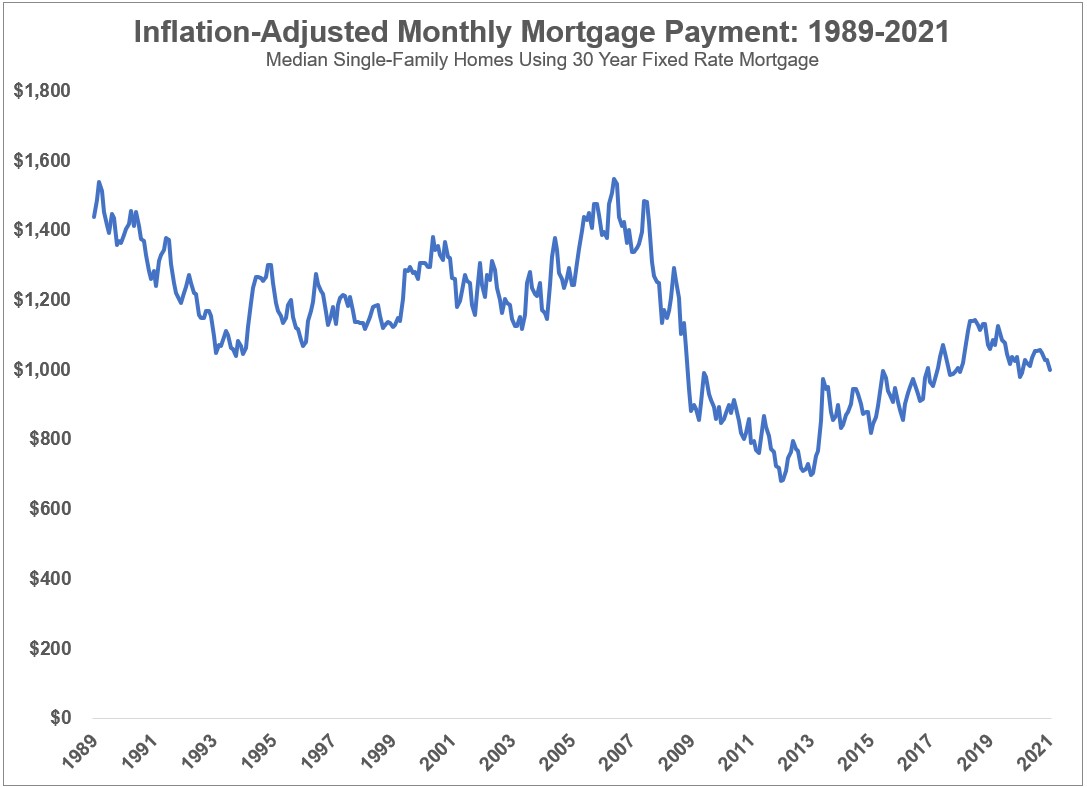
Part of that change is artificial. Mortgage interest rates have plummeted, which have caused prices to go up. The real median mortgage payment is about the same over the last 50 years.
This, unfortunately, also implies an explosion of interest rate risk. Given a fixed monthly payment, I'd much rather be paying it at high rates that have a good chance of dropping, than at low rates that have a good chance at rising.
Edit: Thank you, Americans, for your perspective! I understand now that you have fixed rate mortgages there. That's, for better or worse, not the case in Canada!
Ah, my perspective is coming from Canada where every mortgage is variable rate. ("Fixed rate" mortgages are only locked in for five years).
One would think that would cause US real estate to appreciate much faster than Canada when rates are low, but the opposite is the case. Strange days indeed.
* In Canada you technically can get a 25 year fixed mortgage, but the interest rate is 8.75%. That's a massive premium and I've never heard of anyone doing that.
If you want your monthly payments to be low initially, and you intend to pay off the mortgage debt fully within 5 or 7 years, then a 5/1 or 7/1 ARM can be a good option.
I don't understand this allergy towards debt. Oh no, people had the option to take out a loan to access capital they wanted to invest in themselves. If only we could be like the Europeans instead and waste public money to fund whatever stupid whimsy someone fancied rather than make them responsible for the productivity of their choice.
>70s through 90s wiped the blue collar middle class off the map, there are no other options outside of non-MD healthcare work if you want income that even begins to keep up with inflation.
Is it? According to the CRS[1], real wage (ie. inflation adjusted) growth is up 6.5% even for the bottom percentile.
Ah, my information was bad. The study you originally cited specifically mentions CPI-U as the measure they were using.
I assure you I wasn't lying, and thank you for the correction. (perhaps consider not jumping straight to the lying accusation in the future).
There's still a conversation about housing taking up an increasing share of the pie that doesn't exactly shine through in that top line number, but no point in belaboring it.
> Ah, my information was bad. The study you originally cited specifically mentions CPI-U as the measure they were using.
well the BLS publishes a bunch of CPI numbers, but "the" CPI is just CPI-U. The others are even more specific (eg. CPI-W for clerical workers or CPI for the elderly)
>There's still a conversation about housing taking up an increasing share of the pie that doesn't exactly shine through in that top line number, but no point in belaboring it.
The rise in housing prices has mostly been canceled out (or caused by?) low interest rates. After you adjust for interest rate and inflation, the monthly payment for a house (ie. the price you actually pay) has actually gone down from the 90s.
> The rise in housing prices has mostly been canceled out (or caused by?) low interest rates. After you adjust for interest rate and inflation, the monthly payment for a house (ie. the price you actually pay) has actually gone down from the 90s.
Only if you ignore the tax side of things, housing interest payments are deductible where principal payments aren’t. That ends up having a huge impact when inflation and interest rates drop. It’s not uncommon for mortgages to be less affordable over time. A bump in interest rates without could really mess things up.
> That ends up having a huge impact when inflation and interest rates drop.
How so? The chart in question is for 30 year fixed rate mortgages. You're going to be making the same payment every month regardless of what direction interest rates move.
The mortgage income tax deduction means paying interest comes at a discount, paying principal doesn’t so the effective nominal payment increases over time. However, when inflation is high after 10 years the mortgage becomes trivial to pay. That dramatically increases housing affordability over a lifetime. Making a stretch purchase becomes reasonable, but if inflation is very low making the same nominal payment becomes less affordable every month.
Worse insurance and property taxes are indexed to value and don’t care about inflation. Further people can’t make the same down payment when property values increase. Identical down payments at different interest rates don’t lower monthly payments equally, and at ultra low interest rates their not even a good investment.
Housing is not included in the CPI. The housing figure is Owner's Equivalent Rent. They survey owners and ask them what they think that they could rent their home for.
They do include actual rent costs, but the weighting for rent costs has 1/3 of the weighting of Owner's Equivalent Rent. The CPI-U provides an tiny weighting of rent compared to the real rent costs for anyone who is actually renting.
I'm not sure what report your read, but that report very clearly states the following:
> Real wages fell for workers with lower levels of educational attainment and rose for highly educated workers. Wages for workers with a high school
diploma or less education declined in real terms at the top, middle, and bottom of the wage distribution, whereas wages rose for workers with at least a college degree.
And that is before you start looking at issues with the CPI-U and how it's price weighting compares to real expenses faced by blue collar workers.
Dont you know that equality is a critical aspects of social satisifaction. See everywhere, equality is mentioned as the magic word that described the sacred value of liberal society...
But
It's never applied to personal wealth...
Your thinking is precisely the ludicrous disconnection between the elites' idea of society and the reality... (I am not saying you are elite, just that elitism thinking is so blindly superficial...)
BTW, equality in personal wealth is emphasized nearly 2000 years ago by Confucious 不患寡而患不均.
How is this relevant? The parent poster made a testable statement ("there are no other options outside of non-MD healthcare work if you want income that even begins to keep up with inflation"), and I disproved it by pointing out that even the bottom 10% of Americans are keeping up with inflation and then some.
Software engineering isn’t blue collar work. “A blue-collar worker is a working class person who performs manual labor. Blue-collar work may involve skilled or unskilled labor.” https://en.wikipedia.org/wiki/Blue-collar_worker
Plumber or nurse sure, but staring at a screen or moving Post-it notes isn’t physical labor.
While wrenching on a car is indeed manual labor I feel like it can take similar levels of mental effort, background knowledge, and training as junior dev work. So the parallel isn’t entirely off base. I believe the OP’s argument is that there are new classes of work that didn’t exist back then. Perhaps they’re not as cleanly sorted into white and blue collar lines as before but they occupy similar places in the socio-economic status positioning.
Being a mechanic is extremely repetitive. Occasionally people are faced with something odd, but it’s mostly a checklist job because identical makes and models generally run into the same issues.
Or as a childhood friend out it. It’s boring, but I can zone out and work with my hands.
Where is cost of living in this analysis? In the Midwest you can still have a nice quality of life with any decent job. Yeah sure, you can’t have such things in SF, NY or LA like maybe you could in the 70s.
There is no such thing as a free lunch and so reduced real estate costs bring with it an environment of potential poor local governance, poor job market, neighbors that do not share values that are conducive with rising home prices.
A most recent example is poor compliance with things that benefit the masses (ie. Vaccine, mask etc.)
I suspect the next thing will be poor compliance with switching over to energy efficient power generation as the world moves to clean energy + things implemented to discourage clean transportation (ie. extra taxes on EVs/banning solar installs without major caveats). All these boneheaded things drive down the cost of the real estate to its true market value.
We should consider another alternative - elite overproduction correlated with very wealthy societies, and very wealthy societies revert to the mean. So overproduction of elites correlates to decline, and correlation is not causation.
And attaching my pet theory - China has transformed their society, radically for the better, in 1 generation. As far as I can tell the American press has taken no interest whatsoever in seriously figuring out what happened beyond very surface level analysis. Are the policies that worked in Asia even serious contenders for implementation in America?
>Are the policies that worked in Asia even serious contenders for implementation in America?
No. The US prioritises corporate profit over everything else - even to the point of sacrificing its hegemony.
China just wants to be powerful.
China realized a long time ago that that is the American achilles heel and exploited it by creating long term economic dependency on them in exhange for short term profit.
It's only the last 10 years of China's economy that sparks interest/fear/competition in western minds and often the press is slow to pick up that something is different.
The Soviet Union, and Japan both threatened U.S. economic hegemony, but ultimately saw growth stagnate when the economy ran out of people to throw at the growth engine.
China is starting to look like they can keep the growth engine running even in the industrialized city centers, creating new products and services which rival their western counterparts. If this continues then China could reasonably rival the US and EU on both standard of living as well as total economic power.
There are many wealthy societies that keep growing instead of declining, and many poorer societies that get stuck in a trap and decline. That's the billion-dollar question wrt. China that nobody knows the answer to: will they keep growing and reach a Western-like standard or will they fail to pursue the reforms they would need and get stuck with a middling average income, like so many countries in South America today?
As for the policies that worked there - Deng Xiaoping said "black cat, white cat, if it catches mice it's good cat". But today the popular thing in America is to talk a lot about the ideology of being black or white, and just forget about that catching mice thing.
implying that this is the pinnacle? May be it is possible that they blaze a new way. May be it is possible that they remain as they are, for extended periods of time, or become the next super power.
Increased stratification is largely driven by rewards to technical skills, and technical training/STEM degrees are not the main source of "elite overproduction" by any stretch. Quite to the contrary, this is basically all coming from an extremely traditional idea of education (some would say many centuries or even thousand years old) positing that there's some sort of inherent merit to being an "intellectual" (whatever that might mean) being "socially aware" (again, a very fuzzy idea) or musing about "the human condition", even whilst actual technical merit is broadly disparaged as "beneath" one's perceived station.
It also corresponded with massive illegal and legal immigration entering the labor force of over 50 million individuals (unions were always against immigration for the labor supply competition reason). In addition, there was not a commensurate increase in housing stock in many urban centers and areas leading to more of your income swallowed by rich landlords.
To be fair the immigrants have a much better life in the US, and if you're worried about the US population dropping, boy would it have dropped more without that immigration wave.
My theory has always been that the decoupling was due to the effects of exponential population growth becoming more linear in the 50s (and taking ~20yrs to kick in). When population growth is exponential everyone has opportunity to "move up the ladder". As the growth rate flattens, demand drops and things get more competitive. This combined with an economic/fiscal focus on GDP and "the stock market" meant workers wages had to bear the brunt, thus leading to a number of things like union busting.
This question surprised me. In that any one could read a random comment on the internet as anything other than opinion? There most certainly arguments to be in support or against (Reagan busting up the air traffic controllers is an easy example from that era) but the entire notion is clearly one sided and clearly not fact.
>In that any one could read a random comment on the internet as anything other than opinion?
Maybe? eg. something like "subprime mortgages caused the 2008 recession" would qualify as a fact. Maybe what the parent poster said was the academic consensus among labor economists, or is at least a serious competing theory among mainstream academics (ie. not something that only a few marxist economists believe).
I'm puzzled by this comment. You're seemingly trying to explain a secular trend sweeping across the Western world by pointing to a single short-term event that occurred in the U.S. and was but tangentially related to what's actually going on (returns to highly skilled labor have been going up, not down as we might expect from union busting activity!) That doesn't really make much sense, tbh.
The causal event for that was the discovery that the USSR was a hollow giant and the red scare not based in reality. After that communism lost alot of its fear-factor and a take-over was becoming ever more unlikely.
Time to hit the history books. 1980s the fear propaganda was still strong, but the three letter agencies had enough material to pass judgment on the USSR.
The three letter agencies may have known better, but they weren't setting wages for the country. And, as you said, "the fear propaganda was still strong". So I don't think your position can logically work if 1979 is the year things started to change for wages.
How would anyone possibly change the perception that you have to be a lawyer or MBA or you're useless? When looked at the way you suggest, this problem is enormous. I'm not sure we'd ever solve it. We just have to accommodate ourselves to a society with lawyers, MBAs, and software people everywhere.
Grows the pie, but only for people on the right side of the inequity divide. I would say tech is winner take all more than almost any other industry I can think of.
So for the people feeling the pressure of the inequality divide, there's little difference between these two. Unless they join the ranks of lawyers or engineers, there's nothing in it for them monetarily speaking.
The people get services that were unimaginable (or expensive and inferior, e.g. dedicated GPS navigators) for free, money-wise. If Google/Facebook/Amazon/... weren't providing value, they wouldn't be making so much money off the people who choose to use them. Tech is actually as close as it gets to literally creating and giving everyone free stuff, as far as the pie goes.
The theory is based on historical data, and I doubt that an end to middle class blue-collar work would apply to all that many historical cases.
But you might be onto something - elite overproduction could be a concession made by an elite that's facing a potential uprising - whether it's youth unemployment or a weak king or new technology arming the peasants then allowing the most ambitious potential revolutionaries a chance to advance into the elite is probably a good stalling tactic (but will eventually fail).
It's like if a company starts making everyone a "manager". Maybe the leadership is incompetent, and they are more focused on management than work. Maybe they are trying to raise morale by handing out pseudo-promotions. Maybe they can't attract new workers without giving them attractive job descriptions. Whatever the case, it's unlikely to be sustainable (either the management will collapse under its own weight, or the workers will realise their new titles aren't worth what they thought they were).
And yet it doesn’t look like highly educated but low paid people are the main source of instability. Kids wanting to take down statues do not cause more instability than football hooligans, and as such can be easily handled by the police.
Trump, Brexit or other forms of populism (say Le Pen, AfD, ecc…), which are the main source of political instability in the West, identify their enemies in the “intellectual urban elites” and look for support in the mythological “disenfranchised white working class”.
>It's surreal to see people minted with money for life and yet deliver so little value. That sort of arbitrage usually only happens on Wall Street.
This must be a joke? The multi million-dollar exit with zero actual earnings is an almost uniquely tech phenomenon. There are Wall Street-ers that earned high pay for generating high earnings that many years later were found to be value-destructive, but at least at the time they were paid, they were cash-generating. That Wall Street jobs paid so much was because comp was structurally a function of cash generated.
The difference between “selling a growth story” and “selling current profits booked by incurring future liabilities” seems entirely like a semantic one. What’s the practical difference?
I read a study a while ago arguing that reactor cost was as expensive as it is because nuclear plants are so large, complex, and infrequently built that each project is essentially bespoke.
This ignores the fact that everywhere (including countries where wealth taxes are implemented today), there is a floor below which the tax does not kick in.
Very much. The numbers politicians have thrown around have had floors from 100 million to a billion. If Graham is speaking to the interests of future 100 millionaires I think most of them should be far more concerned about the country they live in when they almost assuredly never get anywhere close to that ceiling. For the few who do, who can shed tears when someone with 100s of millions is thwarted by government policy from reaching levels already so far beyond that which would compromise the happiness of an extremely privileged person. Nobody realistically suggesting something that is going to blunt startup Johnny's adventure to make enough money to buy a huge condo in SF, a Rolls Royce, a yaht, and a private waitstaff, if that is what Graham is raising alarms over. Johnny can keep dreaming.
This. What all of these taxes accomplish is preventing people from becoming wealthy. In this way it benefits the people that are already wealthy by making it that much harder to climb the wealth ladder. Many of the tax increases on the "rich" really just tax the upper middle class and do nothing to tax people that are actually wealthy.
If you want to tax the wealthy, then simplify the tax code and remove loopholes and deductions. Leave rates alone.
No, but they also wouldn't be that effective at taxing wealthy people that would structure their wealth to avoid the tax. That's the issue. You either lower the limit to the point where you capture the upper middle class, or you don't get any revenue because wealthy people can avoid the tax entirely.
Yeah, exactly: The floor is not going to be "100 million" for very long before they have to drop it to "100 thousand" because the people with "100 million" can change the way they structure their wealth faster than the regulators, because of regulatory capture and they'll need that money from somewhere. The upper-middle class carries almost the entire tax burden of the U.S. It's hard to boo-hoo about when you've got 2 cars, a single family home, etc. but it has an enormous negative impact on the economy to punish one tier of the economic ladder so hard.
All breakpoints in tax systems contribute to market inefficiency, because they incentivize manipulating your finances to stay below breakpoints instead of maximizing efficiency. It would be better to apply a flat wealth tax and correct for the regressive effect of decreasing marginal utility of money with UBI.
That doesn't make sense. Once you hit a threshold, usually the amount of money below the threshold is taxed at 0% or a lower percentage, then anything earned on top is taxed at a higher rate. You still earn more money by earning above the threshold.
That's still a discontinuity in the marginal value of income. You don't need the slope of the post-tax income:pre-tax income graph to go negative for there to be inefficiency. Any sharp change in the curve is enough.
Where's the incentive to fiddle your taxes? Yes you can donate your money to bring yourself into a lower tax band but you will still never have more in your bank account by doing so. e.g if there is a system where tax is 10% then it goes up to 20% at a $100 income. If I earn 99 then my take home is 89.1 (99 * 0.9) if I earn 101 then my take home is 90.8 (100 * 0.9 + 1 * 0.8). Yes, the effective tax rate is higher but I can never take home more by deliberately earning less money.
Note: I am note defending any previous arguments, just trying to make a fact clearer.
Your calculations was right in that idealistic tax system, but the real world is really messy with lots of exceptions, Tax credits, Benefits, and such.
Building on your example, I will add a little Child Benefit to make a slightly less ideal idealistic-scenario.
I chose this example because I remember vividly a story about a family in the UK that avoided getting promoted because their take-home would decrease. Of course it have to be a very small promotion in order to not be worth it. I don't know if cases like this is rare in the US, but it is generally a thing.
You're forgetting benefit cliffs which are a large chunk of the discontinuity problems. Any benefit that does not have a gradual phase-out (like subsidized health care plans) will lead to these discontinuity problems.
if you make $100,000,001 under a 100 million wealth tax at 1%, you pay $.01, not $1,000,000.01 so there is no point trying to stay under 100 million.
Further, a flat wealth tax has immense inefficiency in that it forces people with $100s or $1000s of dollars to their name to calculate their wealth for a $1-$100 payout to the government rather than do something productive with their time.
Turmoil, yes, but internalized to the corporations impacted. One of the major impacts of the financial crisis a decade ago was the massive increase in private equity ownership of real estate. Groups like Blackstone (BX), the largest residential landlord in the US, may take a hit. Not covered in the article (but referenced elsewhere on HN lately), you're seeing even worse trends in retail-focused commercial mortage backed security portfolios. REITS like Simon (SPG, a mall operator) have been cut in half since pre-COVID.
Your question, though, is presumably around whether we'd expect problems with systemically important banks. Highly unlikely, for two reasons:
First, regulatory changes to their capital structures largely prevent them from holding things like CMBS on their balance sheet unless they reserve significant amounts of capital against it. This is what facilitate the rise of private equity landlordship: banks exited the business.
Second (and this has, largely, already happened) the Fed and other central banks learned their lessons well, and were swift and comprehensive about backstopping the financial markets.
Third, Dodd-Frank domestically and Basel III rules internationally make banks hold far more safe capital on their books precisely to cushion against a shock like this. Turns out those rules work.
Here’s the question I’m trying to answer:
Do current stress tests contemplate a scenario of the same magnitude as 1/3 of US renters simultaneously missing payments?
The stress tests are designed by the Fed and specify what happens to 28 variables such as unemployment and GDP. The description of the scenarios can be found in [1] page 14. Rent delinquency rate is not one of them, but there are 2 real estate indices, House Price Index and Commercial Real Estate Index. The House Price Index under the Fed's severely adverse scenario is supposed to take an instantaneous hit from 280 to 200 and then to keep sliding down from there for 2 more years and reach a minimum of about 150 (I'm rounding all the numbers a little). What happened is the HPI was flat during the Covid19 crisis [2] page 7. Something similar happened for the Commercial Real Estate Index too: the Fed prescribed shock was very large and the actual index barely moved.
Related question: What's the tech here that this can be accomplished (streaming data via satellite) without spectrum? Spectrum assets are some of the most valuable assets in the US (and are owned by Verizon et al). Satellite phone networks (LightSquared is the big one) have been stymied in the past by unavailability of spectrum and US Govt. concerns about interfering with GPS.
They're using frequencies in the 10.7 to 30.0 GHz range (GPS is much lower at 1.575 GHz) that are already allocated to satellite operations. However, they do have to share these frequencies with others. You can read all the frequency stipulations in the FCC authorization.
For example, operation at 27.5 to 28.35 GHz overlaps a 5G millimeter band in the US. 5G is primary and satellite uplink is secondary in that band, so if Kuiper interferes with a 5G installation, they can be ordered to mitigate the interference (possibly by stopping transmissions).
Lightsquared bought satellite spectrum close to gps, and then did some shady stuff to get terrestrial use approved. This was an attempt to arbitrage the difference between cheap satellite spectrum and expensive terrestrial spectrum. It should never have gotten as far as it did but businessmen and regulators didn't understand the science/technology.