You send them back to Nvidia or a third party e-waste recycler at end of life. Sometimes they're resold and reused, but my understanding is that most are eventually processed for materials.
The distinction being made is the difference between intellectual knowledge and experience, not originality.
Imagine a interviewing a particularly diligent new grad. They've memorized every textbook and best practices book they can find. Will that alone make them a senior+ developer, or do they need a few years learning all the ways reality is more complicated than the curriculum?
Standards and regulations are simply one tool, and not even the most common one. In the US auto market for example, standards besides FMVSS (and IHS testing practically speaking) are purely optional. You can read FMVSS for free and compliance is self-certified. Emissions regs are slightly tighter, but not a hurdle for EVs.
And outside automotive there's plenty of leaders that don't dominate based on regulations. Google search doesn't dominate based on regulations. Spotify doesn't dominate because they enshrined themselves in copyright law.
That's a more complicated example than I think you intended. Seattle tried to move some of the functions SPD was handling to other people during the badly named "Defund SPD" movement. The police got angry that part of "their" budget and responsibility was taken away, and has spent the past few years successfully campaigning to get it back.
Yeah, my country tried to do a switcharoo in the 2000, by funding what was called 'proximity police' on the national police budget. They couldn't arrest for misdemeanor or traffic infractions, couldn't do an identity check, didn't have any weapons, were only able to call other services in case of an imminent danger, and was tasked to organise regular spelling bees, basketball/football games etc. Basically street councillors. Worked in some areas, worked less in others, still, in most areas where young people violence was an issue, it had promising results.
Turns out the police noticed and lobbied the next government into removing the department and getting all the money back for regular law enforcement.
I wish I could get Claude to stop every 15 seconds. There's a persistent bug in the state machine that causes it to miss esc/stop/ctrl-f and continue spending tokens when there's a long running background task or subagent. There's a lot of wasted tokens when it runs for 10, 15, 20 minutes and I can't stop it from running down the wrong rabbit hole.
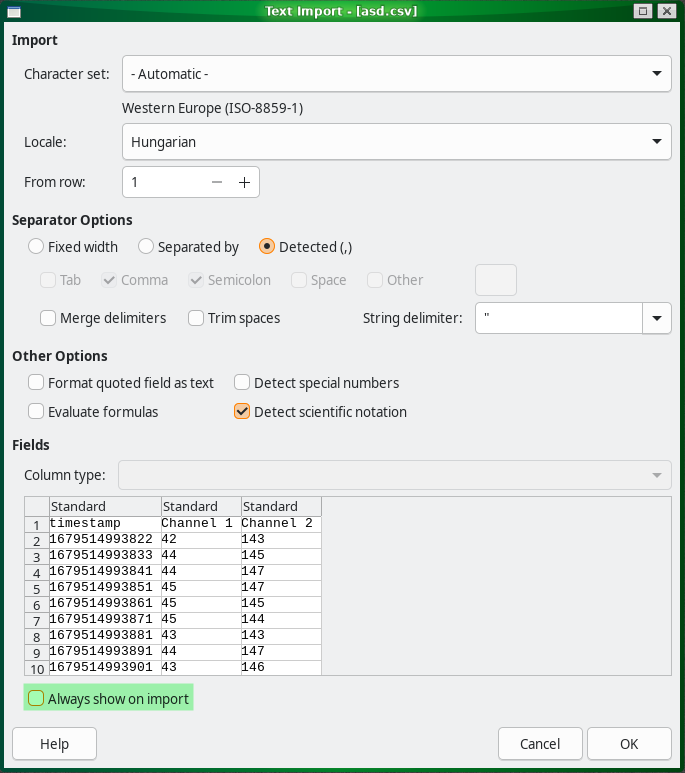
I get why libreoffice has the file open dialog, but it irritates me. 99% of the time I just want the file open to see the shape of the data, not make a bunch of parsing decisions for a file I've never seen before with unknown idiosyncrasies.
The vast majority of the human population is lactose intolerant, both historically and today. Genetically intolerant populations in South and Central Asia have microbiotic help with their dairy-heavy diets, but for people who didn't spend thousands of years developing a culture around it, dairy is just a quick road to an upset stomach and/or food poisoning.
That makes some sense. Given the historic sometime scarcity of food and pressure of starvation, and the widespread availability of milk, I would think people would adapt to it.
I guess that lactose-intolerent people today would drink milk rather than starve - do they get zero nutrients from it? - and that evolution would select for those who could survive that way.
Not going to get into the social darwinism stuff. We can empirically measure an apparent selective pressure for lactase persistence, but it's an open question without clear answers what the factors driving that are.
I think you're missing why milk is useful though. Dairy allows you to take resources that aren't calorically useful like grasslands and turn them into food. You can consume it either immediately or later via preservation techniques like cheese. Even if you consume it immediately, milk is a seasonal product.
Dairy also isn't the only way of turning unusable resources into food though. You can eat the animal, for example. That's less efficient if you're limited to a single species, but cattle and other large livestock suitable for the scale of milk production you're talking about are so phenomenally inefficient that you're likely better off if you consume more efficient animals instead.
> I think you're missing why milk is useful though.
? I was saying it is useful, and therefore I expect Homo sapiens would adapt to it.
After writing the GP I was told that humans, and some or all mammals, have a gene that disables lactose tolerance when they reach the stage of life where they no longer need milk. A miniority of humans have a mutation that stops that process, making them lactose-tolerent.
Why haven't we evolved to consume milk lifelong, given its obvious advantages (or why have we evolved to become lactose-intolerent past early childhood)?
A guess: Obviously milk consumption is inherited from mammal ancestors. That provides plenty of time (66 million years +) and population to evolve lifelong lactose digestion.
But other mammals don't have much need for that adaptation - for the most part, they can't figure out obtaining milk from another species as a regular food source. Human ancestors didn't figure out tool use until 2.6-3.3 million years ago; would we have figured it out then?
My guess is that it required domestication of animals ~12 thousand years ago before non-childhood milk consumption was commonplace. 12,000 years isn't much time to evolve much.
For bonus brownie points, here is a piece of trivia: the language is called assembly and the tool that translates it into executable machine code is called the assembler.
IBM has a long history of using "assembler" as a shorthand away to refer to languages. IBM was dominant enough historically that you'd find it used in all sorts of other places. It's bad terminology, but it's not wrong.
You should write more pieces like this and display them more prominently than an HN thread.
Your market is founders who have put money in an MMF and stopped thinking about it, not the people evaluating different optimization strategies day-to-day. So acknowledging the risks and saying "here's exactly when you should consider us" is exactly the kind of thing that helps overcome that uncertainty hurdle that results in choosing the simplest, safest option.
Founders should obviously do their own research, but that's asking the customer to proactively expend effort digging through future marketing copy to evaluate your product. They're not realistically going to do that as well as they should and the people who don't need to probably aren't your target market.
I put engineering effort into handling bad hardware all the time because safety critical, :)
It significantly overlaps the engineering to gracefully handle non-hardware things like null pointers and forgetting to update one side of a communication interface.
80/20 rule, really. If you're thoughtful about how you build, you can get most of the benefits without doing the expensive stuff.


reply